
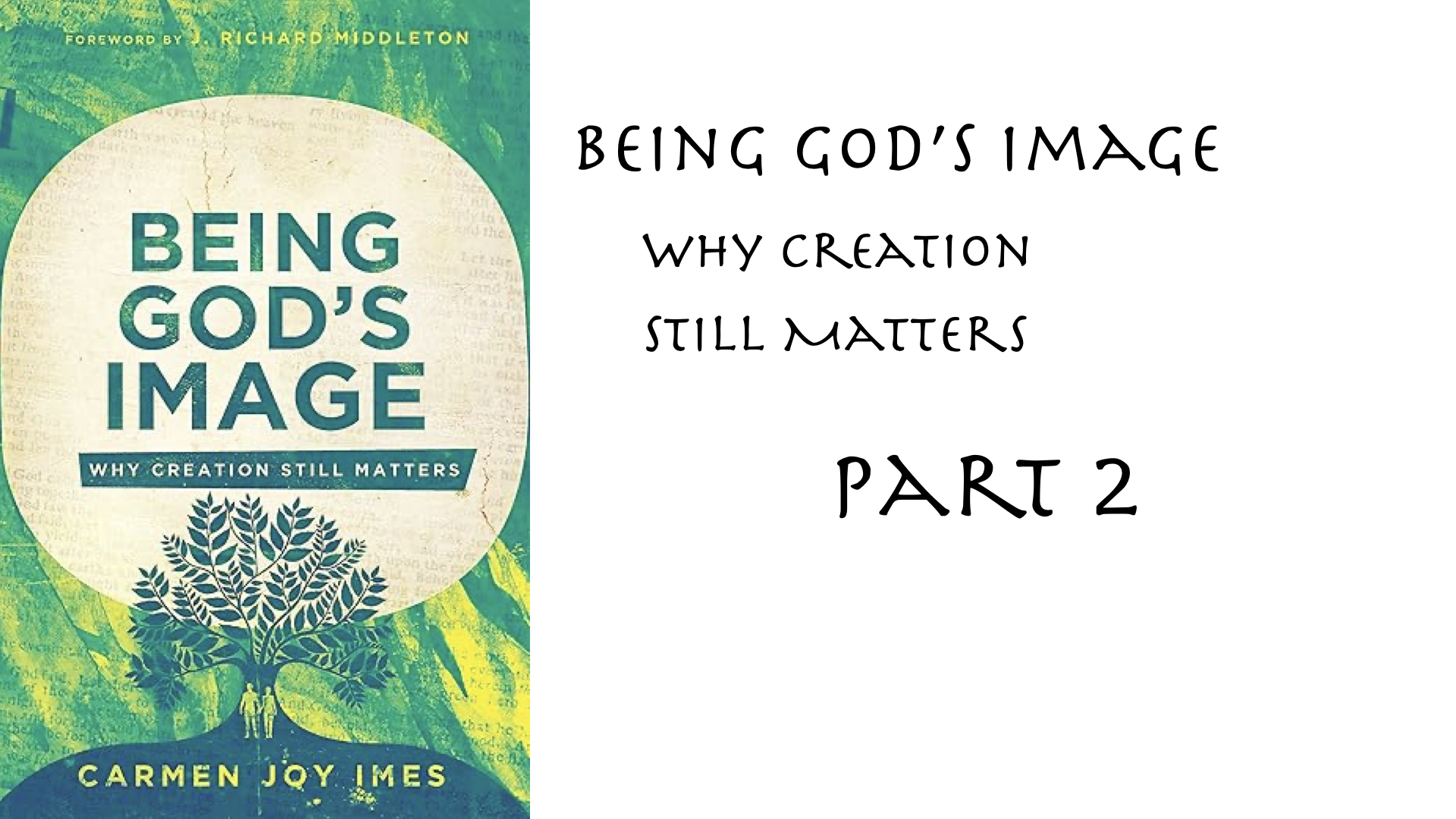
By Christian / Carmen Joy Imes
In this series, we look at thoughts from the book Being God’s Image – Why Creation still matters by Carmen Joy Imes. As there is unfortunately no German translation, we will at least deal with excerpts from her presentation in the German version of this video. This English version contains the same excerpts, but I recommend that you read the complete book.
We concluded the first part with this statement:
Creation is the cosmic temple of Yahweh in which he is to be worshipped. God presides over his creation through his images, which he has appointed as rulers over creation to maintain order in it.
But what is meant here by ‚his images‘? That’s what this second part of the series is about.
Crown of creation – image of God
Why have I spoken here of people as images of God? This already becomes clear from Genesis 1:27, when the climax of creation is described:
And God created man as his own image, as the image of God he created him; male and female he created them.
Genesis 1:27 englisch Translation of Züricher version, also Elberfelder version and others
So God created humankind as his own image, as the image of God he created them: male and female he created them.
Genesis 1:27 translation by Carmn J. Imes
But perhaps you were also surprised because you remembered the text differently:
So God created man in His own image, in the image of God He created him; male and female He created them.
Genesis 1:27 NASB
Are we now created in the image of God or as the image of God? Which idea comes closest to the original text? The best way to find out is to use (1) ancient culture and (2) other passages of Scripture. In Latin translations of the Bible, the term ‚imago Dei‚ is used here: God’s image. In Hebrew, the word is tselem. This has a sister word with a clear meaning in related ancient languages: it is the statue of a god in its temple. This brings us back to the temple symbolism of the Bible, which we have already mentioned. So we were created to be God’s image:
Just as a statue of a god is intended to represent that god’s claim to a particular area, so humans are the physical representation of the Creator God on earth. And just as an idol is meant to deflect praise to the actual dity, so humans are to deflect praise to Yahweh. Theologian Marc Cortez calls this „representational presence“: „We need to view the imago Dei as a declaration that God intended to create human persons to be the physical means through which he would manifest his own divine presence in the world.“
N. T. Wright says we are to be an „angled mirror, reflecting God’s wise order into the world and reflecting the praises of all creation back to the Creator.“
We are God’s family. Being God’s image involves both kinship and kingship. Wer are part of the royal family.
Although the creation account climaxes with the appearance of humans, we are not the center of the universe. God is.
Being God’s Image, Carmen Joy Imes
„To be human is to participate in creation care on God’s behalf. Our task is to care for the earth the way the Creator would. We continue God’s creative work.“
You’re probably already thinking about how you can implement this. In itself, it’s good to think about what you can do yourself. On the other hand, it is also a symptom of many Christian faiths to focus very much on the individual.
„Together we are God’s image. God designed men and women to provide companionship to each other and work side by side in the world.“
Even in relation to Yahweh himself, this becomes clear in the Bible account in Genesis 1:26: „Let us make man in our image, after our likeness.“ (Züricher). The use of the plural here is neither an honourable designation for God nor a reference to the Trinity. „In an ancient Near Eastern context, the first audience would have heard this as a reference to God’s heavenly court, his devine council. (e.g. Job 1:6-12; Psalm 82; Isaiah 6:8)“ Humanity as the image of God was created by God as part of a community.
Now that this has been clarified, we can continue reading Genesis 2. And that’s where most people stumble. Because from verse 4 onwards it is apparently told again, but differently. But there is a reason for this: in Genesis 1, God is centre stage. Genesis 2 is about humanity:
„Genesis 2 explores what it means to be human in relation to God, to the earth, to plants, to the animals, and to each other.“ Therefore, the second creation account focuses on human identity and vocation. This chapter allows us to discover that humans were meant to be gardeners. This becomes clear from Genesis 2:5, where two reasons are given why the earth was not yet fertile: 1. God had not yet caused it to rain, 2. there were not yet any people to cultivate the land. „This statement implies that the intended design is partnership between Godd and humans to cultivate the earth.“ The whole earth was to become like Eden with the help of mankind.
In this context, we should also briefly clarify why the woman Eve is referred to in translations as a „helper“ of Adam. Was she only meant to be something like a subordinate, not equal to Adam? Not at all, as the original text shows. In Genesis 2:18,20, the Hebrew word kenegdo is used, which is correctly translated as ‚equal‘ or ‚exact match‘ or ‚corresponds to him‘. ‚Helper‘ is the translation of the Hebrew ‚ezer. It occurs over 90 times as a common noun in the Old Testament and is mainly used in two ways: (1) for allied soldiers and (2) for God as Israel’s helper. It is never used in reference to a servant or subordinate. Its primary use is military and is best translated as ‚ally‘. In fact, before Adam and Eve’s rebellion against God, there was no hierarchy separating the two.
We are all – regardless of gender – the image of God to fulfil his mission. No one is excluded from this. And none of us can fulfil this task alone. No one has to fulfil this task alone. In order to fulfil God’s mission, we need each other.
And I would like to leave it at that for this episode. Because if this part wasn’t long, it contained a lot of thoughts that are worth thinking about. In the next part, we are getting to work – as imago Dei, image of God.
Getting to Work
What does this mean for us humans as the image of God, as imago Dei?
Doing good work is one way to express our purpose.
„The image of God means being placed into a particular set or relationships with God, each other, and the rest of creation, for the purpose of ruling as his royal representatives.“
If I truly believe that every human being is the image of God, created to signal the presence of God to the world, this belief ought to compel me to treat my fellow humans with dignity.
Women are God’s image, sharing equal dignity and bearing equal responsibility for representing God to creation.
Being God’s Image, Carmen Joy Imes