
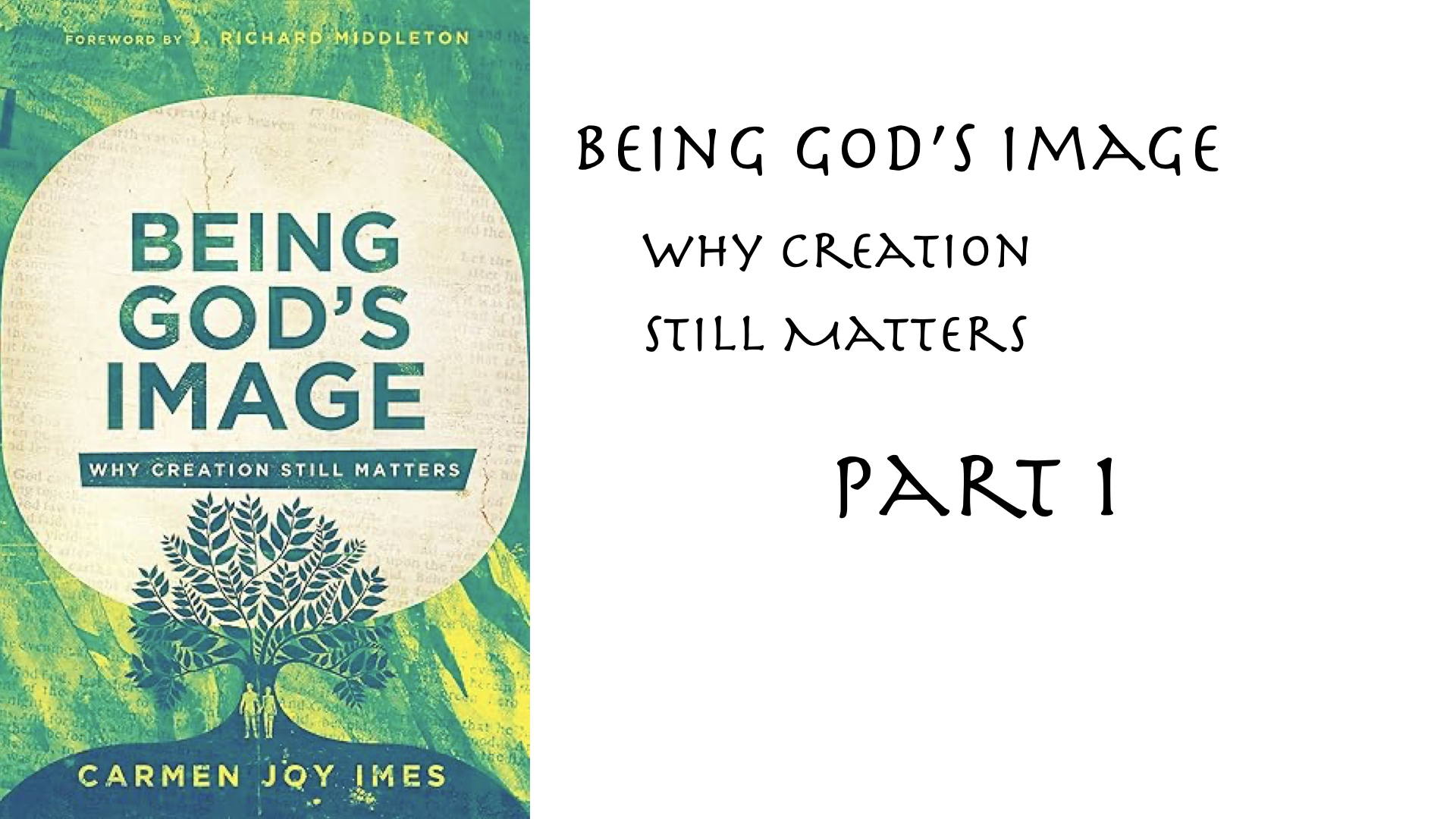
By Christian / Carmen Joy Imes
In this series, we will be looking at thoughts from the book Being God’s Image – Why Creation still matters by Carmen Joy Imes. As there is unfortunately no German translation, we will at least deal with excerpts from her presentation in the German version of this video. This English version contains the same excerpts, but I recommend that you read the complete book.
In order to better understand our calling and future as humans from a biblical perspective, we need to start with the Genesis account of creation. However, this is a very bad starting point for a video these days because practically everyone already has an opinion on it and switches off: There is everything from strictly literal interpretation to outright rejection.
But what Genesis is about can only be properly understood if we forget our 21st century context – insofar as that is possible at all – and read the words with the context of the Israelites 3500 years ago. We must take at least three essential differences into account:
- People back then were not interested in „what holds the world together at its core“, i.e. today’s scientific approach. Instead, they were interested in who orders the world and is responsible for its functioning.
- The concept of heaven and earth back then was very different to today. No, it’s not that it was somehow more limited or ‚primitive‘. As the ‚world‘ of these people was limited to a very manageable part of the earth, something like a globe or a world map was unimportant. What interested them was a description of the ‚world‘ in which the realm of humans, spiritual beings, the dead and the order of the whole was easy to understand. And this was also how the world views or models of other peoples were structured. Anyone who ridicules them today as unscientific has not understood their actual purpose.
- The Israelites were familiar with the world views and creation stories from Egypt and Mesepotamia. A comparison of Genesis with these is therefore very revealing.
Patterns in the biblical account of creation
Carmen Imes refers here to the work of various scholars, in particular John H. Walton’s work, which can be found, for example, in his book The Lost World of Genesis One:

Jascha Schmitz had already explained the content in detail in his German video series Video Serie Genesis – Schöpfungsbericht der Bibel kritisch hinterfragt. I will therefore only summarise the results very briefly here.
In short, the creation account in Genesis is not about how God made everything, but why.
Carmen Joy Imes, Being God’s Image
To minimise the risk of adding our own ideas to the text of the Bible, it is important to look for patterns that the author uses to emphasise things. What is usually lost in a translation is the rhythm and repetition of certain words or images in the original language of the text. It is the same here: „God said“ is used 3 times for people and 7 times everything else, so 10 times. „Let there be …“ is used 3 times for the heavens and 7 times for the earth, i.e. 10 times. „make“ is used 10 times, „according to their kind“ 10 times, „God saw that it was good“ 7 times, etc. There are more of these. And we find this pattern:

Into the world, which in Genesis 1:2 is still „formless and empty“, Yahweh brings the order we know. On the first day, Yahweh separates light from darkness, which are then populated with sun, moon and stars on the fourth day. On the second day, Yahweh separates the waters – above and below – creating the sky in between. On the fifth day, Yahweh populates them with birds and fish. On the third day Yahweh separates dry land and on the sixth day these are populated with land animals and humans.
Ancient people were not interested in how things came into existence, but why. And the creation account in Genesis 1 gives the reasons, the why: on day 1, Yahweh provides light and on day 4, celestial bodies with which the Israelites could measure time, which was not only important for agriculture, but also for the observance of the feast days, which were also communicated to the Israelites according to the books of Moses. On day 2, Yahweh provides the area of air between the waters so that fish and birds can live in it on day 5 and more later. On day 3, dry land and vegetation are mentioned so that on day 6 land animals and man can live in it.
We must not forget that this is not a scientific description of a chronological order, but that the areas are mentioned on days 1, 2 and 3 and, symmetrically, the ‚inhabitants‘ of these areas on days 4, 5 and 6. Even if the 7th day comes afterwards, it is not primarily about a chronological sequence, but about the purpose, the why: everything was good and Yahweh could now ‚rest‘. Not in the sense of ‚rest‘, but that order was now established. There are also more detailed explanations of this. However, the word used here for ‚rest‘ is also used in the sense that the preparations are now complete and the actual reigning can begin.
Are we still thinking about the Israelites in the desert 3500 years ago? This is what was said about Yahweh, the God who brought them out of Egypt and who wants to make a covenant with them: This is Yahweh, who will be your God and you will be his people who will bear his name. Let us not forget to read and see the Genesis account in this context. That is why the account was written the way it is.
In connection with the creation account, God’s day of rest and the later Sabbath provision, we can also derive something for our lives:
The Sabbath calls us to stop working like slaves and start living like members of the royal family.
We will gain a better understanding of why a royal family is mentioned here as the series progresses. This is about another pattern in the text of the Bible, a metaphor that was well known to the Israelites: the members of the king’s family had a different status from all other people. Not just in relation to the inheritance of kingship, but throughout their lives. This pattern appears again and again in the Bible to describe our relationship with God.
What idea of the world did the Israelites of antiquity have? Based on the ideas of the nations and according to the account in Genesis and many other texts of the Old Testament, approximately this one:

As I said, we should not be too quick to dismiss this idea as ‚unscientific‘, primitive, naive and wrong, because people were concerned with completely different questions. Today’s scientific world view only answers part of the how and the why within the limited framework of the laws of nature. And even in the standard physical model, there are laws and constants for which there is no further justification. The ancient world view of the Israelites, on the other hand, contains everything that was known to them and the reason why it was like this: the why and wherefrom and the reason why everything is organised in this way and not otherwise. Everything was described in such a way that even the last Israelite could understand where and why things are the way they are.
Why is the creation account still formulated in this way? Because God did not want to make it clear to the Israelites how it was all ’scientifically correct‘ in contrast to the myths that had long been passed down among the peoples. We might be happy about such an explanation, but it was the last thing the Israelites needed after their liberation from Egypt in the desert. God merely took up the idea they knew and corrected the important points: No pantheon of gods provided for the order of the world – only he alone. There were also no battles between gods before creation. Nor did he use the body of a slain god or goddess as a substance for the earth. This is the case, for example, in the Babylonian creation myth Enuma Elish. He alone is the Creator, the God who showed himself to be superior to all the gods of Egypt, who freed them from Egypt and made a covenant with them so that they would be his people – bearing his name (see my video series Bearing God’s Name).
The biblical account of creation, on the other hand, is composed in such a way that some scholars consider it to be a kind of liturgy: The 7-day framework of the creation account was designed to be a must for the Israelites‘ working week. A cycle of 7 days is not found in other ancient calendars derived from celestial bodies. According to the books of Moses, it comes from a commandment of God and therefore in Hebrew 7 is a number for completeness. The designation of the 7th day as a day of rest is echoed in Psalm 132:7-8 or Isaiah 66:1,2 where God’s place of rest is mentioned. Many scholars therefore consider Genesis 1 to be a temple dedication text – the cosmic temple of God. But that is another exciting topic, which Jascha Schmitz has looked at in a longer video series in German: Kosmischer Tempel – Zentrales Thema der Bibel That series summarizes the content of Prof. Gregory K. Beale’s book The Temple and the Church’s Mission: A Biblical Theology of the Dwelling Place of God (New Studies in Biblical Theology)
This is not about a secret message hidden in the Bible. It is about the pattern of a temple, which is used again and again in the text of the Bible. A metaphor with which the Israelites and people of antiquity were completely familiar. A temple was the place of the presence of a god or goddess. In the cosmology of the Israelites, the realm of Yahweh and that of man were separate. However, in connection with Sinai, the Ark of the Covenant and later the temple, the Old Testament speaks of the presence of Yahweh. This is also the case in Genesis – in the creation account in Genesis. This is in connection with the Garden of Eden in paradise and the people. This pattern of Eden is later found again in the construction and depictions in the tabernacle, the temple and on to Revelation.
Creation is the cosmic temple of Yahweh in which he is to be worshipped. God presides over his creation through his images, which he has appointed as rulers over creation to maintain order in it.
An interesting statement with far-reaching consequences. But what is meant here by ‚his images‘? We will go into this in the next part.
Du muss angemeldet sein, um einen Kommentar zu veröffentlichen.