
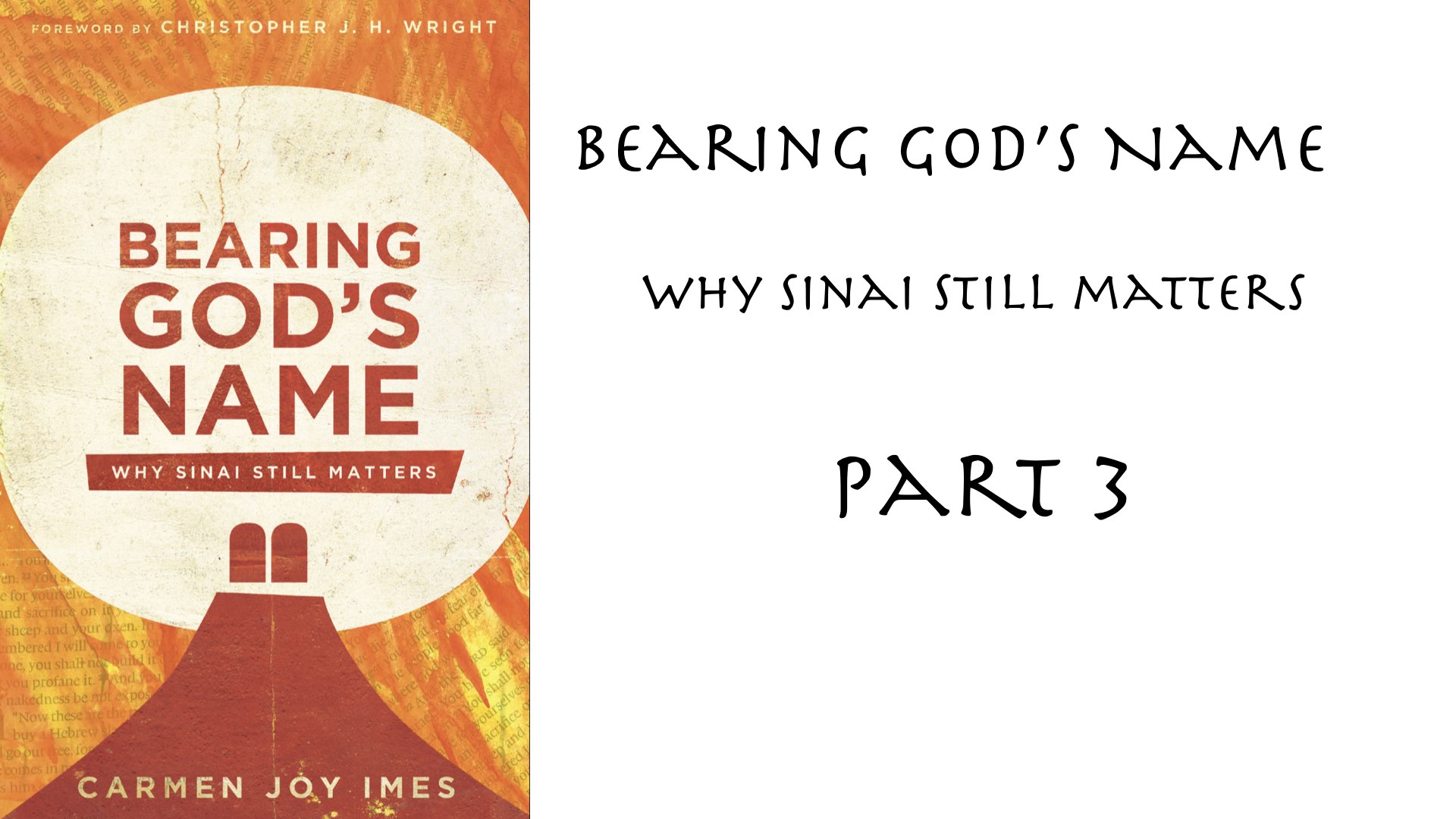
By Christian / Carmen Joy Imes
In this series, we are looking at thoughts from the book Bearing God’s Name – Why Sinai still matters by Carmen Joy Imes.
In the second part, we talked about what changed at Sinai. The Hebrews became God’s „personal property“, „his treasured possession“. However, from the cognates of the Hebrew word segullha with other languages of the time, it is clear that it was also applied to someone in a special relationship with the king. „They have a role that corresponds to their status. Their status is to be a special treasure. Their role is to be a priestly and holy community in the midst of the nations.“ (J. T. Wright, from Carmen Imes‘ book).
This is also expressed in the ’Ten Commandments‘, which are referred to as ’10 words‘ in the Torah and are instructions rather than laws in the modern sense. The first two ‚words‘ already show what the Hebrews‘ task was: 1. worship only Yahweh. 2. represent him well. Whoever gets to know the Hebrews should get to know God. In this way they would carry the name of Yahweh among the nations.
Now what?
Not everything is said with ‚the Law‘. They need further, ongoing guidance from Yahweh:
‘{Look!} I’m going to send My messenger to you in order to keep you headed in the right direction; for he will lead you into the land that I have prepared for you. Be sure to listen to him… Obey him! He won’t give in to you, because he carries My Name.
Exodus 23:20-21 2001 Translation
Is that why we repeated the law in Genesis? One reason was certainly that 40 years had passed and a different generation was living than at Sinai. But it is also interesting that the structure of Deuteronomy has some similarities with ancient treaties. For example, between the great king and the vassal kings. The agreement, the covenant, between Yahweh and the Hebrews is confirmed once again.
This is interesting because the covenant was broken by the Hebrews just after they had agreed to keep everything: Moses was not yet down from the mountain with the two tablets of stone, they violated the first commandment and made a golden calf. Moses smashing the stone tablets of the covenant was a clear sign that the covenant had been broken.
Was Yahweh now completely surprised that the Hebrews so soon stopped keeping their words?
Next, [Moses] took the scroll of the Sacred Agreement [that he wrote] and read it to the people.
Exodus 24:7 2001 Translation
And they [again] said: ‘We will do and pay attention to everything that Jehovah has said.’
Has Yahweh now carried out the punishment for breaking the covenant justly but harshly? That is what the great kings of that time did. And according to Exodus 32, he would have been prepared to do so. This is also how many imagine the ‚God of the Old Testament‘. In fact, however, we have skipped a few chapters between chapters 24 and 32 that show something else: Grace!
Grace? Between Exodus 24 and Exodus 32 there are 7 chapters that once again show Yahweh’s grace in the ‚law‘, in the covenant with the Hebrews. These contain detailed plans for the sanctuary. So God’s first response to the Hebrews‘ agreement was 7 chapters of instructions for His sanctuary, the means by which they can obtain forgiveness if they break the covenant. This is grace.
And that’s not all: Genesis 1-7 contains the instructions for priests. Tiresome to read if you’re not one. But let’s not overlook the repeated refrain: „and … shall be forgiven“.
Another side thought: Yahweh’s covenant with the Hebrews, the law, is therefore characterized by grace. A large part of the provisions revolve around how to forgive. No one is exempt. The provisions are for everyone in the people up to the high priest himself. So how could anyone think that without this they would stand righteous before Yahweh by their own works? And if the Hebrews didn’t think so, what is Paul discussing? We looked at this in the previous series „The new perspective on Paul„.
Were the Hebrews ready for the Promised Land?
Ready to roll
Moses himself was of a different opinion:
Thereafter, Moses said to Yahweh: ‘{Look!} You told me to lead these people on, but You haven’t shown me where You want me to go yet. ‘You’ve also told me that You know me better than all the rest, and that You care for me… So now, if I’ve found favor in Your eyes, show Yourself to me so I can see You. Then I’ll know that I’ve found favor in Your eyes, and I can be sure that this great nation is truly Your people.’ And [God] replied: ‘I’ll pass before you, to satisfy you.’ Then [Moses] said: ‘But if You aren’t going to [travel] with us, don’t make me go either! ‘For, how would anyone know for sure that these people and I have found favor with You, unless You go with us? [And if You should choose to go], both Your people and I’ll be glorified above all the nations of the earth.’ Well at this, the Lord told Moses: ‘I’ll do this thing that you’ve asked, because you’ve found My favor and I’ve put you above all the rest.’
Exodus 33:12-18 2001 Translation
Moses had internalized the lesson: without Yahweh they were nothing. „Everything they were was bcause of who he was. The same is true of you and me. What matters most about is is to whom we belong.“
What did the Hebrews still lack? The book of Numbers. It begins with the instruction of Jahweh to number the people. Then comes the order of the camp of Israel, etc. … Hardly anyone reads Numbers. But let’s not forget: this book was not written for us, but for them!
God’s vision takes shape concretely on the pages of Numbers. It’s practical. For people who have only known life as slaves and have had little practive at self-determination, God meets them where they are and makes their task straightforward. Follow me. Camp here. Eat this. Line up in this order.
Imes, Carmen Joy. Bearing God’s Name: Why Sinai Still Matters (English Edition)
The enumeration has a completely different effect. The Hebrews were simply slaves. The names of the ruling families of Egypt were remembered. But now it is quite different. It is as if Yahweh is saying to them: You no longer belong to Pharaoh. You belong to me. You are not insignificant. Your families will be remembered from now on as the beginning of a new nation.
What are they still missing? The priestly blessing of Yahweh.
The Lord said to Moses, “Tell Aaron and his sons, ‘This is how you are to bless the Israelites. Say to them: “ ‘ “The Lord bless you and keep you; the Lord make his face shine on you and be gracious to you; the Lord turn his face toward you and give you peace.” ’ “So they will put my name on the Israelites, and I will bless them.”
Numbers 6:22-27 NIV
In blessing by his name, he is seentially placing his name upon his people. Yahweh had already claimed them as his own at Sinai. Now he istitutes an official blessing to serve as a regular reminder. From this moment they are identified as his.
It is the clearest indication in Scripture of Yahweh actually putting his name on his people.
Imes, Carmen Joy. Bearing God’s Name: Why Sinai Still Matters (English Edition)
As an aside, the Hebrew word eleph, which is usually translated as ‚thousand‘, is used in the census in Genesis 4. The only difference is that there are no numbers in the Hebrew text as we know them. However, the resulting large number of Hebrews of over 2 million does not agree with archaeology, the space available on their journey or, above all, with the Bible itself. In Genesis 3:43, the total number of firstborns is given as only 22,273. This gives a ratio of 1:50 and each Israeli mother should have had an average of 100 children. The word eleph is also rendered elsewhere not as 1000 but as ‚clan‘ or military unit. A number of about 10 men per eleph is consistent with other data in Genesis and historical sources. This gives a figure of perhaps around 22,000 men, women and children.
Still an impressive amount. And more than enough for the foundation of this new nation of Yahweh. Under his leadership and with his blessing, they would continue to grow. And lest they forget all that we have discussed so far, Yahweh has a spectacular plan: every year the Israelites are to set aside a day to commemorate the last night in Egypt. This is so important to Yahweh that anyone who was unable to celebrate it should do so the following month.
By constantly remembering all the events and what Yahweh has done for them, one thing is impressed on them: they bear Yahweh’s name.