
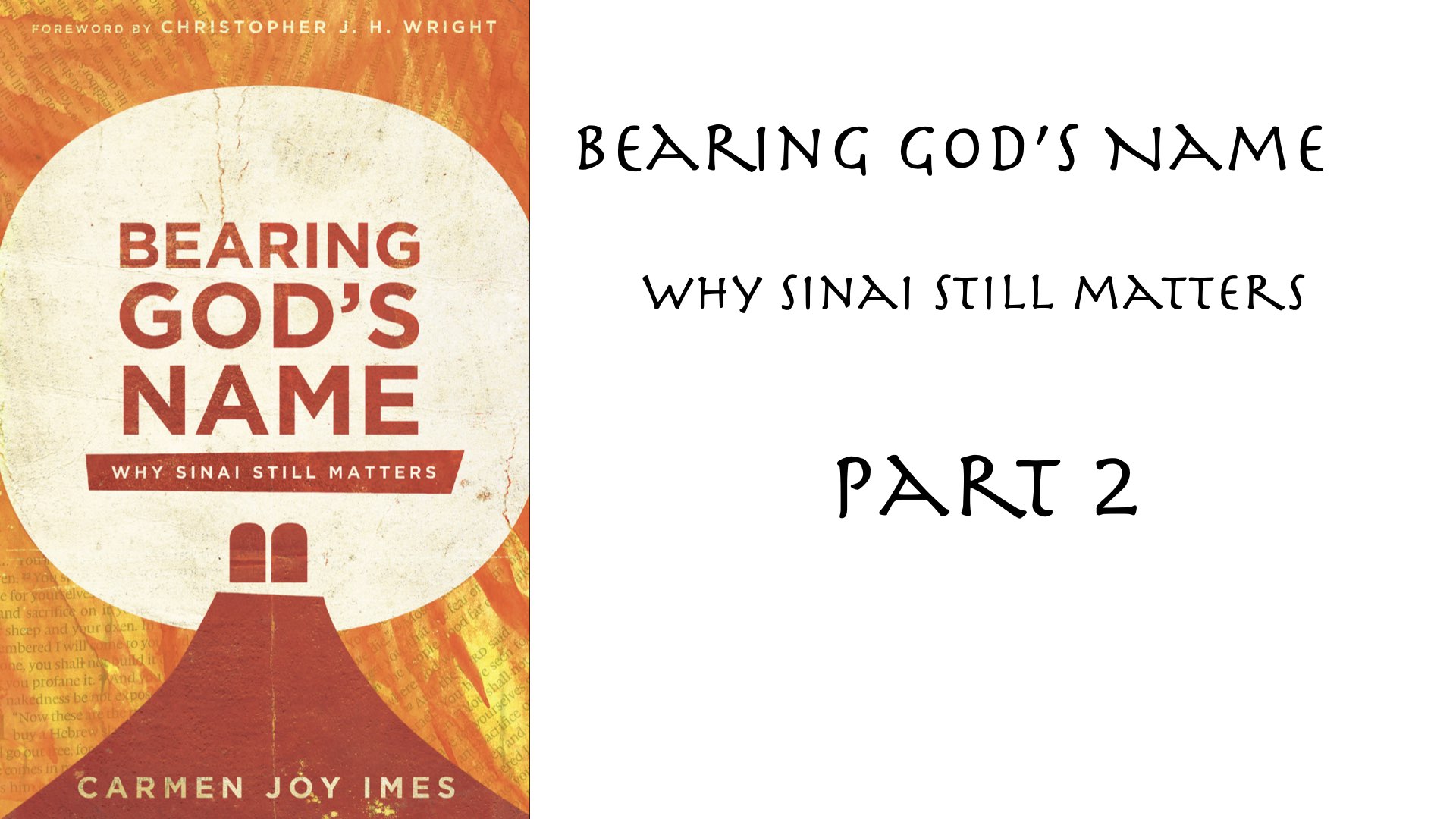
By Christian / Carmen Joy Imes
In this series, we are looking at thoughts from the book Bearing God’s Name – Why Sinai still matters by Carmen Joy Imes.
In the first part, we saw how events at Sinai are framed in the text of the books of Moses in order to emphasize their significance. And that the Israelites first had to get to know Yahweh and build trust in him.
What is changing at Sinai
Now the Israelites have been wandering through the desert for three months until they reach Sinai. What comes next? What did they expect? Had Moses told them what Yahweh had said years before at the burning bush?
And God replied: ‘I will be with you! This [place] will serve as the sign that I’m sending you.’ sThen when you bring My people out of Egypt, you must serve God on this mountain.’
Exodus 3:12 2001 Translation
For Moses, the crucial part was: „I will stand by you“. The decisive factor was not who Moses was, but whose he was. In that situation, God therefore also revealed his name to Moses. This may not be a big deal to some, but it was back then. Most other gods were known under a pseudonym to keep people at a distance.
At Sinai, everything changes.
At Sinai, the Hebrews discover who they are and, more importantly, whose they are.
Sinai is about worship. God’s first instruction at Sinai lays the foundation, a new spiritual route. If we do not understand it, we may well misunderstand everything that follows.
Then Moses climbed the Mountain of God, and God called to him on the mountain, saying:’ You must say this to the house of Jacob and report [My words] to the children of IsraEl: ‘You’ve seen all that I’ve done to the Egyptians, and how I lifted you as on the wings of eagles and drawn you close to Me. Now, if you’ll listen to what I say and keep My Sacred Agreement, you’ll be a special people to Me that will be higher than all other nations!’ And because the whole earth is Mine, you’ll become My holy nation and a Kingdom of Priests.’’ Now, [go] and tell this to the children of IsraEl!’
Exodus 19:3-6 2001 Translation
Yahweh begins with a description of his grace! Grace in the books of Moses? Perhaps we are too fixated on the laws – and our understanding of laws today. We will come back to this again. But this is about Yahweh’s grace. He does not reproach the Hebrews for their behavior so far. He shows that it was his desire to bring them to him and not their merit. And then comes this Hebrew word: segullah (pronounced SEH-gull-ah).
To fully grasp the significance of Israel’s new status, I need to teach you my favorite Hebrew word: segullah (pronounced SEH-gull-ah). In the NIV, it’s appropriately translated as “treasured possession,” but it helps if we understand the wider use of this word. … Sehgullah appears eight times in the Old Testament.
The related ancient languages of Ugaritic and Akkadian both employ an equivalent word to refer to someone who enjoys a special status in relation to the king, a covenant partner who is especially treasured and entrusted with greater responsibility.
In the Aramaic translations of the Old Testament, the segullah is described as “beloved.”
They are to be a “kingdom of priests,” serving as his ambassadors to the nations, and a “holy nation,” set apart for God’s purposes. In my all-time favorite book, The Mission of God, Christopher J. H. Wright emphasizes that Israel was chosen in order to bless the nations. He says, “They have a role that matches their status. The status is to be a special treasured possession. The role is to be a priestly and holy community in the midst of the nations.”
Imes, Carmen Joy. Bearing God’s Name: Why Sinai Still Matters (English Edition)
The law of Moses was a gift for Hebrews. That shows their answer. And how Moses spoke about it or later Psalm 119. Other gods did not answer people. You never really knew what they wanted or why they seemed angry. They had to be appeased. Yahweh is very different: He even speaks directly to the Hebrews. He says clearly what he wants and what is not acceptable. The law is like a fence that protects them and helps them to live a prosperous life within it.
One more note on the word ‚law‘:
The English word “law” is both too narrow and too misleading to accurately translate the Hebrew word torah. It is better translated as “instruction.” Torah encompasses a wider scope of material than just laws. And “law” is not the best word to describe what the Torah contains.
Imes, Carmen Joy. Bearing God’s Name: Why Sinai Still Matters (English Edition)
The Ten Commandments – Commandments?
The Ten Commandments are in the Bible – but they are never called that! Excuse me? In fact, Exodus 34:28 speaks of 10 ‚words‘:

The Hebrew word dabar can also mean ‚matter‘ as well as ’thing‘. This is fitting, because it contains more than just commandments, as we will see in a moment.
Let’s look at the second misconception that is often encountered: How many panels were there? And how were they described? There are many images of them on the internet. I once took one from Jehovah’s Witnesses from 2020 because they always emphasize how thoroughly they ‚investigate‘ for their pictures:

How many words do you see?
x
“And Moses turned and he went down from the mountain, and the two tablets of the covenant document [eduth] were in his hand, tablets inscribed on both sides, inscribed on front and back” (Exodus 32:15, author’s translation).
Imes, Carmen Joy. Bearing God’s Name: Why Sinai Still Matters (English Edition)
We see two tablets but very few words. In Hebrew, the ’10 words‘ only consist of 171 words. But there must be a lot more on the back. Well, it’s just an illustration. More importantly, however, we also find here the idea that two tablets were necessary because the text would not have fitted on one. This is not the case. Rather, the Hebrew word eduth, which is translated here as covenant deed, has a special meaning and is found in a similar way in other languages of the ancient Near East. When it came to such documents, the tablet and an exact copy were made. If it was a treaty between two peoples, a copy of each was placed in the temple of their own god so that he could watch over its observance. In this case, however, the covenant was between Yahweh and Israel. Both tablets were therefore placed in the sanctuary.
Let’s come to the third common misunderstanding: the 10 ‚commandments‘ can be clearly divided into two groups of laws. One that concerns God and one that concerns people. However, this is not an adequate view of these instructions. Even when Israelites violated a ‚commandment‘ from the second group, they spoke of sinning against God (see 2 Samuel 12:13, Psalm 51:4)
In the covenant community, every part of life is an expression of worship and loyalty to the God who has committed himself to these people. How they treat others reveals their heart toward God.
Imes, Carmen Joy. Bearing God’s Name: Why Sinai Still Matters (English Edition)
Do the ’10 Commandments‘ now apply forever because they are even literally ‚carved in stone‘? Right before that, Yahweh speaks of who they are addressed to: „“I am Yahweh your God! I have freed you from the house of slavery in Egypt. You may …““ (Exodus 20:2 NT). They often use a specific ancient context and vocabulary. And they were never communicated to other nations.
The commands in this ancient context are for the Israelites alone. The torah was a gift to Israel, the people of Yahweh.
Imes, Carmen Joy. Bearing God’s Name: Why Sinai Still Matters (English Edition)
Therefore, it makes the most sense to read the first three sentences together as the first ‚word‘. This is shown by the chiasm used (Exodus 20:2-6, Deuteronomy 5:6-10):

The point of images is worship.
Imes, Carmen Joy. Bearing God’s Name: Why Sinai Still Matters (English Edition)
The means of worship are images.
This brings us to the second commandment, from which the title of Carmen Imes‘ book is derived.
Invisible tattoo: The Second Command
You must not bear (or carry) the name of Yahweh, your God, in vain, for Yahweh will not hold guiltless one who bears (or carries) his name in vain. (Exodus 20:7, author’s translation)
Imes, Carmen Joy. Bearing God’s Name: Why Sinai Still Matters (English Edition)
(S.49). InterVarsity Press. Kindle-Version.
Many translations render this differently because the translators and theologians thought that this would otherwise make no sense. But what does it look like if you try to let the Bible explain itself exegetically? The next context is Exodus 28: „So Aaron shall have the names of the sons of Israel on his breastplate for the arbitration, as a constant reminder before Yahweh when he enters the sanctuary.“ (Exodus 28:29). And the high priest also has a name on his forehead: qodesh layahweh. „holy, belonging to Yahweh“. The letter lamed before Yahweh is used here, as it was also used elsewhere in ancient seals to indicate ownership.
The twelve gemstones indicate that the high priest represents the entire nation before Yahweh. The medallion on his forehead indicates that he is Yahweh’s authorized representative to the nation. Now think back to the dramatic declaration of Exodus 19, when Israel first arrived at Mount Sinai. There God bestowed titles on his people like treasured possession, kingdom of priests, holy nation. As his treasured possession, Israel’s vocation—the thing they were born to do—is to represent their God to the rest of humanity. They function in priestly ways, mediating between Yahweh and everyone else. They are set apart for his service.
Imes, Carmen Joy. Bearing God’s Name: Why Sinai Still Matters (English Edition)
By looking at Aaron, every Israelite is reminded of their calling as a nation. Just as he is set apart for service (“holy”), so are they (“a holy nation”). At Sinai, Yahweh claims this nation as his very own and releases them to live out their calling. That calling is to bear Yahweh’s name among the nations, that is, to represent him well.
Imes, Carmen Joy. Bearing God’s Name: Why Sinai Still Matters (English Edition)
In short, the first two commandments say: 1. worship only Yahweh. 2. represent him well.
This now makes it clear why the term ‚law‘ as a translation for the Hebrew Torah is inadequate and even misleading: it is not a collection of regulations and laws in our modern sense, but character formation.
Du muss angemeldet sein, um einen Kommentar zu veröffentlichen.