
By Christian / Carmen Joy Imes
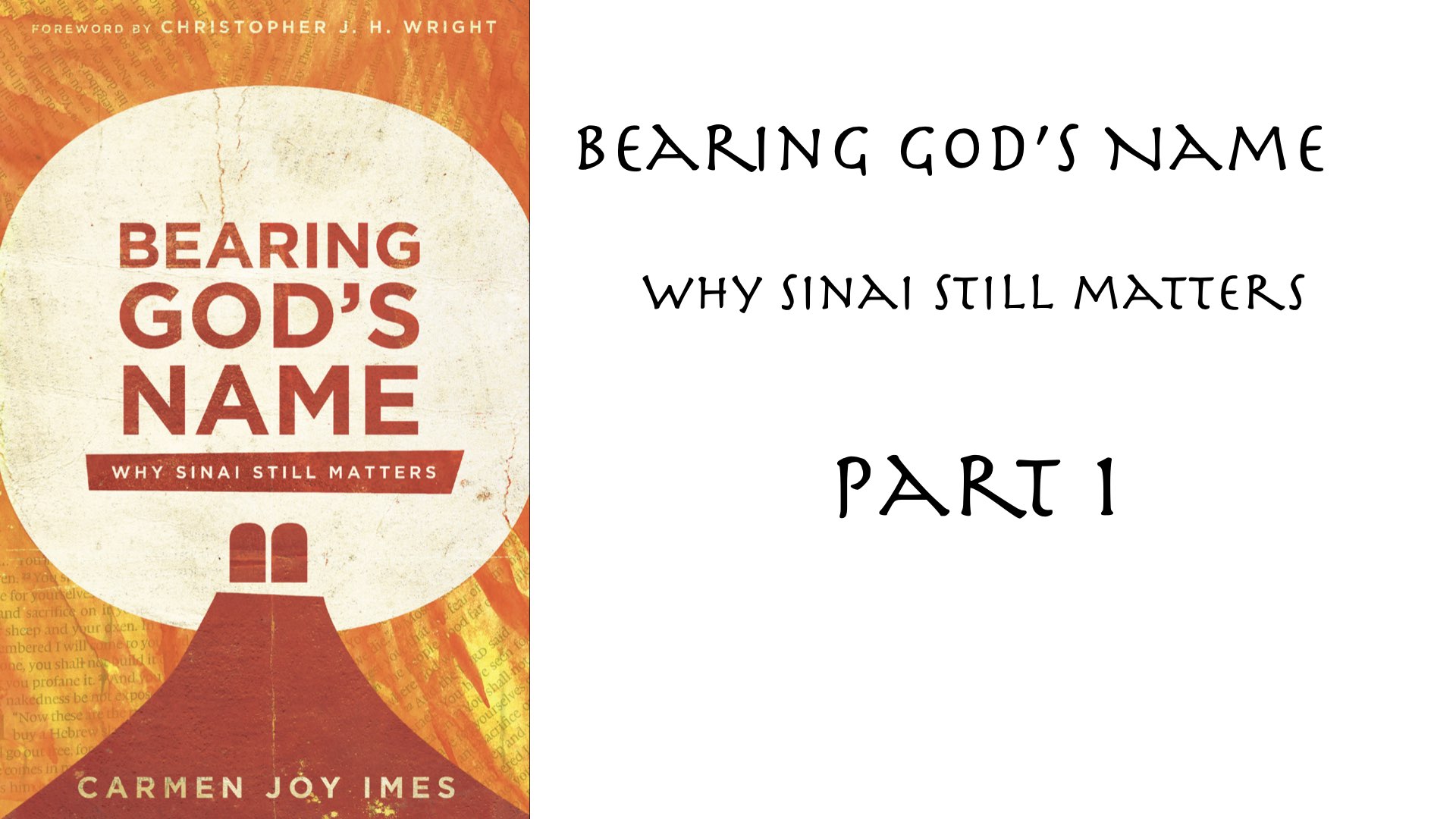
In this series, we will be looking at thoughts from the book Bearing God’s Name – Why Sinai still matters by Carmen Joy Imes. The book is a presentation of Professor Imes‘ doctoral thesis that is also easy to read for laypeople. As there is unfortunately no German translation, we will at least deal with excerpts from her presentation.
But why is this of any interest to us today? In the foreword to her book, Imes describes the usual reservations very well: „The Old Testament has been given a bad rap for lots of reasons. Too violent. Too confusing. Too remote. Too legalistic. Too outdated.“ What many lack in the Old Testament is the grace that seems so essential in the New Testament. We will see that this is not the case at all and that Christians in particular need the Old Testament more than ever. And especially the Mosaic Law. Excuse me? The Mosaic Law of all things?
We will also see what the text from Exodus 20:7 „You shall not make wrongful use of the name of the LORD your God“ (NRSV) actually means. The significance of the actual meaning is still the same today as it was then, as can be seen from the first words of the foreword by Christopher J. H. Wright: „“And you call yourself a Christian!” That was about the worst thing we feared hearing as young Christians in my Northern Ireland childhood. … whatever it was, the most stinging rebuke from other kids (or worst of all from a teacher) would be, “And you call yourself a Christian!”“
Therefore, we will now not only look at Exodus 20:7 but also at the Mosaic Law and the events at Sinai at that time. I know what you’re thinking: that’s as dry as the desert at Sinai! But you’ll be surprised. With a good guide through these events, it will be very interesting.
Just imagine what the Israelites had experienced until they reached Sinai. What do you need to live when you are on your way through the desert after all that? And what does Moses get from God? The law with all its rules. But how does Moses see it?
‘{Look} I’ve shown you all the rules and decisions, just as Yahweh gave them to me… So you must follow them in the land that you’re traveling to and which you’ll inherit. Obey them, and do them… Because this is what will brand you as a wise and understanding people to the nations! ‘For when they hear all these rules they’ll say:‘Look! They’re a great nation of wise and understanding people!’ ‘What other nation is there that’s so great that they have a God as close to them as our God Yahweh is [to us], and to whom we may call about anything? ‘And what other nation has rules and decisions that are as righteous as all these laws that I’m setting before you today?
Deuteronomy 4:5-8 2001 Translation
In other words, the Israelites have received something precious with the law that the other nations will be jealous of!
But we will not be so much concerned with the 10 commandments or the many individual regulations, but with the overall picture. We will recognize that the five of the Pentateuch contain an interesting framework that we may never have consciously noticed when reading them because we have only seen the details. We will talk about the actual purpose of the law and the task of the Israelites. And how this is taken up again in the New Testament. Because God has not abandoned his plan, but gives all people the opportunity to fulfill the original mission.
Becoming the people who bear God’s name
Leaving Egypt
Context is everything
In the series The new perspective on Paul, which is based on the book „The New Perspective on Paul – An Introduction“ by Prof. Kent L. Yinger, we have already seen that many Christians have the following idea:
- In Old Testament times, Israel was concerned with earning salvation by keeping the Sinai covenant.
- Jesus did away with this idea and made salvation available without any personal action.
In that series, however, we also saw that both statements are not based on the Holy Scriptures but on the reflections of later scholars and the Reformation. Carmen Imes also addresses this in her book and shows why the first statement cannot be true:
Consider the context: Israel arrives at Sinai in Exodus 19 and receives the law from Yahweh. However, we find Israel’s rescue from Egypt both chronologically and in the text earlier in Exodus 3-14. The Law from Sinai cannot therefore have been the prerequisite for Israel’s rescue from Egypt.
Hence we also read this in Exodus 6:6
‘So, go and tell the children of IsraEl that I am Jehovah and that I will lead them out of the tyranny of the Egyptians and free them from slavery. ‘I’ll pay their ransom with a hard pitch and a great judgment, …
Exodus 6:6 2001 Translation
God did not first check whether they perhaps still had idols at home or whether they complied with the law in terms of morality. Their salvation had nothing to do with their righteousness or their actions, but with his promise to their forefather Abraham.
The following aspect of Exodus 12:13 is also interesting:
The blood shall be a sign for you on the houses where you live; and when I see the blood I will pass over you, and no plague will come upon you to destroy you when I strike the land of Egypt.
Exodus 12:13 NASB
The Hebrew word pasakh, from which our Passover is derived, can be translated as ‚to pass over‘. In this context, however, another meaning makes more sense, as can also be found in Isaiah 31:5, for example.
‘Now, this blood will be the sign that you’re inside of each house; for when I see the blood, I’ll protect you, and you won’t be a part of the plague of destruction when I strike the land of Egypt.
Exodus 12:13 2001 Translation
In Exodus 12:13,23,27 Yahweh does not pass over Israel, but ‚protects‘ it.
Framing Sinai: The wilderness journeys
The account of Israel and Sinai contains another special feature that we may never have noticed before. In Exodus 33, the entire itinerary of Israel’s hike from Egypt to Canaan is described. There are forty-two camping spots on the itinerary. However, if we read the accounts in Exodus 12-18 and Numbers 11-32 carefully, we only come across six campsites before and after Sinai. And they all begin with the same Hebrew phrase: „and they set out.“ So we have found no contradiction in the books of Moses. Both accounts fulfill a different purpose. And the purpose of the accounts before and after Sinai is made clear in this illustration from Carmen Imes‘ book:

That this is no mere coincidence, but a common way of emphasizing something at that time and in that culture, becomes clear from the other symmetrical reports:
| Before Sinai | After Sinai |
|---|---|
| 6 campsites, „and they set out“ (Exodus 12-18) | 6 campsites, „and they set out“ (Numbers 11-32) |
| 7 times „desert“ mentioned | 7 times „desert“ mentioned |
| God’s provision of manna and quail (Exodus 16), as well as two requests for water satisfied by a gushing rock (Exodus 17:1-7). | One story about manna and quail (Numbers 11) and two requests for water satisfied by a gushing rock (Numbers 20:1-16) |
| God’s angelic messenger protects the Hebrews from a foreign king. (Exodus 14:19-20) | God’s angelic messenger protects the Hebrews from a foreign king. (Numbers 22:21-35) |
| Israel fights the Amalekites (Exodus 17:8-16) | Israel fights the Amalekites (Numbers 14:39-45) |
| Moses meets with a Midianite family member and receives guidance (Exodus 18) | Moses meets with a Midianite family member and receives guidance (Numbers 10:29-32) |
| Moses is weighed down with leadership responsibilities (Exodus 18:17-18) | Moses is weighed down with leadership responsibilities (Numbers 11:10-15) |
| Moses begins delegating responsibilities to others (Exodus 18:24-26) | Moses begins delegating responsibilities to others (Numbers 11:16-17) Deliberate quotation from Exodus |
| Israel laments why they left Egypt (Exodus 14:10-12) | Israel laments due to the report of the scouts (Numbers 14) |
Why are the events at Sinai so emphasized by this framework? Because a great transformation had taken place there: the Israelites were in a state of liminality at Sinai. A phase of transition, of fundamental change in their status. They were no longer slaves of Egypt. But what would they become? What kind of God is Yahweh? What would he expect of them? What would their future look like?
For Israel, the wilderness journey from Egypt to Canaan is liminal space. Far more than just a place to pass through, it is the workshop of Israel’s becoming. The wilderness is the temporary destination that makes them who they are. Liminal places always do this. They change us.
God is not in a hurry to lead them out of liminal space and into the land he promised to give them. They’re not ready yet.
Imes, Carmen Joy. Bearing God’s Name: Why Sinai Still Matters (English Edition)
When we fully imagine the magnitude of the change, the unanswered questions and the uncertainty about the future and the nature of the God who had saved them, we also better understand why they were seemingly so quick to forget God’s power to save them. Who wouldn’t worry about water and food in a desert? Surrounded by hostile peoples? „Yahweh knows this. Remarkably, he does not chide the Israelites when they complain or panic as they travel toward Sinai. He simply provides for their needs. He utilizes this trek to demonstrate to them his trustworthiness.“
Well, after PharaOh had sent the people away, God didn’t lead them towards the land of the Philistines (even though it wasn’t far away), because God said:‘[I’m doing this to keep] the people from having a change of heart when they see war, and from thereafter returning to Egypt.’ So God led them around the desert towards the Red Sea.
God led them there using a tall column of clouds during the day (to show them the way) and a tall column of fire during the night… The column of clouds was there all day long, every day, and the column of fire was always there in front of the people all night long.
Exodus 13:17-18,21,22 2001 Translation
Trust is not automatic, and God does not expect it to be. He patiently works on Israel’s behalf until they can see that he is worthy of their confidence.
Imes, Carmen Joy. Bearing God’s Name: Why Sinai Still Matters (English Edition)
The Israelites ‚go to school‘, so to speak. They learn that they must and can trust in God every day. That they depend on him daily. On the way to Sinai, the Israelites find out what kind of God Yahweh is and how they can live in trust in him.
Du muss angemeldet sein, um einen Kommentar zu veröffentlichen.