
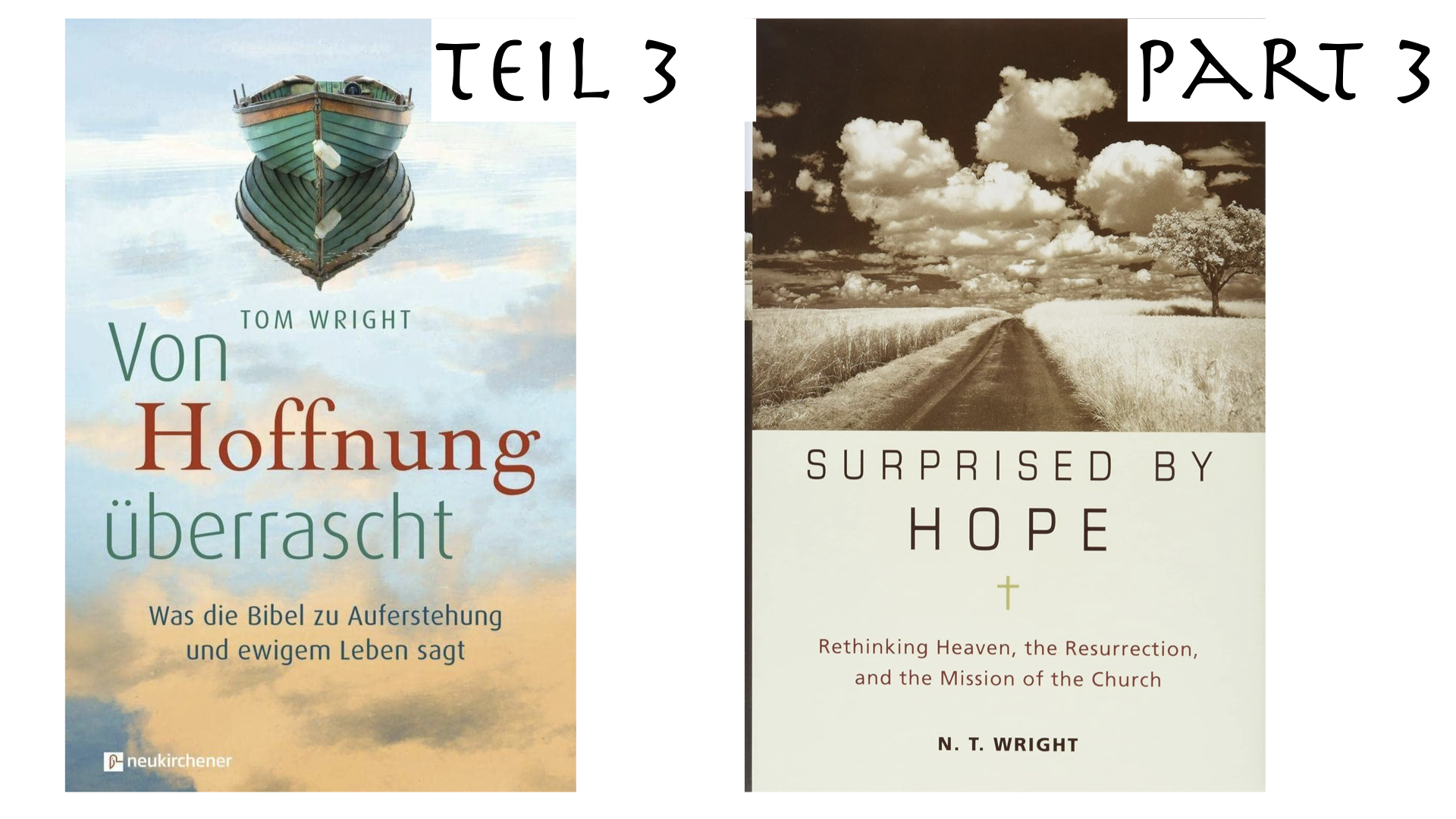
By Christian / Tom Wright
This series takes up the main ideas from the book by Bible scholar N. T. Wright Surprised by Hope: Rethinking Heaven, the Resurrection, and the Mission of the Church (German Von Hoffnung überrascht – Was die Bibel zu Auferstehung und ewigem Leben sagt).


I read the book in the German translation. So the quotes are from the German translation and retranslated into English. The quotes will therefore differ from the English original.
The surprising nature of early Christian hope
It turns out that the early Christian belief in a hope beyond death was demonstrably based on Judaism and not paganism. N. T. Wright then lists seven important core statements in which early Christian hope clearly differs from that of Judaism.
First of all, „the resurrection formed the centre of the early Christian hope for the future.“ This sentence is perhaps easy to read over. You probably don’t recognise the implications. N. T. Wright now summarises much more detailed reasons:
The first Christians did not simply believe in life after death; they more or less never spoke of going to heaven after death. But when they spoke of heaven as a destination waiting for you after death, they seemed to have seen this heavenly life as a temporary stage on the way to the ultimate resurrection of the body. When Jesus told the thief on the cross that they would meet in paradise on the last day (Luke 23:43), paradise clearly cannot be the final destination, as Luke makes clear in the next chapter. Rather, paradise is the glorious garden in which God’s people rest before the resurrection.
When Jesus explained that there were many dwellings in his Father’s house, he used the word mone for „dwelling place“, which means temporary accommodation. (John 14:2)
When Paul says that his desire is to „die and be with Christ, which is far better“, he is indeed thinking of a blissful life with his Lord immediately after death, but this is only a prelude before the resurrection. (Philippians 1:23;3:9-11;3:20-21)
In the terminology of the discussion in the previous chapter, the first Christians held to a two-stage belief in the future. First comes death and whatever comes immediately afterwards; then there is a new physical existence in a newly created world.
N. T. Wright, Von Hoffnung überrascht, S. 67
I wouldn’t be surprised if that was quite surprising for you too. And it was at the time. „There is nothing in paganism that comes even remotely close to this belief. This belief is as Jewish as it can be.“ But the first Christians made modifications, all of which can be found in authors as diverse as Paul, John of Patmos, Luke and Justin Martyr, Matthew and Irenaeus.
1. Within early Christianity, there is more or less no range of beliefs about life beyond death
„In this respect, Christianity looks like a variety of Pharisaic Judaism. There is no trace of a Sadducean worldview or one that belongs to the Philo’s school of thought.“ „Only in the late second century, a good 150 years after the time of Jesus, do we find people who assign a completely different meaning to the word resurrection than what it meant in Judaism and early Christianity, namely a spiritual experience in the present that leads to an incorporeal hope for the future.“
2. In early Christianity, the resurrection moved from the periphery to the centre
„One cannot imagine Pauline thinking without it. Nor should we imagine Johannine thought without it …. Resurrection is of enormous importance in Clement and Ignatius, Justin and Irenaeus. It is one of the key beliefs that enraged the pagans in Lyons in 177 AD and drove them to slaughter several Christians, including the bishop who preceded the great Irenaeus. Belief in bodily resurrection was one of two key things the pagan physician Galen noted about Christians (the other was their remarkable sexual reticence). Take away the resurrection and you lose the whole New Testament, as well as the theology of most of the second-century church fathers.“
3. The resurrection of a transformed body
„Within early Christianity, it was part of the core belief in the resurrection from the beginning that the new body would certainly be a body in the sense of a physical object occupying space and time, but that it would also be a transformed body, a body whose material would be created from the old material but would have new properties.“
But what about Paul in 1 Corinthians 15? An often misunderstood passage. Actually, he explains it quite well and most later writers look back on it. „But unfortunately, many translations completely misunderstand Paul here and use wording that leads to the widespread assumption that Paul is speaking here of a spiritual body in the sense of a non-material body.“ But then Jesus would not have left an empty tomb. „It can be shown in detail, philologically as well as exegetically, that this view is exactly not what Paul meant.“
The contrast he sets up is not between what we understand by a present physical body and what we understand by a future spiritual body, but between a present body animated by the normal human soul and a future body animated by God’s Spirit.
N. T. Wright, Von Hoffnung überrascht, S. 70
„His point is that the future body is imperishable. The present flesh and blood is perishable, condemned to decay and death. That is why Paul says, „Flesh and blood cannot inherit the kingdom of God.“ The new body will be imperishable. The entire chapter, one of Paul’s longest continuous discussions and the decisive climax of the entire letter, is about the new creation, about the Creator God who renews creation and does not abandon it, as Platonists of all colours, including the Gnostics, would like.“
„But this transformed physicality … does not include a transformation into the light form. This is another point where many go astray and misunderstand the word glory as implying a physical shining rather than a status within the world that belongs to God. This is all the more remarkable because the most famous of the biblical resurrection texts, Daniel 12, says of the righteous who are resurrected that they will shine like the stars. Surprisingly, this text is not quoted anywhere in the New Testament when it comes to the resurrection body, apart from the interpretation of a parable. Where we do find the text, it is used metaphorically for the present Christian witness in the world.“
4. The resurrection is a two-part event
This is also centrally evidenced by 1 Corinthians 15 and this aspect is consistently accepted throughout the first two centuries. „No first-century Jew before Easter expected the resurrection to be anything other than the large-scale event that would happen to all God’s people, or perhaps even to all humanity. It would be part of the sudden event during which God’s kingdom, as in heaven, would ultimately come on earth.“
Since this is the context in which Jesus, the apostles and others said and wrote the words handed down to us, it is also the key to interpretation: „Resurrection, we must always remember, did not mean going to heaven or escaping death or having a glorious existence after death, but coming back to new bodily life after bodily death.“
Therefore, this becomes a central feature of the surprising hope of the first Christians: „The belief that the beginning of the Kingdom of God consisted in the resurrection itself, which reflected a single person in the midst of human history, in anticipation of the great, final resurrection. The resurrection of Jesus already guarantees and points to that final resurrection of the people of God at the end of history.“
5. Our task between the resurrection of Jesus and the general resurrection
The first Christians believed that the resurrection had begun with Jesus and would be completed in the last great resurrection on the last day. They therefore also believed that God had called them to work with him in the power of the Holy Spirit to realise what Jesus had achieved and thereby foreshadow the final resurrection. „It was not merely that God had already heralded „the end“, his kingdom; if Jesus, the Messiah, was the end in person, God’s future arrived in the present, then those who belonged to Jesus, followed him and were empowered by his Spirit, had the mission, as far as they were able, to change the present in the light of that future.“
6. The resurrection as a methaphor
„Within Judaism, resurrection could be used both as a metaphor and a metonymy for the return from exile. … So when resurrection is used metaphorically in Judaism, it refers to the restoration of Israel; but from the earliest days of Christianity – and this is all the more remarkable when one considers how Christianity began as a Jewish messianic movement – this meaning has disappeared;“
The new metaphorical meaning had already taken strong root in Paul’s time: resurrection as a metaphorical reference to baptism (a dying and rising with Christ), and resurrection as a reference to the new life in untiring ethical obedience, empowered by the Holy Spirit, the life to which the believer commits himself.
7. Resurrection and Messianity
The link between the resurrection and Messiahship was completely new. „In Judaism, no one expected the Messiah to die, and therefore of course no one imagined that the Messiah would rise from the dead.“
„But from the earliest beginnings, attested in texts that may be pre-Pauline fragments of very early creeds, the first Christians claimed that Jesus was indeed the Messiah, precisely because of his resurrection.“
In connection with the actual task that Israel had been given at Sinai (see serie Bearing God’s Name – why Sinai still matters) and the prophecies about the Messiah, the resurrection of the Messiah made perfect sense. It was the fulfilment of what God had planned and intended – even if people had imagined it very differently.
„This means that we can already rule out the revisionist positions on the resurrection of Jesus that so many authors have advocated in recent years. Many suggest that the first disciples were so overcome with grief at the death of Jesus that they picked up the idea of resurrection from the surrounding culture, held on to it and convinced themselves that Jesus had been raised from the dead, even though they knew, of course, that he had not been resurrected.“
„Due to the early Christian belief in Jesus as the Messiah, the belief developed very early on that Jesus is Lord and therefore the emperor is not. But even for Paul, both Jesus‘ resurrection and the future resurrection of his people are the basis of Christian loyalty to another king, another lord. Death is the tyrant’s last weapon.“ And so for Christians, the resurrection is not just about ‚life after death‘.
Resurrection is not a new description of death; it is the overcoming of death and thus the overcoming of those whose power depends on death.
Despite the scorn and derision of some modern scholars, those who were burned at the stake and thrown to the lions were people who believed in bodily resurrection. Resurrection was never a way to get cosy and gain prestige; … It was the Gnostics who translated the language of resurrection into a private spirituality and a dualistic cosmology, more or less turning the meaning of resurrection into its opposite. It was also the Gnostics who escaped persecution. What ruler would have sleepless nights worrying about his subjects reading the Gospel of Thomas? The resurrection was always predestined to get you into trouble, and it did so regularly.“
N. T. Wright, Von Hoffnung überrascht, S. 77
II think you are beginning to realise why N. T. Wright spoke of a surprising hope. Not only because it was surprising in the first century. But probably also for you – even if you consider yourself a Christian. So even with this topic, you may well realise when reading the Bible that it was not the textual or historical context that was decisive in the interpretation of some passages, but rather assumptions and ideas that we or others put into them – in other words, eisegesis. Take time to think about this.
So, since the resurrection has a much broader meaning than just that Jesus lived again, it is good to briefly look at whether we can believe these reports. We will then look at what surprising hope there still is in relation to God’s plan for the future. And both in the next part 4.
Du muss angemeldet sein, um einen Kommentar zu veröffentlichen.