

By Christian / Tom Wright
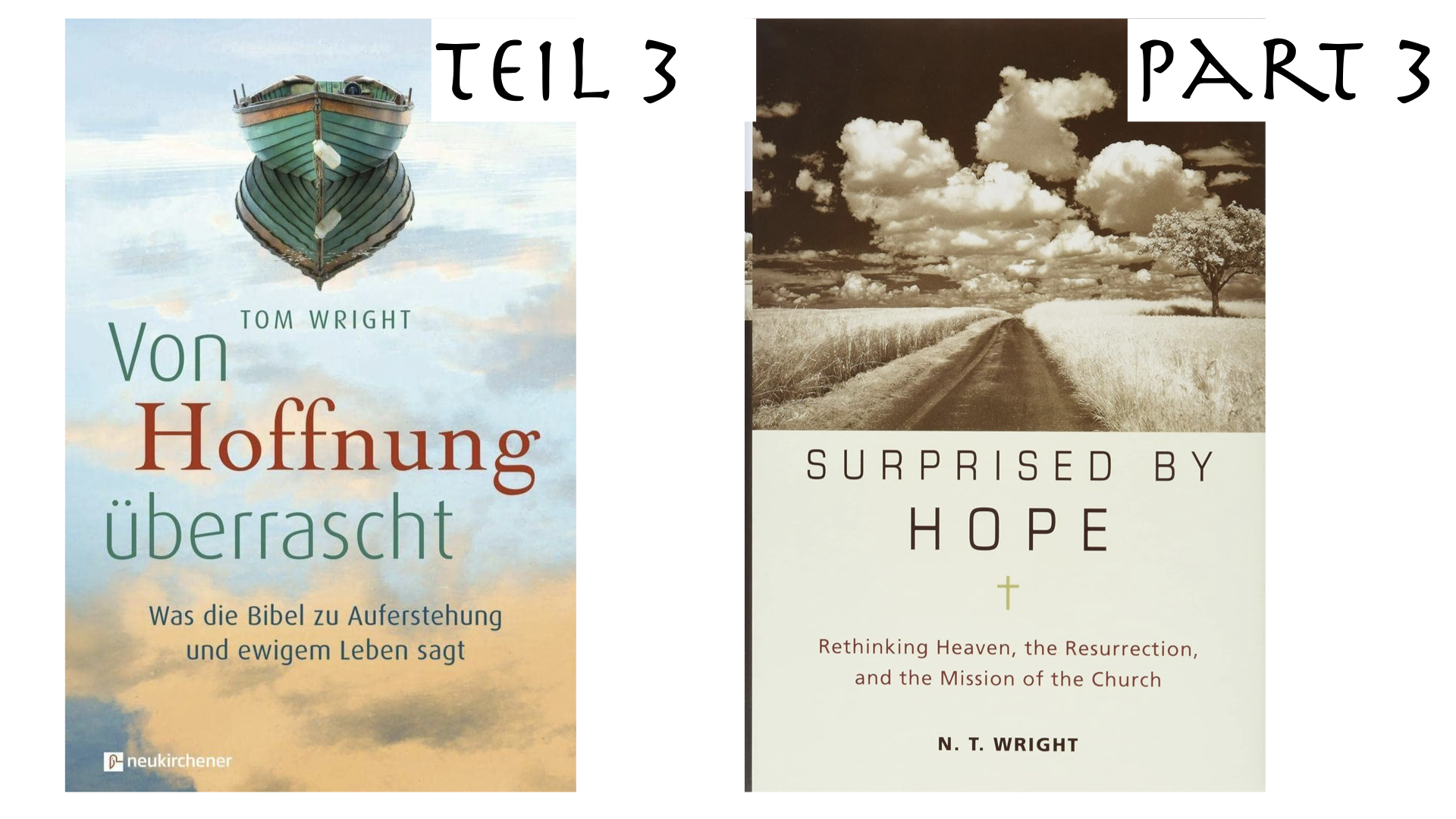
This series takes up the main ideas from the book by Bible scholar N. T. Wright Surprised by Hope: Rethinking Heaven, the Resurrection, and the Mission of the Church (German Von Hoffnung überrascht – Was die Bibel zu Auferstehung und ewigem Leben sagt).


I read the book in the German translation. So the quotes are from the German translation and retranslated into English. The quotes will therefore differ from the English original.
Purgatory, paradise, hell
In the last part, we clarified the meaning of our present and future bodies in the section „The redemption of our body“. Now the question naturally arises: And what is in between?
As far as purgatory is concerned, it is basically a Roman Catholic doctrine that is not held by the Orthodox Church and was rejected by the Reformation. It is interesting to note that even Cardinal Ratzinger (Pope Benedict XVI) and other important theologians withdrew very strongly from what the Catholic Church taught on the subject for a long time. However, this teaching also goes hand in hand with the belief that the „saints“ are already in heaven and everyone else … just not yet.
N. T. Wright questions this idea on four points.
1. The majority doctrine of all orthodox theologians is that the resurrection has not yet taken place. Resurrection is not the same as life after death; it refers to life after life after death.
2. The New Testament contains no reason to believe that there are any different categories of Christians in heaven while waiting for the resurrection.
3. N. T. Wright „does not believe in purgatory as a place, a time, or a state. Purgatory was in any case a late Western invention that has no biblical basis, and its alleged theological foundations are now, as we have seen, being questioned even by leading Roman Catholic theologians.“
4. „I thus arrive, fourthly, at the following view: all deceased Christians are substantially in the same state, a state of restful happiness.“ (p. 201) „However, neither in the New Testament nor in the very early Church Fathers do I find any indication that those who are presently in heaven or (whoever prefers) paradise are actively engaged in praying for us here in this life.“ (p. 202) „In particular, we should be suspicious of the medieval notion that the saints function like friends at court: We may shy away from approaching the king himself, but we know someone who is one of us, so to speak, to whom we can speak openly and who might put in a good word for us.“ (S. 202)
What N. T. Wright probably does not know is how much the so-called ‚anointed ones‘, the remnant of the 144,00 who see themselves as the saints, demand precisely this role in Jehovah’s Witnesses today and in the future. All other Jehovah’s Witnesses – the so-called ‚other sheep‘ – will only survive and live if they obey and honour this group of saints.
The idea of hell is no different. „The word hell conjures up images that are more strongly characterised by medieval imagery than by early Christian writings.“ (p. 204) „The most common New Testament word sometimes translated as hell is Gehenna. Gehenna was a place, not just an idea: it was the rubbish dump outside the south-west corner of Jerusalem’s Old City. To this day, there is a valley called „Ge Hinnom“ at the site. This word is also found in the original text, for example Luke 12:5, but is often translated as hell: „I will show you whom you should fear: Fear him who, after he has killed, has the power to cast into hell Gehenna. Yes, I say to you: Fear him!“ (Züricher) But what Jesus repeatedly emphasises in this and other passages is „that what counts is what happens on earth, not anywhere else.“ (p. 205) And therefore, according to Luke 13:3, he said, „No, I tell you; but unless you repent, you will all likewise perish.“ (Zurich)
Even the parable – parable! – of Abraham and Lazarus says nothing about a hell. „Taking the scene with Abraham, the rich man, and Lazarus literally makes about as much sense as trying to track down the name of the prodigal son. Jesus simply didn’t say much about the future life; after all, he was primarily concerned with announcing the coming of God’s kingdom, „on earth as it is in heaven.“ (p. 206) When we consider that Jesus was rebuking Jews here, it is not surprising that he cited Abraham, whom they regarded as their father.
On the other hand, the hope may be surprising to some because it does not include an all-reconciliation or a liberal overlooking of all sin and evil. Even though we consistently find in the translations of 1 Timothy 2:4 that God „wants all people to be saved and to come to a knowledge of the truth.“ (NIV). So this translation corresponds to a conviction, but not to the text of the New Testament. It is clear from many passages of the New Testament „that he does not mean „all individual people“ but „all kinds of people.““ (S. 213). For example, Paul clearly states:
But for those who are self-seeking and who reject the truth and follow evil, there will be wrath and anger.
Romans 2:8 NIV
In the description of the New Jerusalem in chapters 21 and 22 of the Revelation of John, it is also clear that some categories of people remain outside. But before we hastily have „an image of two beautiful and orderly categories in our minds, we should also remember that the river of the water of life flows out of the city; that on each side the tree of life grows, and not a single tree, but many; and that „the leaves of the trees are for the healing of the nations“. This is a great mystery that all our talk about God’s ultimate future must make room for. This is in no way to doubt the reality of the final judgement on those who have resolutely worshipped idols and served that which dehumanises us and distorts God’s world. It is only to say that God is always a God of surprises.“ (S. 213)
Conclusion
Truly, we have been „surprised by hope“. At least that’s how I felt on some points. As N. T. Wright draws on his decades of experience and backs this up with many examples, this is the case for most Christians.
Based on my personal life story as someone who grew up in the religion of Jehovah’s Witnesses, served for decades in an ‚exemplary manner‘ and finally consciously left this church, I realise that this hope will also come as a surprise to many former Jehovah’s Witnesses.
What many former Jehovah’s Witnesses have to deal with is not only the consequences of indoctrination and the treatment by the leadership and members of this cult. Nor is it just the realisation that many teachings specific to Jehovah’s Witnesses were inventions by people who have no basis in the Bible. And which are also increasingly being abandoned, watered down or concealed by the current ‚Governing Body‘ of Jehovah’s Witnesses.
Perhaps the most difficult thing for former Jehovah’s Witnesses is to read the Bible in a completely new way and also to accept findings in which the statements and teachings of their former religion were not entirely wrong after all. You probably believed that as the ‚other sheep‘ you had an earthly hope and could only survive Armageddon with the greatest effort and then live forever on earth after 1000 years and another final test. Okay, the few ‚anointed members of the remnant‘ have it easier – they die and, according to the teachings of Jehovah’s Witnesses, are immediately endowed with super-power and immortality in heaven. Then you realised that this was a hoax. There is only one hope for all Christians in the New Testament. And so you were of the opinion that you would go to heaven like all God’s children – just like the 144,000 Jehovah’s Witnesses or all Catholics and Protestants. Now you’ve been surprised by ‚the hope‘ that heaven might not be your final destination after all. Or at least your hope is quite different from what you thought.
If you, as a former Jehovah’s Witness, recognise which teachings of Jehovah’s Witnesses are not based on the Bible but are a fake, you are only halfway there. The house of faith has collapsed and is almost completely demolished. Now it’s time to build up your faith. It’s not easy to learn something new. It is even more difficult to correct something you have learnt incorrectly. I would like to make a contribution to this with this series.
Rethinking things is an important task for everyone. That is why N. T. Wright’s book contains a third part: Resurrection and the Mission of the Church. However, I will not be looking at this in this series. I hope you enjoy reading and reflecting on it.
Du muss angemeldet sein, um einen Kommentar zu veröffentlichen.