
By Christian / Tom Wright
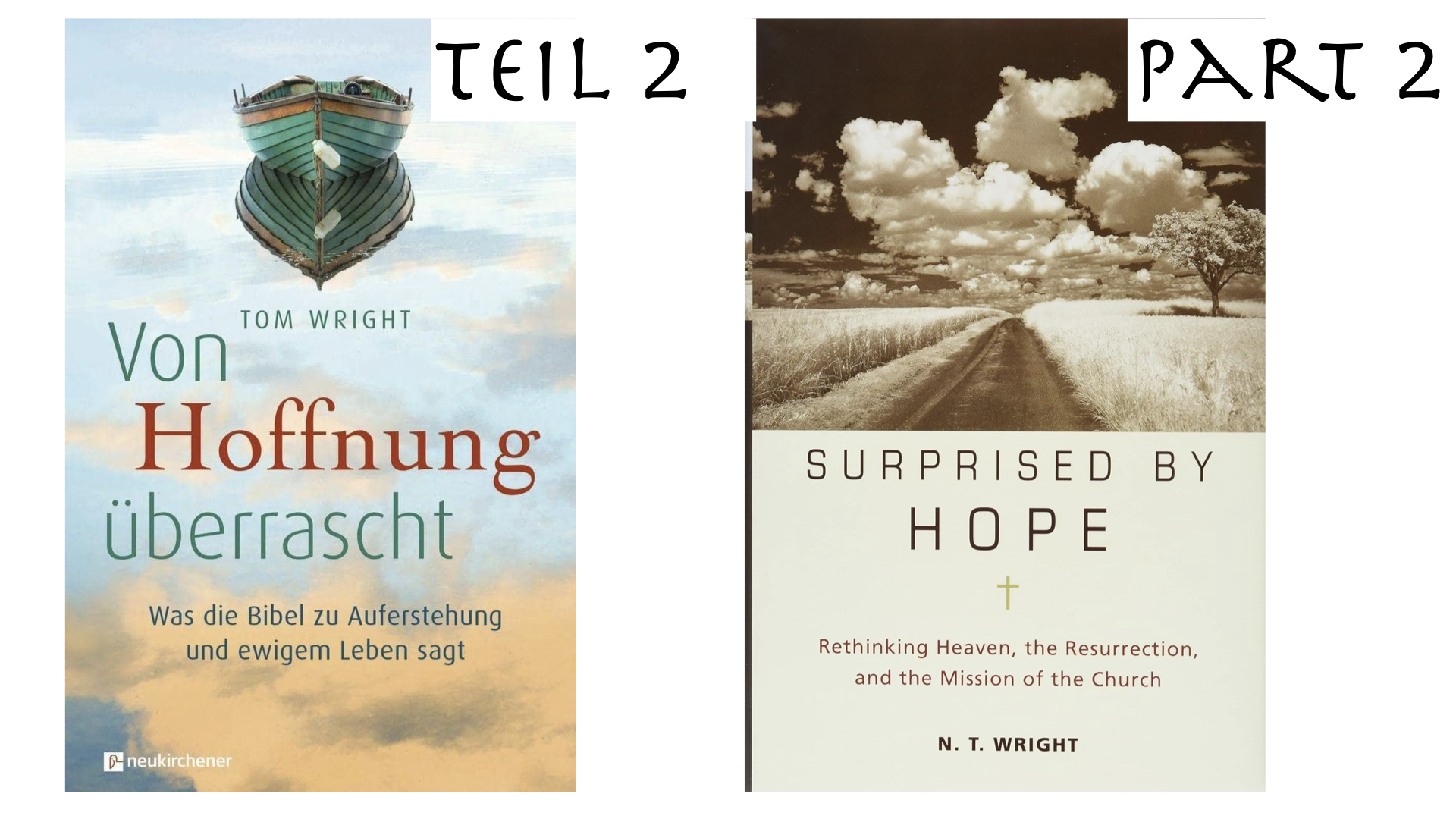
This series takes up the main ideas from the book by Bible scholar N. T. Wright Surprised by Hope: Rethinking Heaven, the Resurrection, and the Mission of the Church (German Von Hoffnung überrascht – Was die Bibel zu Auferstehung und ewigem Leben sagt).


Therefore, in this series I would like to present only the main points and encourage everyone to read the book for themselves and check the arguments against the Bible.
I read the book in the German translation. So the quotes are from the German translation and retranslated into English. The quotes will therefore differ from the English original.
Well prepared, but no goal in sight
This is how N. T. Wright describes what this book is about:
This book deals with two questions that have often been treated completely separately, but which, I passionately believe, belong very closely together. Firstly, what is the ultimate Christian hope? Then: What hope is there for change, for salvation, for transformation, for new possibilities within the present world?
N. T. Wright, Von Hoffnung überrascht, S. 21
Today, there is a vast number of different answers to this question – all of which more or less claim to be based on the Bible. And which one is right? Wrong question. It is better to ask ourselves which view is closer to what the text says. Tom Wright has a good tip on this:
And since good theology is never based on the opinion of the majority: What does the Bible teach on this subject? What do Jesus and the apostles say?
N. T. Wright, Von Hoffnung überrascht, S. 31
I’m afraid that unfortunately only a few people are really interested in this. But we are all influenced by what we have read, heard and seen since childhood. Ultimately, this is reflected in the behaviour of each individual. If we are living in the end times and will soon be taken to heaven by the Lord and the earth will be scorched with fire anyway, what do we care about environmental problems or climate change now? Not my thoughts, but those of quite a few evangelicals in the USA. And quite a few try to make spiritual contact with the dead. Even certain customs indicate that the conception of many differs significantly from that of Jesus‘ first disciples:
Funeral customs, new or re-emerging today, bring out the same kind of confusion. The gesture of placing objects next to the deceased in the coffin to comfort or help them in their future lives was until recently described by cultural observers as an interesting custom that has now been abandoned in modern Western society. Meanwhile, gifts for the deceased are making a comeback, with photos, jewellery, teddy bears and the like being placed in the coffin. Nigel Barley recounts stories from a crematorium employee; stories of widows placing a packet of wholemeal biscuits or the deceased’s second pair of glasses and dentures in the coffin. In one case, a widow placed two aerosol cans of glue in the coffin. Her husband had always used it to glue his toupee on. The spray cans caused an explosion, bending the door of the crematorium’s combustion chamber.
N. T. Wright, Von Hoffnung überrascht, S. 35
There is probably no better way to summarise the situation than this:
Most people simply do not know what the Orthodox Christian faith actually consists of.
Frankly speaking: What we have today is not „the sure and certain hope of the resurrection of the dead“, as the old liturgies say, but the vague and fuzzy optimism that things will somehow be all right in the end.
N. T. Wright, Von Hoffnung überrascht, S. 36, 51
Therefore, we will now need to address some key issues relating to our hope based on Scripture:
- How can we know anything at all about all these things?
The Church of England says: In Scripture, tradition and reason. And in an appropriate mixture. „I submit that a good proportion of our present view of death and the afterlife derives from none of these sources, but from cultural impulses which have generated at best semi-Christian informal traditions.“ (S. 53) - Do we have immortal souls, and if so, what are they?
- Jesus‘ own resurrection must be the starting point for all Christian thinking on the subject of hope.
To do this, we have to go back two thousand years in history.
Early Christian hope in its historical context
The resurrection of Jesus is described in the New Testament in the Gospels and the letters. However, with certain deviations. If the accounts were exactly the same word for word, it would be said that one source had merely copied from the other. Now, however, we are dealing with eyewitness accounts that differ from one another. This may be a problem for someone who advocates literal inspiration (See video The Canon of the New Testament – Part 9: Inspiration). But is that so unusual? You can see the same thing with eyewitness accounts today. But only in the rarest of cases would one conclude that the event described never took place. So why was the report of Jesus‘ disciples so spectacular?
Resurrection and life after death in ancient paganism and Judaism
Tom Wright summarises it like this:
The ancient world – with the exception of the Jews – insisted that the dead do not resurrect; and Jews did not believe that anyone had already resurrected or that anyone would do so by their own power before the resurrection of the dead.
As far as the ancient pagan world was concerned, the path to the underworld was a one-way street. Death was omnipotent; you could not escape it and you could not break its power once it had occurred. The ancient pagan world was therefore roughly divided into those who, like Homer’s shadows, would have liked to have a new body but knew they would not receive one, and those who, like Plato’s philosophers, did not want a body because an incorporeal soul was far better.
Within this world, the word resurrection in its Greek, Latin or other equivalents was never used to refer to life after death. The term resurrection was used to denote new physical life, after life after death, however that was imagined.
In terms of content, resurrection referred specifically to something that happened to the body; hence the later debates about how God would bring about a resurrection – whether he would work with the existing bones or create new bones etc. Such debates could only occur when it was fairly clear that something tangible and physical would be the end result.
N. T. Wright, Von Hoffnung überrascht, S. 60, 61
According to Mark 6:14-16 and the parallel passages, „Herod the Great is reported as saying that he thought Jesus might be John the Baptist, who had risen from the dead – but he did not think it was a ghost.“
„When the first Christians said that Jesus had been resurrected from the dead, they knew that they were saying that something had happened to him that had never happened to anyone else and that had not been expected at all. They did not say that Jesus‘ soul had entered heavenly bliss.“ (p. 63)
What was the situation in the Jewish world? Some Jews – like the Sadducees – „agreed with the Gentiles who denied any afterlife, especially a physical afterlife. Others agreed with the pagans who thought of a glorious, albeit incorporeal, future for the soul. Here the philosopher Philo is the obvious example. But most Jews of the time believed in the eventual resurrection of the dead – that is, that God would take care of the soul after death until he would give new bodies to his people on the Last Day, when he would judge the whole world and make it new.“ John 11:24 „I know that he will rise again – at the resurrection on the last day.“
But didn’t Jesus say in Mark 12:18-27, Matthew 22:23-33 and Luke 20:27-40 that we become angels in the resurrection? Here, too, you have to read the texts carefully (preferably in the original languages): He said to be like (Matthew, Mark) or equal to (Luke) angels. And that was a discussion with the Sadducees, who completely denied a resurrection.
„Apart from this discussion, the more or less only reference to the „resurrection“ as a whole within the Gospels appears in Matthew 13:43″. And thus quotes Daniel 12:3 and thus the usual view in the Jewish world.
And what about the isolated reference in John 5:28, 29?
Do not be amazed at this; for a time is coming when all who are in the tombs will hear His voice, and will come out: those who did the good deeds to a resurrection of life, those who committed the bad deeds to a resurrection of judgment.
John 5:28,29 NASB
On this Tom Wright writes: „Up to this point he remains squarely on the map of first-century Jewish belief. In contrast to his redefinition of the kingdom and messianicity, he seems to have had little or nothing new to say on the question of resurrection. Except that he then begins to tell his followers that he himself will be killed and then resurrected three days later. …. But the Gospels insist again and again that the disciples simply could not understand what Jesus was saying.“ (p. 65) They discussed among themselves, somewhat confused, what this „rising from the dead“ could mean (Mark 9:10; interestingly reported only in Mark)
This was not because these disciples simply didn’t know their Bible well enough or were even a little slow on the uptake. The resurrection of a single person before ‚that time‘ was simply beyond their imagination.
So for them, Jesus‘ crucifixion was the end of all their hope. „Nobody dreamed of saying: „Oh, that’s okay – he’ll be back in a few days.“ Or: „Well, at least he’s in heaven with God now.“ According to Luke 24:21, they were thinking, „We had hoped he was the one who would redeem Israel.“ In other words, „the crucifixion meant that the kingdom had not come, not that it had come. The crucifixion of a „would-be Messiah“ meant that he was not the Messiah, not that he was. When Jesus was crucified, every single disciple knew what that meant: „We backed the wrong horse. The game is over.“
So this is the context in which early Christian hope was proclaimed. If we keep this in mind, we understand much better the surprising character of early Christian hope, which we will look at in the next part.
Du muss angemeldet sein, um einen Kommentar zu veröffentlichen.