
By Christian
Can it even be the case that we can still be somehow surprised today with regard to the hope we are given in the Bible? Hasn’t everything already been understood, written and said about it? Does anyone here think they know better than the first Christians, the ‚Church Fathers‘, the great theological thinkers of the Middle Ages and the Reformation?
We may have already noticed from the list in the last question that the focus here was strongly on the ‚Western Church‘. For example, the ‚Eastern Church‘, i.e. the Greek Orthodox Church and the churches of the Middle East, are missing from the list. Or the further development of Judaism. And all of their hopes are sometimes far apart.
But can we today know any more about the Old Testament, the New Testament and the context in which they were written than even the Church Fathers? The answer here must be a resounding yes. Why is that the case?
Because today we have many more sources from antiquity at our disposal and the languages used are better understood. What did the Church Fathers know? They had very few sources at their disposal. Many were part of a local persecuted group and not scholars with access to huge libraries and computers. And they were not even closer to the languages used than we are today. Excuse me? How many of the church fathers do you think could read the Old Testament in Hebrew, for example? Not even a handful! And why do you think Jerome was commissioned to produce a Latin translation of the Bible (later called the Vulgate) at the end of the fourth century? Not only because of the differences in the existing Latin translations. The fact that there were Latin translations shows that most of them did not even know Greek. And Jerome also translated the Old Testament from the Septuagint, i.e. the Greek translation, and his knowledge of Hebrew is unclear. (See the series Serie The canon of the New Testament).
From the second century onwards, people had already moved far away from Paul’s letters and the texts of the first century in their thinking and reasoning. And the Old Testament was pushed aside as ‚outdated‘. (See the video The Canon of the New Testament – Part 13: Marcion and Other Vanished Christians)
We should also not overlook the strong influence of Greek philosophy, especially Plato, on Christian doctrine and theology and even Judaism at the time of Christ. When were the doctrines of heaven, hell, purgatory and the immortal soul coined in their present form? Do we find them in the text of the Old or New Testament? With the Church Fathers? Or only from the Middle Ages onwards? We shall see.
It is therefore a question of going back to the text of the Old and New Testaments with all the possibilities available to us today. What can a biblical scholar say today about what the apostle Paul wrote, for example? Or what can be found in the Gospels? What was the message that Christians heard and proclaimed in the first century? That’s what this video series will be about.
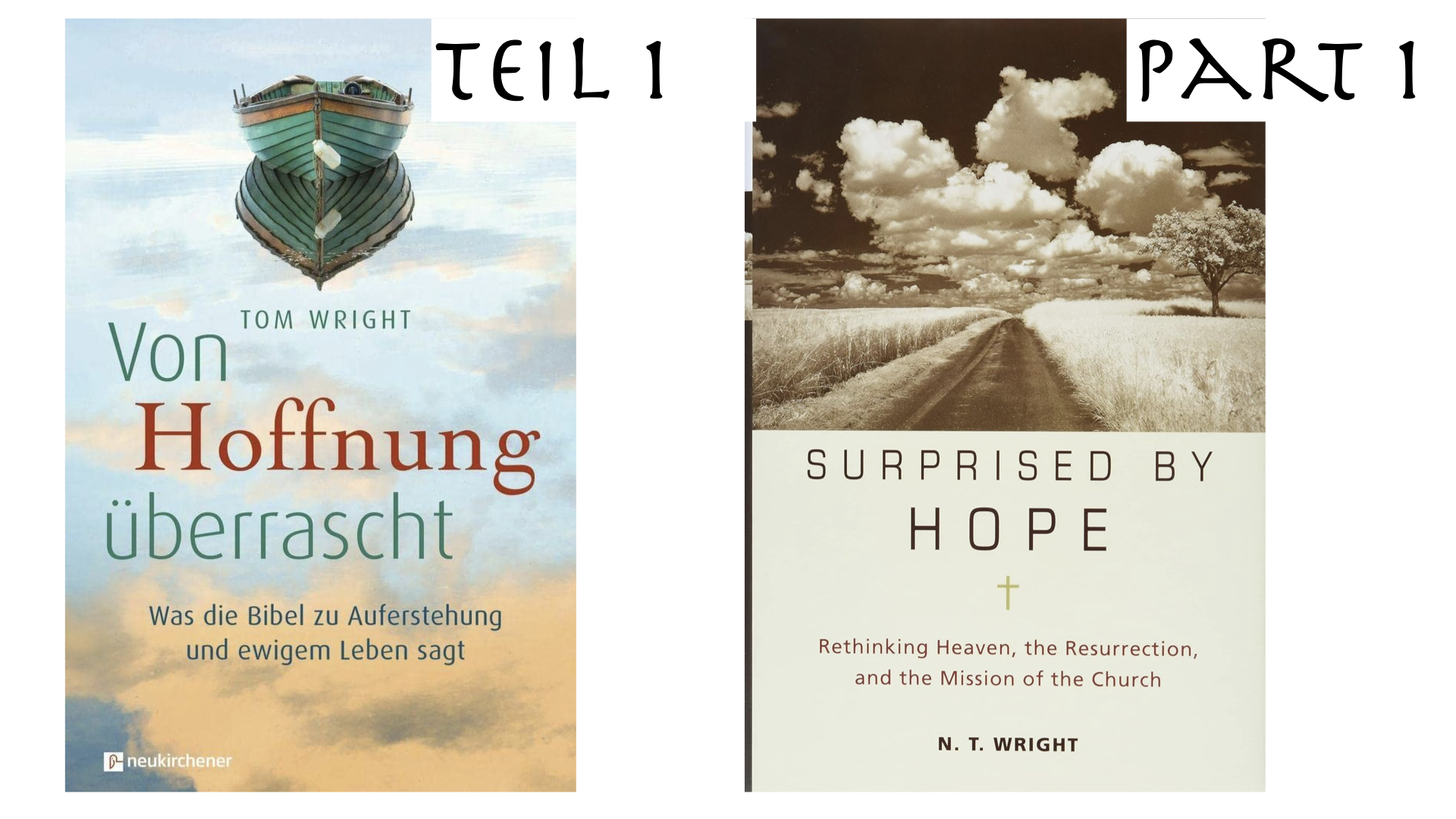
Fortunately, the book Surprised by Hope: Rethinking Heaven, the Resurrection, and the Mission of the Church by Bible scholar N. T. Wright is also available in German translation: Von Hoffnung überrascht – Was die Bibel zu Auferstehung und ewigem Leben sagt.


Therefore, in this series I would like to present only the main points and encourage everyone to read the book for themselves and check the arguments against the Bible.
I read the book in the German translation. So the quotes are from the German translation and retranslated into English. The quotes will therefore differ from the English original.
Firstly, I would like to briefly provide some information about N. T. Wright. Not because an argument becomes more important or more correct because a recognised scholar says so. „Nicholas Thomas Wright, better known as N. T. Wright or Tom Wright, was Professor of New Testament and Early Christianity at the University of St Andrews, Anglican Bishop Emeritus of Durham (England) and one of the leading New Testament theologians and Life of Jesus scholars in the English-speaking world. He has been a Senior Research Fellow at the University of Oxford since 2019. … Wright is an independent, unconventional thinker who challenges modern and classical interpretations and is difficult to categorise. He sets out complex theological issues in a clear and readable way to make the reader think.“ (Wikipedia) So let’s listen to what someone has to say who has devoted decades of academic research to the text of the New Testament and the Pauline letters in particular.
Let’s start with an important note in the foreword (p. 14).
All language about the future, as any economist or politician will tell you, is nothing more than a series of signs pointing into the fog. We are looking through a glass darkly, said St Paul as he looked at what is to come. All our language about future states of the world and of ourselves consists of complex images that correspond more or less well with the ultimate reality. But that doesn’t mean that things are completely unclear or that every opinion about these things is equally valid. And what if someone came out of the fog to meet us? This is, of course, the central, if often ignored, Christian belief.
N. T. Wright, Von Hoffnung überrascht, S. 14,15
In this respect, no one should claim to know exactly what the hope and future of a Christian will look like. After all, Paul says that he and his contemporaries could not do this even though they had the Holy Spirit. (1 Corinthians 13:12).
What hope have you got?
This brings us to the point where you should briefly consider what hope you have.
As a Catholic, you probably believe that you will go to heaven after death. But not to hell for eternity. And only briefly in purgatory. Interestingly, heaven and hell were adopted in the Koran and thus the Isalm, although this is not found in either the Old or New Testament. As a Protestant, you probably also hope to go to heaven. But the hell thing … too cruel. Maybe everyone will go to heaven one day? For some, that sounds a lot like Asian religions and philosophies. To be reunited with God (or the universe?).
I would particularly like to address the hope of Jehovah’s Witnesses and ex-Witnesses – not only because of my own experiences – because it often takes an interesting turn.
When Jehovah’s Witnesses were still Bible Students, they also essentially believed that they would go to heaven like all Christians. When the hope proclaimed for years that „millions now living will never die“ was not fulfilled in 1925, the move to heaven simply had to be postponed. In the 1930s, the president of the Watchtower Bible & Tract Society, J. F. Rutherford, not only gave his followers the name Jehovah’s Witnesses, but also a new hope: only a small remnant of the literal 144,000 anointed Christians would go to heaven to reign with Jesus. All the others would be ‚other sheep‘ and would remain on earth. (See video Identifying True Worship, Part 8: The Jehovah’s Witnesses‘ Teaching on the ‚Other Sheep‘)
However, many have now woken up and realised that J. F. Rutherford only justified this doctrine of the ‚other sheep‘ at the time on the basis of his own made-up type and anti-type comparisons. That is why these original articles from the 1930s have not been quoted in the Watchtower literature for a long time. Then everyone would notice.
But this leads to the following: If there are no two hopes, as Jehovah’s Witnesses teach, but only one hope for all followers of Jesus, then it is the … heavenly one, isn’t it? So the ‚children of God‘ all go to heaven. Welcome to the bosom of the church, I would like to say. But not quite. What about the others? Do they go to purgatory and hell? Well, anyone who has preached for years and decades that the Bible shows that there is no hell and no immortal soul will probably not believe that. But what then? Will such people be ‚destroyed forever‘ at the final judgement? Doesn’t that still sound like something out of the Jehovah’s Witnesses‘ preaching toolbox? And what happens between death as a human being and the future? Are we then ‚in the memory of God‘? Sounds somehow familiar too …
I wonder how many ‚proof texts‘ have already gone through your head for one thing or another. But we still draw our conclusions far too early. Because we unconsciously still have a lot of ideas as presuppositions in our thinking. And because reading the Bible is usually not enough. Not even with prayer and the Holy Spirit. He would have to perform true miracles because we can neither read the texts in the original languages nor with the context of that time. We do not understand the meaning of the words and phrases. Often we even miss the almost obvious reference to the Old Testament when reference is made to the Septuagint or linguistic images are used. Or the use of certain words and terms in the first century. What was perhaps clear to every follower of Christ at the time is not self-explanatory for us. And even worse: we read terms in the translations and associate them with ideas that the disciples of Jesus in the first century did not even have.
So the motto now can only be: Back to the text! And back to the context!
And that’s exactly where we start in the next part.
Du muss angemeldet sein, um einen Kommentar zu veröffentlichen.