
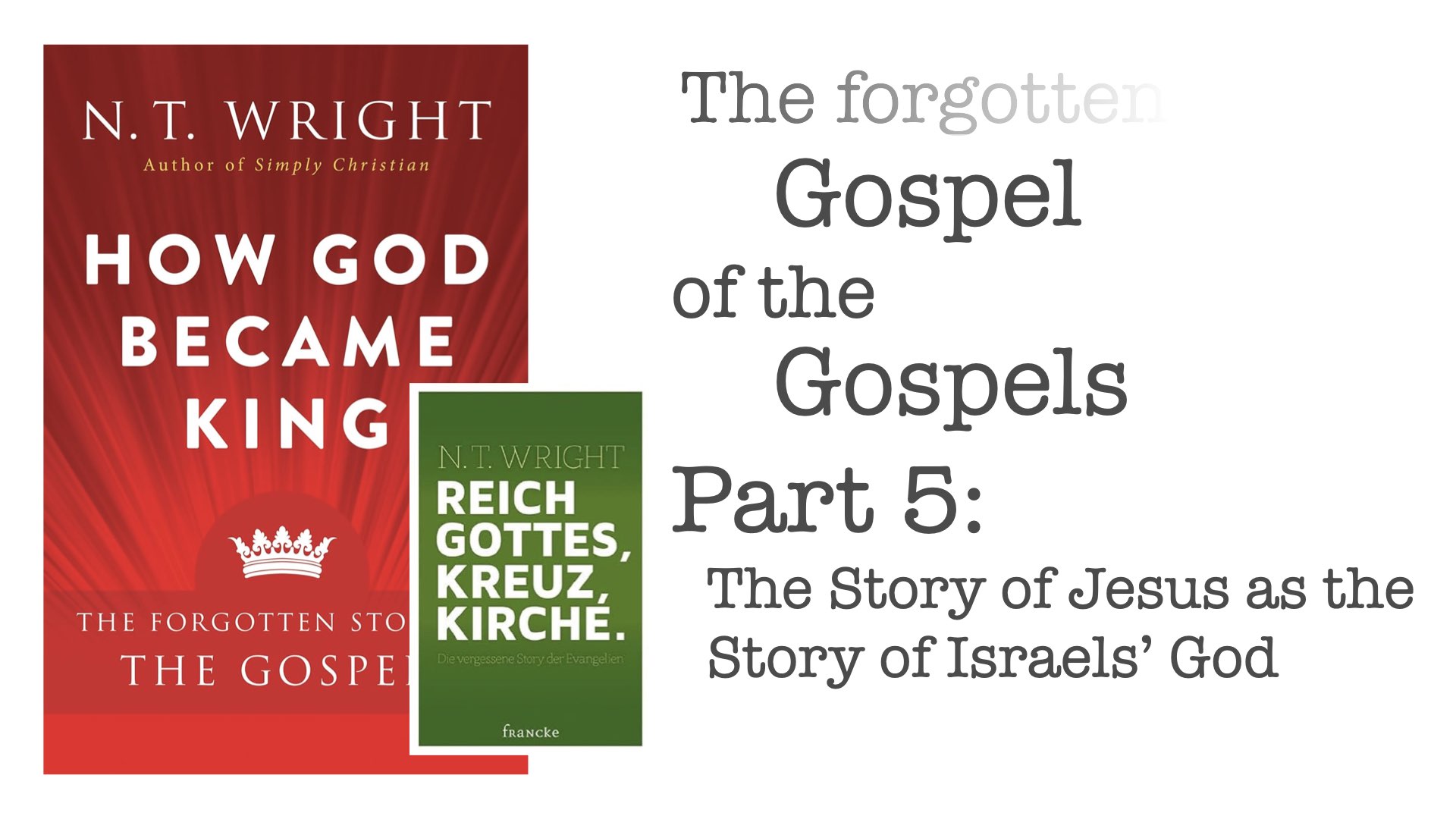
Von Christian / N. T. Wright
In the fifth chapter of N.T. Wright’s book How God Became King: The Forgotten Story of the Gospels, the point is that the story of Jesus is the story of the God of Israel, who returns to his people as he has always promised.
The problem is that one particular aspect of it has been so overemphasized in the Western church in the past few centuries that we no longer hear the quieter tones of the evangelists.
We have been so concerned to let the gospels tell us that the story of Jesus is the story of God incarnate that we have been unable to listen more carefully to the evangelists telling us which God they are talking about and what exactly it is that this God is now doing.
N.T. Wright How God Became King, chapter 5
For far too long, Christians have told the story of Jesus as if it were directly linked to the story of human sin in Genesis 3, skipping over the story of Israel. As if this part was a failed attempt by God and with Jesus, Plan B began, so to speak. But that is not what the Bible says.
The Biblical Story of God
God’s covenant with Abraham and the promise to bless all families of the earth through him is a direct response to the wickedness of mankind described in Genesis 3 to 11, which culminates in the dispersion of the people of Babel.
If we consider the worldview of early antiquity, then in Genesis creation is described as if it were a kind of temple in which God lives among humans. (See the series “Being God’s image”). While there was an image of the god or goddess in the ancient temples for this purpose, this was not the case in Eden and in the temple in Jerusalem: humans were to fulfill this task as the image of God. This is the core of the story, but it is ruined by the rebellion of the creatures bearing the image of God.
This thought seems to disappear, only to resurface all the more clearly:
But the astonishing thing about the book of Exodus, doubly astonishing as it turns out, is that God himself accompanies the people on their journey and then gives instructions for the “tabernacle,” the holy tent or “tent of meeting,” where he will be present in their midst and where he will meet, more particularly, with Moses himself.
N.T. Wright How God Became King, chapter 5
But very soon the Israelites also rebel. This does not thwart God’s purpose, but a pattern becomes apparent:
This pattern—God intending to live among his people, being unable to because of their rebellion, but coming back in grace to do so at last—is, in a measure, the story of the whole Old Testament.
Magnify that exodus story, project it onto the screen of hundreds of years of history, and you have the larger story. Solomon builds the Temple, succeeding generations either corrupt it or try to reform it, but eventually, faced with overwhelming rebellion and idolatry, God abandons the Temple at last, leaving it to its fate when the Babylonians close in. (Note the irony: Babylon, “Babel,” is the place of human pride and idolatry in contrast to which God called Abraham in the first place.) The whole of what we call the Second Temple period, roughly 538 BC onward, is characterized by this sense of divine absence; God is gone, and he hasn’t come back.
N.T. Wright How God Became King, chapter 5
ABut it will not remain so, as the prophet Malachi says, for example:
“Behold, I am sending My messenger, and he will clear a way before Me. And the Lord, whom you are seeking, will suddenly come to His temple; and the messenger of the covenant, in whom you delight, behold, He is coming,” says the LORD of armies.
Malachi 3:1 NASB
And that is the story the Gospels want to tell us: how Yahweh finally came back to his people.
Looking for the right thing
And that can be found in all the gospels if you are looking for it. If, for example, you assume on the basis of tradition that you will find a high Christology in John and only a low one in the synoptic gospels, then it will be difficult to recognize.
In Mark, however, Malachi 3:1 is quoted exactly and linked with Isaiah 40:3-11. On closer inspection, we therefore find a Christology in Mark’s first pages, albeit a Jewish Christology.
Mark’s Jesus goes about doing and saying things that declare that Israel’s God is now becoming king—Israel’s dream come true. But Jesus is talking about God becoming king in order to explain the things he himself is doing. He isn’t pointing away from himself to God. He is pointing to God in order to explain his own actions.
N.T. Wright How God Became King, chapter 5
Take, for example, how Jesus acts in Mark 4:35-41 and compare it with statements from the Old Testament:
And He got up and rebuked the wind and said to the sea, “Hush, be still.” And the wind dieddown and it became perfectly calm.
Who stills the roaring of the seas, The roaring of their waves,
LORD God of armies, who is like You, mighty LORD? Your faithfulness also surrounds You. You rule the surging of the sea; When its waves rise, You calm them.
Then they cried out to the LORD in their trouble, And He brought them out of their distresses. He caused the storm to be still, So that the waves [s]of the sea were hushed. Then they were glad because they were quiet, So He guided them to their desired harbor.
Mark 4:39 NASB; Psalm 65:7;89:8,9;107:28-30 NASB
Attentive readers of Mark may well wonder at such passages: Is it possible that God will return in this way?
Finally, we find another interesting clue at the end:
At the ninth hour Jesus cried out with a loud voice, “ELOI, ELOI, LEMA SABAKTANEI?” which is translated, “MY GOD, MY GOD, WHY HAVE YOU FORSAKEN ME?” …
And when the centurion, who was standing right in front of Him, saw that He died in this way, he said, “Truly this man was the Son of God!”
Mark 15:34, 39 NASB
The term “Son of God” naturally reminds us of God’s voice at Jesus‘ baptism in Mark 1:11. But should a Roman centurion have referred to it? Wouldn’t he rather think of Tiberius Caesar, the son of the ‚divine‘ Augustus, as the Son of God? After all, this was even written on the coins – like the ones they had shown Jesus a few days earlier (12:15-17).
For Mark and other Christians, ‚Son of God‘ could have four meanings:
- First, in the Old Testament Israel itself is “God’s son” (Exod. 4:22; Jer. 31:9).
- Second — and this seems to be a primary meaning in the baptism story — it is the messiah, Israel’s anointed king, who is “God’s son” (2 Sam. 7:12–14; Pss. 2:7; 89:26–27).
- Third, as we just noted, “son of God” was a regular and primary title taken by the Roman emperors from Augustus on.
- But fourth, looming up behind and beyond all of these was the sense we find in the very earliest Christian documents that all of these pointed to a strange new reality: that, in Jesus, Israel’s God had become present, had become human, had come to live in the midst of his people, to set up his kingdom, to take upon himself the full horror of their plight, and to bring about his long-awaited new world. The phrase “son of God” was ready at hand to express that huge, evocative, frightening possibility, without leaving behind any of its other resonances. We can see this already going on in the writings of Paul. It is highly likely that Mark expected his first readers to have the same combination of themes in mind.
As a secondary thought, I would like to mention something that N.T. Wright does not address in his book. There are all sorts of explanations as to why Jesus says in Mark 15:34, “My God, my God, why have you forsaken me?” Various scholars have rightly pointed out that Jesus here seems to be quoting Psalm 22, which begins exactly like this. What did Jesus or Mark want his readers to remember? Those who knew Psalm 22 well? Let’s look at the end:
My God, my God, why have You forsaken me?
Psalm 22:1;29-32 NASB
…
For the kingdom is the LORD’S. And He rules over the nations. All the prosperous of the earth will eat and worship, All those who go down to the dust will kneel before Him, Even he who [w]cannot keep his soul alive. A posterity will serve Him; It will be told of the Lord to the coming generation. They will come and will declare His righteousness To a people who will be born, that He has performed it.
Well, if that doesn’t fit our topic…
Matthew and Luke: Seeing Jesus, Thinking God
After seeing how Mark approaches the subject, it is easier to discover the same thing in Matthew and Luke. After the genealogy, Matthew starts with this topic right away:
The angel tells Joseph that Mary’s child is to be called “Jesus,” because “he is the one who will save his people from their sins”; the name “Jesus” is here being interpreted as meaning “YHWH saves.” Matthew’s comment fills this in from another angle: All this happened so that what the Lord said through the prophet might be fulfilled: “Look: the virgin is pregnant, and will have a son, and they shall give him the name Emmanuel”—which means, in translation, “God with us.” (Matthew 1:22–23)
N.T. Wright How God Became King, chapter 5
The name of Jesus is interpreted here as “Yahweh saves” in accordance with the Hebrew or Aramaic name. And Matthew links this to the idea – however strange it may seem – that the God of Israel is personally present among his people in order to save them.
This is also reflected at the end of the Gospel of Matthew:
Jesus came toward them and addressed them. “All authority in heaven and on earth,” he said, “has been given to me! So you must go and make all the nations into disciples. Baptize them in the name of the father, and of the son, and of the holy spirit. Teach them to observe everything I have commanded you. And look: I am with you, every single day, to the very end of the age.” (28:18–20)
Matthew 28:18-20 N.T. Wright
“God is with us” has become ‘Jesus is with us.’ If we think of the first disciples of Jesus, who were all devout Jews, waiting for their God to be among them again, then some events take on a different perspective. Like the one where Peter almost perished: ‘They got into the boat, and the wind died down. The people in the boat worshipped him. “You really are God’s son!” they said.” (Matthew 14:32-33 N.T. Wright)
And so many of Jesus‘ parables make much more sense when he speaks of a noble man in Luke 19:11-27 who went away to attain kingship. In Luke 19:44, Jesus speaks of “you didn’t know the moment when God was visiting you.”. That sounds rather strange. The God of Israel Yahweh “visited” his people by being there. Is this a tendentious translation?
Actually, the Greek simply says ton kairon tes episkopes sou, “the day of your visitation.” But the word “visitation” here has only one possible meaning. This is the time when God was coming back, coming back at last to see how his people had been doing with their centuries-old commission. This, for Luke, is the meaning of the parable. Jesus is telling a story about Israel’s God coming back to his people to explain what was going on when he himself was arriving in Jerusalem.
N.T. Wright How God Became King, chapter 5
And so, according to Luke, Jesus kept drawing attention to this point:
“Go back to your home,” said Jesus, “and tell them what God has done for you.” And he went off around every town, declaring what Jesus had done for him.
Lukas 8:39 NEÜ
Glory Unveiled: John’s temple Christology
In Eden, the tent of meeting or tabernacle and the Jerusalem Temple were always about a place through which God dwells with people. Therefore, the destruction of the Temple in 587 BC was the greatest disaster for his people. And Yahweh had not yet returned despite the rebuilding of the second Temple.
And John, more clearly than the others, insists from the start that this promise has been made good in Jesus. The Word became flesh and kai eskenosen en hemin, “set up among us his skene,” his “tent” (it’s the word from which we get “scene”; a theatrical backdrop is a kind of “tent” in which the action takes place). In case there was any doubt, the Greek word skene is (coincidentally?) a close echo of the Hebrew shakan, which means “dwell” or “abide”; when we read of people “abiding” with Jesus or his “abiding” with them later in John, we should almost certainly catch this echo. In particular, in postbiblical Jewish writing the idea of the presence of God in the Temple was given the name Shekinah, the “tabernacling, abiding divine presence,” the personal presence of the glory of God. So, when John continues by saying, “We gazed upon his glory, glory like that of the father’s only son, full of grace and truth” (1:14), we should get the point loud and clear.
N.T. Wright How God Became King, chapter 5
As for the relationship between Jesus and Yahweh, we should not jump to any hasty conclusions, however:
All this means that we should be able to read John with more sensitivity to the nature of his “high Christology.” Obviously he thinks Jesus was and is fully divine (as well as fully human, but he doesn’t need to make that point in the same way). But this doesn’t mean he is simply saying “Jesus is God” in the way of some rationalist apologists. John’s “high Christology” remains very, very Jewish, very much rooted in Israel’s scriptures. His chosen vehicle for his matchless opening statement, the logos, draws not so much on Platonic or Stoic ideas as on the living Word of the Old Testament, as, for instance, in Isaiah 55, where the word goes out like rain or snow and accomplishes God’s work (55:10–11). This work, God’s great act of rescue, rooted in the accomplishment of the “servant of the LORD” in chapter 53 and the renewal of the covenant in 54, brings about the new creation in 55, with the thorns and thistles of Genesis 3 and Isaiah 5 replaced by wonderful trees and shrubs (55:12–13). It is (in other words) the creator God, and it is Israel’s God, who has become human in and as Jesus of Nazareth.
N.T. Wright How God Became King, chapter 5
In summary, N.T. Wright describes his proposal as follows:
The gospels offer us not so much a different kind of human, but a different kind of God: a God who, having made humans in his own image, will most naturally express himself in and as that image-bearing creature; a God who, having made Israel to share and bear the pain and horror of the world, will most naturally express himself in and as that pain-bearing, horror-facing creature. This is perhaps the most difficult thing for us to keep in mind, though the gospels are inviting us to do so on every page.
N.T. Wright How God Became King, chapter 5