
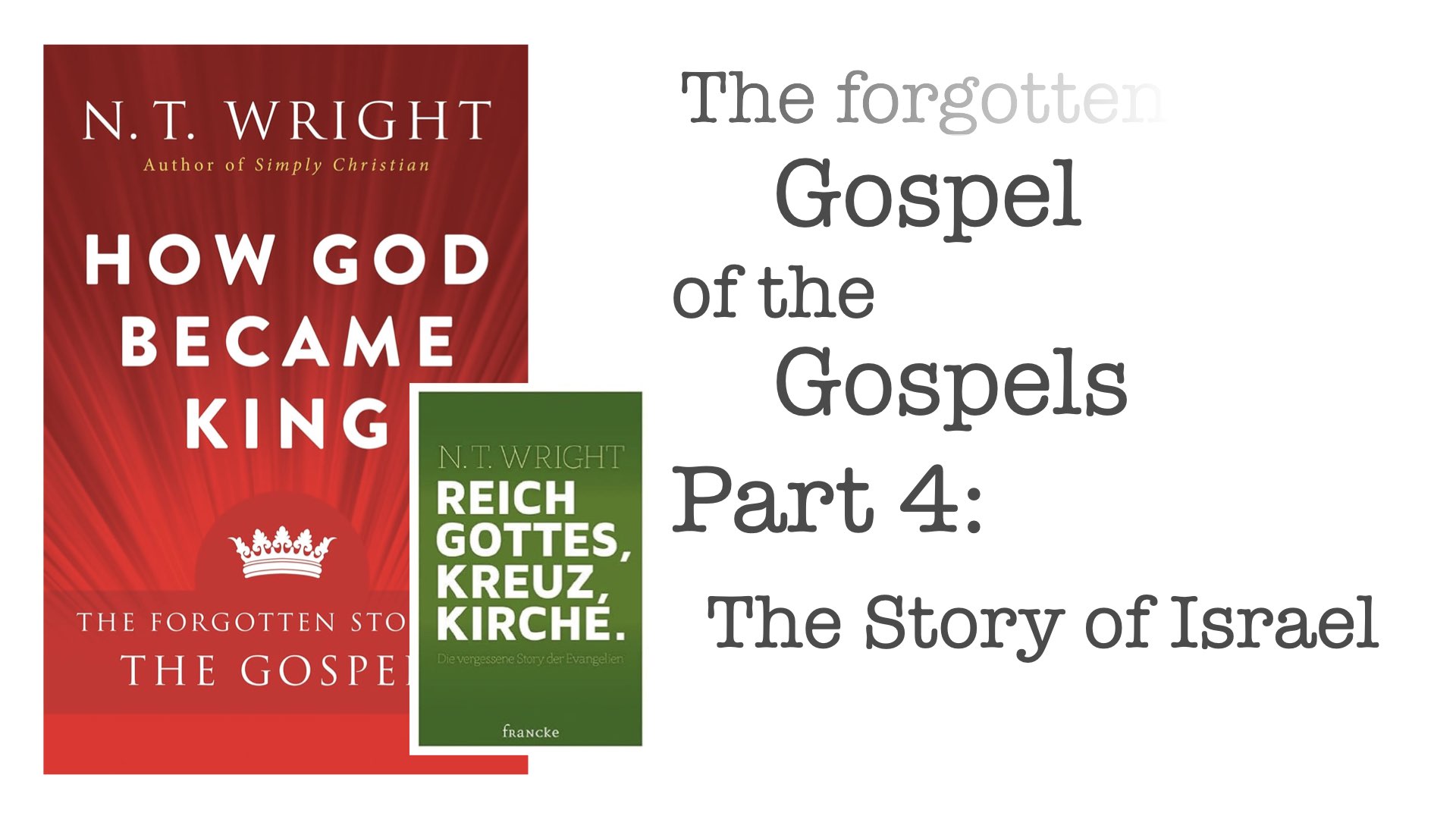
Von Christian / N. T. Wright
To hear the gospel of the gospels, the actual story of the gospels, we need to talk about four strands or levels of the gospels, which have either been pushed into the foreground or almost invisibly into the background. Because of this distortion, we find it difficult to recognize the story itself.
In the fourth chapter of N.T. Wright’s book How God Became King: The Forgotten Story of the Gospels, the story of Israel is the focus. So it is not a historical outline of events, but the story, the deeper content that is to be communicated to us.
The Gospels as biographies
The times when scholars could proclaim that the gospels are not biographies of Jesus are long gone. They are not biographies like those written today, but resemble ancient Greek or Roman biographies. And the four gospels are different because they are not just biographies of the person of Jesus, but want to convey a much larger story. And they do that from different angles and with different focal points.
The four gospels present themselves as the climax of the story of Israel. All four evangelists, I suggest, deliberately frame their material in such a way as to make this clear.
N.T. Wright How God Became King, Chapter 4
Unfortunately, generations of Christian readers have virtually ignored this context and connection. We too will only be able to understand this point if we explicitly realize how the story of Israel was told at the time.
The strange story of Israel
N.T. Wright summarizes it as follows:
The story of Israel too is a subject for an entire book. But we can sum it up like this. Israel’s ancient scriptures are framed with a narrative, an unfinished narrative of a certain shape and type. Whether you read the Old Testament as set out in most English Bibles from Genesis to Malachi or whether you read it in the Hebrew canon from Genesis to Chronicles with the prophets in the middle, you are still left with a sense that this story is supposed to be going somewhere, but that it hasn’t gotten there yet. It is an unfinished narrative, an unfinished agenda. Things are supposed to happen that haven’t happened yet.
N.T. Wright How God Became King, Chapter 4
Just as Genesis 1-3 tells the story of human plight using the pattern of glorious beginnings, rich callings and then terrible failure and exile, so between Genesis 12 and Chronicles or Malachi we find the same story in relation to Israel. But it is precisely this story of Israel that is ignored by most modern readers of the Bible today.
And the creeds have a significant part in this, because they do not mention Israel at all. On the contrary, they give the impression that a new beginning was made with Jesus.
But the evangelists saw it quite differently.
Matthew: The story reaches its goal
The Gospel of Matthew, which has always been at the beginning of the canon, begins with what? The family tree of Jesus from Abraham. It thus covers the period from before Israel, from its patriarch Abraham, to after the exile in the time of Jesus. Now it is important to know that in Jesus‘ day, most Jews, even half a millennium after the return from the Babylonian exile, were of the opinion that the exile had not yet really ended (see Nehemiah 9:36). The great prophecies of Isaiah, Jeremiah, Ezekiel and Daniel had yet to be fulfilled.
In Daniel 9, the prophet asks how much longer it will take before Jeremiah’s prophecy of 70 years will be fulfilled. And the answer is: not 70 years, but 70 weeks of seven years each. But this formulation also reminded of the sabbath and jubilee years, the release of all slaves and the restitution of inherited property. 70 times 7 is indeed a long time, but it indicates a great liberation.
And Matthew makes it clear beyond cavil, to anyone thinking Jewishly in that period, that the moment had come with Jesus. Instead of years, he does it with generations, the generations of Israel’s entire history from Abraham to the present. All the generations to that point were fourteen times three, that is, six sevens—with Jesus we get the seventh seven. He is the jubilee in person. He is the one who will rescue Israel from its long-continued nightmare. “He,” says the angel to Joseph, “is the one who will save his people from their sins” (1:21). That, to any first-century Jew, didn’t just mean that individuals could turn to him and find personal forgiveness, though that would obviously be true as well. Read Isaiah 40 and Lamentations 4 again and see.
N.T. Wright How God Became King, Chapter 4
In this way, we have recognized an idea that Matthew also highlights: the life of Jesus recapitulates key events in the history of Israel! Jesus preaches on a mountain and, at that moment, he is Moses. When he answers his critics about the Sabbath, he is David. He chooses 12 as his apostles, which is reminiscent of Jacob and the 12 patriarchs. He heals the sick and raises the dead like Elijah and Elisha. In the transformation, he even meets Elijah and Moses.
But far more important than flashbacks, than the picking up of detached themes and hints from long ago, is the towering sense of a single story now at last reaching its conclusion.
The gospel writers saw the events concerning Jesus, particularly his kingdom-inaugurating life, death, and resurrection, not just as isolated events to which remote prophets might have distantly pointed. They saw those events as bringing the long story of Israel to its proper goal, even though that long story had apparently become lost, stuck, and all but forgotten.
In Israel’s scriptures, the reason Israel’s story matters is that the creator of the world has chosen and called Israel to be the people through whom he will redeem the world.
What God does for Israel is what God is doing in relation to the whole world. That is what it meant to be Israel, to be the people who, for better and worse, carried the destiny of the world on their shoulders. Grasp that, and you have a pathway into the heart of the New Testament.
N.T. Wright How God Became King, Chapter 4
Mark: Jesus and the breaking in of God’s new world
In the Gospel of Mark, this is made clear right from the first verses:
Isaiah the prophet put it like this (“Look! I am sending my messenger ahead of me; he will clear the way for you!”): “A shout goes up in the desert: Make way for the Lord! Clear a straight path for him!” (1:2–3)
This is how it happened. Around that time, Jesus came from Nazareth in Galilee, and was baptized by John in the river Jordan. That very moment, as he was getting out of the water, he saw the heavens open, and the spirit coming down like a dove onto him. Then there came a voice, out of the heavens: “You are my son! You are the one I love! You make me very glad.” (1:9–11)
Mark 1:1-3;9-11
So it starts right away with a reference to an old prophecy of Isaiah. Do we have to look only in the Old Testament to find the story of Jesus?
Here, to be sure, is a paradox we meet throughout the New Testament: God acts completely unexpectedly—as he always said he would. Just because the new events are able to be seen as the fulfillment of ancient prophecy (and Mark, like the other evangelists, is clear that this is the only right way to see them), that doesn’t mean that one can see a smooth, easy line from the ancient texts to the modern fulfillment. On the contrary, what is being fulfilled is precisely the promise of drastic, unexpected, and perhaps even unwelcome judgment and mercy.
N.T. Wright How God Became King, Chapter 4
But now in the gospel of Mark, not just a few fulfillments are constructed. Already in verse 15 of the first chapter, Jesus himself is quoted: “The time is fulfilled, and the kingdom of God is at hand.” (Mark 1:15 Zurich). Mark builds the dramatic events up to 8:29, when Peter states that Jesus is the Messiah. And the transfiguration of Jesus follows in the very next chapter. Jesus talks about his death in 10:45 (alluding to Daniel 7 and Isaiah 53). “Jesus is fulfilling the story of Israel, even though this requires readers to understand Israel’s story in a new way.”
Luke: The scriptures must be fulfilled
That the scriptures must be fulfilled in this way is also exactly the point that Luke makes in key passages. This begins in the first chapter with the words of Mary (1:46-55) and Zechariah (1:68-79). And it continues until it is emphasized by Jesus himself in 22:37, for example: “For I tell you, this scripture must still be fulfilled in me: ‘He was numbered with the transgressors.’ And that is now being fulfilled.” (NEÜ). But even Jesus‘ disciples could not initially see the fulfillment of Israel’s story in Jesus‘ death: “We had hoped that he would be the one to redeem Israel.” (24:21) say the two disciples on the road to Emmaus. In this regard, Luke leaves no doubt as to the idea he wants to convey:
And then He said to them, “You foolish men and slow of heart to believe in all that the prophets have spoken! Was it not necessary for the Christ to suffer these things and to come into His glory?” Then beginning with Moses and with all the Prophets, He explained to them the things written about Himself in all the Scriptures.
Luke 24:25-27 NASB
So it was not a matter of course for them to understand this surprising fulfillment of the scriptures. Jesus had to “explain the scriptures” to them (24:27) and “then he opened their minds to understand the scriptures” (24:45).
across—that the life, death, and resurrection of Jesus is in fact the climax of the story of Israel, even though nobody was expecting such a thing and many didn’t like the look of it when it was presented to them—is something that, like the risen Jesus himself, is visible to the eye of faith. The story makes sense as a whole or not at all.
N.T. Wright How God Became King, Chapter 4
John: Creation and New Creation
The gospel of John is no exception: the events related to Jesus are the fulfillment of the story of Israel – even if the latter neither expected nor desired such a ‚fulfillment‘. The gospel begins with references to Genesis. “In the beginning was…” (1:1) is an echo of the story of creation. In verse 14, we may not immediately notice something in German: “And the word, the Logos, became flesh and dwelt among us, …”. The word for “dwelt” actually means: He pitched his tent, his tabernacle or tabernacle. And with that, he refers to the presence of God among the Israelites from Exodus.
And even in the Gospel of John, the first chapter does not end without the emphatic indication of what it is about:
“We’ve found him!” said Philip. “The one Moses wrote about in the law! And the prophets, too! We’ve found him! It’s Jesus, Joseph’s son, from Nazareth!” “Really?” replied Nathanael. “Are you telling me that something good can come out of Nazareth?”
John 1:45,46
And so this theme keeps coming up (5:39-40; 7:31-52; 10:22-30; 5:46; 8:30-59). Caiaphas wants to save the nation of Israel and the Temple by having Jesus killed. But John gives this a different meaning, the fulfillment of the story of Israel:
Now he did not say this on his own, but as he was high priest that year, he prophesied that Jesus was going to die for the nation; and not for the nation only, but in order that He might also gather together into one the children of God who are scattered abroad.
John 11:51,52 NASB
The paradox of the two stories remains all the way through, and John claims that Jesus was in line with the ancient prophecies, which always included prophecies about Israel’s failure to see, hear, and understand (12:37-41).
The result — the climax of the gospel, and for John the climax of Israel’s entire story — is the paradoxical “enthronement” of Jesus on the cross, the final moment of the fulfillment of the great scriptural story (19:19, 24, 28). Jesus’s final word, tetelestai, “It’s all done!” says it clearly. The story has been completed—the story of creation, the story of God’s covenant with Israel. Now new creation can begin, as it does immediately afterwards with Jesus’s resurrection. Now the new covenant can be launched, as the disciples are sent out into the world equipped with Jesus’s own Spirit (20:19–23). This is how Israel’s story has reached its goal and can now bear fruit in all the world.
N.T. Wright How God Became King, Chapter 4