
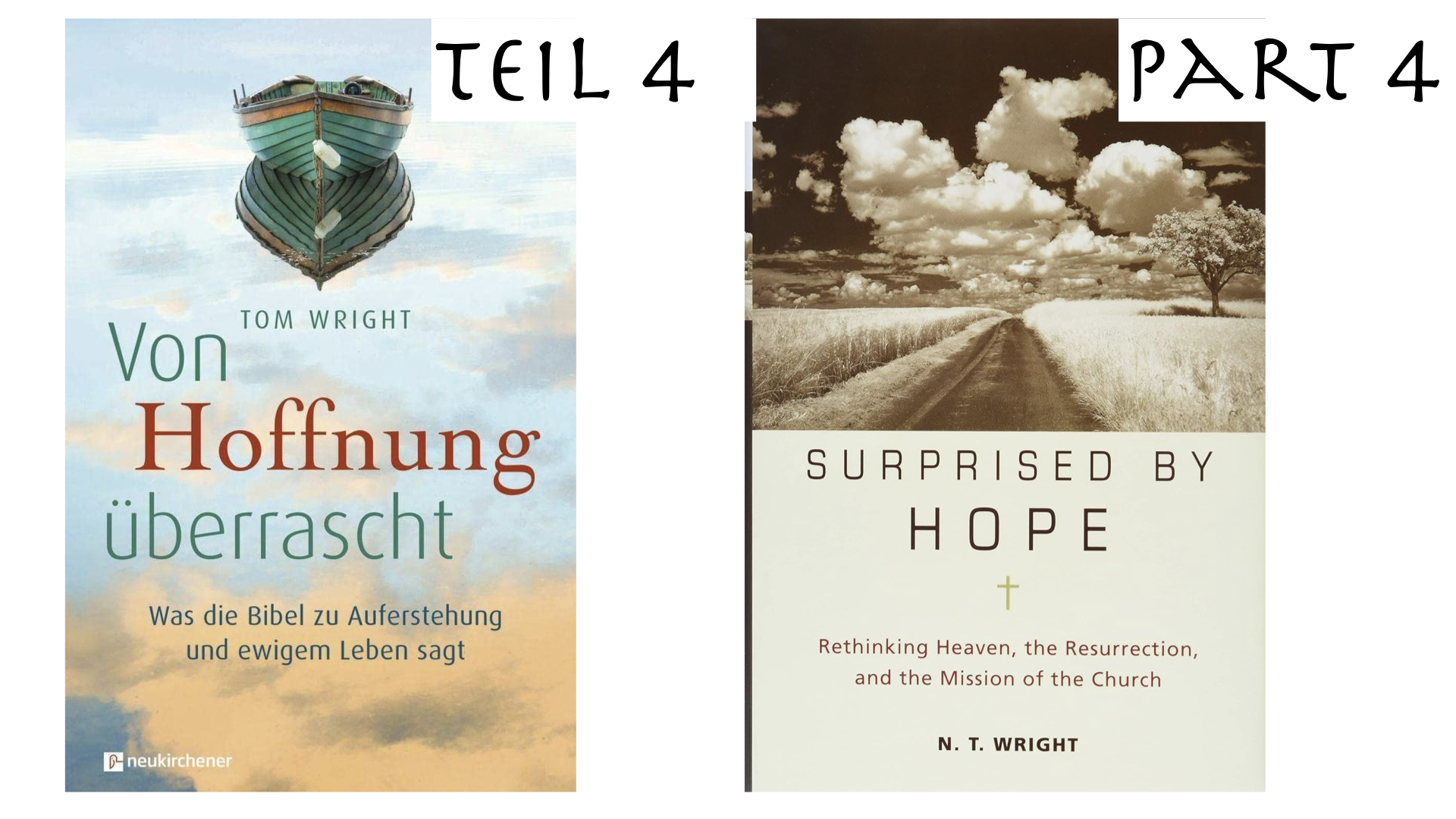
By Christian / Tom Wright
This series takes up the main ideas from the book by Bible scholar N. T. Wright Surprised by Hope: Rethinking Heaven, the Resurrection, and the Mission of the Church (German Von Hoffnung überrascht – Was die Bibel zu Auferstehung und ewigem Leben sagt).


I read the book in the German translation. So the quotes are from the German translation and retranslated into English. The quotes will therefore differ from the English original.
The strange story of Easter
As announced at the end of the previous part we will only briefly look at why we can believe the reports in the Gospels about the resurrection of Jesus.
On the one hand, N. T. Wright argues that discrepancies on the surface do not mean that nothing happened. Just as discrepant testimonies do not. He also explains four features of these narratives that are so extraordinary that they urge us to take them seriously as very early accounts, not as later inventions, as is often claimed.
1. The Bible is hardly quoted at this point
Until the resurrection, „all four evangelists rely heavily on biblical quotations, allusions and echoes to make it clear that Jesus‘ death is „scriptural“. … Even though these stories were written down much later, they go back to very, very early oral traditions that were shaped and moulded in the memories of various storytellers before there was time for biblical reflection.“
2. Women as the first witnesses
Women were not regarded as credible witnesses in ancient times. Later, unfortunately, women were also dropped from Christian writings and church life – but they appear in all four gospels and are at the centre of everything. So why would anyone invent this of all things?
3. The portrayal of Jesus
If a Messiah had been invented to fit the existing scriptures, he would have been portrayed differently. The resurrected Jesus should have been a shining star – but „the resurrected Jesus is portrayed as a human being with a body that is in some ways quite normal and could be mistaken for a gardener or a fellow traveller on the road. Yet the stories also contain clear indications that this body has been transformed. … This kind of account has no antecedent.“
4. The resurrection accounts never contain the Christian hope for the future
Almost everywhere else in the New Testament the resurrection of Jesus is mentioned in connection with the ultimate hope that those who belong to Jesus will one day be raised as he was raised, and it is added that this must be anticipated in the present in baptism and behaviour.“
Each gospel has its own theological interests. You could compare it to four artists portraying the same person. With different accents, but the person is recognisable as the same.
But the accounts of the resurrection have a common „meaning related to the present age: Jesus is risen, so he is the Messiah and therefore the true Lord of the world; Jesus is risen, so God’s new creation has begun – and we, his followers, have a job to do!“
But what is ‚God’s new creation‘ and what job do we have to do?
Part II God’s plan for the future
The future of the cosmos: progress or despair?
Doesn’t everyone realise what the future of the cosmos consists of? This is not an astrophysical question. It’s about what God intends to do with his creation. And our cultural context could stand in our way.
Over the last two hundred years, Western thought has overemphasised the individual at the expense of the bigger picture of God’s creation. What’s more, in much of Western piety, at least since the Middle Ages, the influence of Greek philosophy has been very pronounced. This led to an expectation of the future that bears much more resemblance to Plato’s vision of souls entering an incorporeal bliss than to the biblical image of the new heaven and the new earth.
N. T. Wright, Von Hoffnung überrascht, S. 108
This has given rise to two major movements:
- The myth of progress
Originating in the Renaissance and fuelled by the European Enlightenment, there is the utopian dream that there will always be more progress and that the world will always be better. In addition to the social gospel, there were also other Christian movements whose aim was to make the world better and better until God was satisfied. The real problem with the myth of progress, however, is that it cannot cope with the existence of evil.
„The optimist, the evolutionist, the school of the myth of progress all say that these are just the growing pains of something bigger and better.“ - Souls in transit
The Platonist, the Hindu, the Muslim and, following Plato, the Gnostic, the Manicheans and countless other variants within the Christian and Jewish traditions all say that these are signs that we were created for something completely different, for a world that is not made of space, time and matter, a world of pure spiritual existence in which we happily leave the shackles of mortality behind us once and for all.
„This Platonic trait entered Christian thought very early on, not least with the phenomenon known as Gnosticism.“
What the whole world is waiting for
The early Christians did not believe any of this. „Since most people who think about these things today lean toward one or the other of these views, it is something of a surprise when they discover that the early Christians held a rather different view. They believed that God would do for the whole cosmos what he had done for Jesus at Easter.“ What on earth does that mean? We will now work through this step by step.
Basic structures of hope
The hope of the oldest Christianity known to us is characterised by some basic structures.
Firstly, the disciples were convinced of the goodness of creation. At no point was a cosmological dualism accepted, i.e. a separation into a created world, which is not really good and is not given by God, and a good spiritual world. „The world is good as creation, not as independent or self-sufficient „nature“. There is no evidence of pantheism or panentheism.“ Then N. T. Wright makes a point that we will look at in more detail in another video series:
At the climax of creation, which according to Genesis 1 consists of the creation of human beings, creation was intended to reflect God, to reflect God back to God in worship and to reflect Him into the rest of creation. The latter is to happen in man’s stewardship of creation.
N. T. Wright, Von Hoffnung überrascht, S. 122
Secondly, there was a certain conception of the nature of evil. „Evil is real and powerful within a biblical theology, but it exists neither in creatureliness nor in otherness to God. … Nor does evil consist – this is decisive! – in transience, in decay. … Transience functions as a sign given by God that does not point away from the material world to a non-material world, but from a world as it is to a world as it shall be one day – in other words: it points from the present to the future that God has prepared.“
What counts is eschatological dualism (the present age and the age to come), not ontological dualism (an evil „earth“ and a good „heaven“).
N. T. Wright, Von Hoffnung überrascht, S. 123
Thirdly, the hope contained an idea of God’s plan of redemption.
Redemption does not mean a „scrapping“ of what is present in order to start anew, liberated from all that, but rather liberation of what has become enslaved. If evil is now understood not as materialism but as rebellion, the enslavement of people and the world does not consist in embodiment. Redemption from embodiment would mean: Death of the body and the subsequent release of the soul or spirit. However, the enslavement is rather in sin. Redemption from sin must ultimately include not only the goodness of the soul or spirit, but also a new physical life.
N. T. Wright, Von Hoffnung überrascht, S. 123, 124
Jesus played a central dual role for his disciples, which can be found in lyrical form in Colossians 1:15-20. This is a revealing passage, but it would go too far to discuss it here. What we should note, however, is that „redemption is the new creation of creation, after the evil that disfigured and deformed creation has been reckoned with. And it is brought about by the same God who is now recognised in Jesus Christ, through whom creation was created in the first place.“
N. T. Wright breaks down the basic structure and cosmic dimensions of Christian hope into six themes:
Sowing and harvesting
In 1 Corinthians 15, Paul uses the image of the firstfruits. Jesus is the first to be resurrected from the dead. The first fruits are about the fact that there will be many more fruits.
The victorious battle
In 1 Corinthians, Paul continues with a completely different image that has many biblical antecedents: the image of the king who establishes his kingdom by subduing all enemies. „Paul is clearly articulating a theology of the new creation“. „The gospel of Jesus Christ proclaims that what God did for Christ at Easter, he will do not only for all who are „in Christ“, but also for the entire cosmos. It will be an act of re-creation, parallel to and derived from the act of re-creation when God raised Jesus from the dead.“ And this brings something that has already been said into view: „Jesus was raised bodily from the dead, contrary to the view that says that after his death he began to exist in a new, non-corporeal mode. … If Jesus had passed into some kind of immaterial existence after his death, then death would not be defeated. He would remain intact; he would only be described anew. … But that is precisely what Paul denies. Death as we know it is the last enemy, it is not a good part of the good creation; and therefore death must be defeated if the life-turning God is to be honoured as the true Lord of the world. When this is done, and only then, will Jesus, the Messiah, the Lord of the world, hand over the rule of the kingdom to his Father, and God will be all in all.“
Citizens of heaven on earth
Another royal image is found in Philippians 3:20,21, which is important for our hope because it uses a term that leads many to think that they are going to heaven. Once again, it is important to keep the historical context in mind: „Philippi was a Roman colony. Augustus had settled his veterans from the battles of Philippi (42 BC) and Actium (31 BC) there. Even if not everyone had it, everyone knew what Roman citizenship meant. It was Roman citizenship, but they did not live in Rome. Augustus had given it to them so that they would stay in Philippi.
„So when Paul says: „We are citizens of heaven“, he does not mean that we go to heaven to live there after we have lived this life. What he means is this: The Saviour, the Lord, Jesus, the King – all of which were of course imperial titles – will come from heaven to earth to change the present situation and condition of his people. The key word here is transformation: „He will transform our present humble bodies so that they will become his glorious body.“
N. T. Wright, Von Hoffnung überrascht, S. 128, 129
Jesus will transform the present human body.
God will be all in all
In 1 Corinthians 15:28 we find one of the clearest statements about the absolute centre of the future-oriented New Testament worldview: God will „be all in all“ as the goal of all history. „God ultimately intends to fill all creation with his own presence and love.“
The world was created good, but incomplete. One day, when the forces of rebellion are defeated and creation responds freely and joyfully to the love of its Creator, the Creator will fill creation with Himself so that it remains both an independent being, other than God, and suffused with God’s own life.
N. T. Wright, Von Hoffnung überrascht, S. 131
A new birth
In Romans chapter 8, Paul takes up another image: The image of the new birth. Creation is in a state of slavery, like the children of Israel in Egypt (Romans 8:21). „God’s plan was to govern creation with life-giving wisdom through his images, the human creatures. However, this was always a promise of the future. …. Meanwhile, creation was subject to corruption and decay.“ How does creation emerge from this state? In Romans 8:22, Paul uses the image of a new birth for the whole cosmos itself.
The wedding of heaven and earth
Finally, Revelation 21 and 22 use the image of a wedding: „The New Jerusalem comes down from heaven like a bride who has adorned herself for her bridegroom. We immediately realise how different this image is from all the supposedly Christian scenarios that end with the Christian going to heaven as a soul, naked and unadorned, to meet his Creator with fear and trembling.“
„The end of Revelation describes the final answer to the Lord’s Prayer, that God’s kingdom will come and his will be done on earth as it is in heaven. Paul also talks about this in Ephesians 1:10: God’s plan and promise was to bring all things together in Christ, both heavenly and earthly things.“
Here we have a sign of the future task that ultimately awaits the redeemed in God’s new world. Far from the often popular idea of sitting on clouds and playing the harp, the redeemed people of God in the new world will be the mediators of God’s love, which will flow out in new ways to fulfil new creative tasks in order to celebrate and spread the glory of his love.
N. T. Wright, Von Hoffnung überrascht, S. 134
Conclusion
Why are all these images and metaphors used in the New Testament? Because we can only form a certain idea with their help. „What we can say about the future is like a series of signs pointing into a bright mist. We have no photograph of what we will find when we arrive.“
In the next part of this servies we look at some of these ’signs‘ that we find in the Bible.
Du muss angemeldet sein, um einen Kommentar zu veröffentlichen.