
By Christian
In the first part, we saw how the view of Judaism in the 1st century has changed since around 1977. This has anything but minor consequences when it comes to the interpretation of Jesus‘ or Paul’s statements in the New Testament:
If, in fact, Jewish theology of the first century was not particularly legalistic, we’re going to have to re-read these and other central passages, and possibly re-envision the Christian understanding of salvation.
Chapter 2
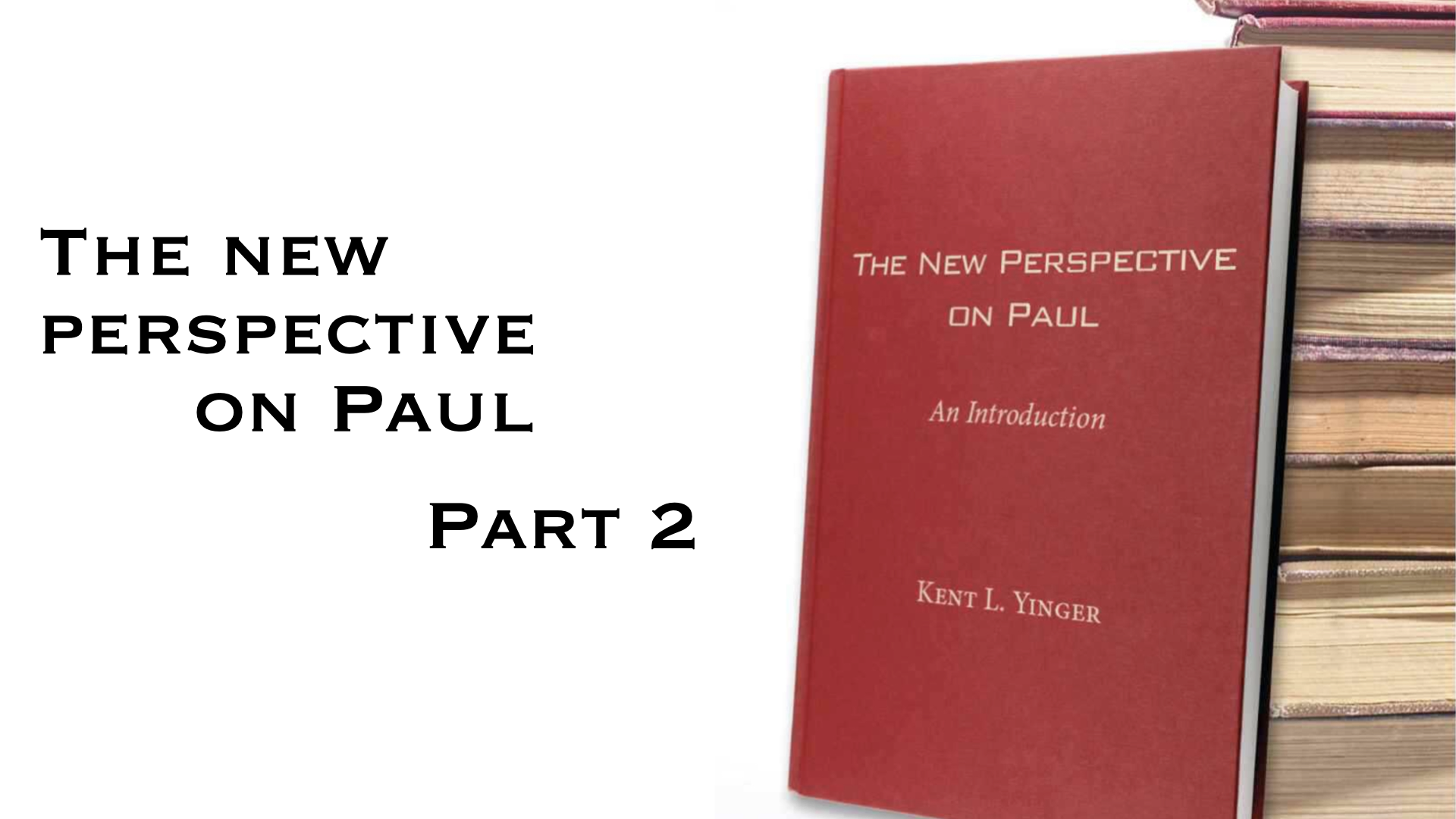
Before we go into the details of the justification, however, we will first look at the positive effects as mentioned. [The quotes are from the book „The New Perspective on Paul – An Introduction“ by Prof. Kent L. Yinger, which forms the basis for this series]
Chapter 8: Let’s Hear It for the NPP
Better grasp on Paul’s letters
Yinger describes one major advantage as follows:
Was Paul nervous about legalism, about self-righteous good works, when he said “not by works of law but by faith in Jesus Christ” (Gal 2:16)? Or, with the NPP, was his concern primarily with whether Gentiles had to become Jewish? And when he then praises the doing of good works—“if you sow to the Spirit, you will reap eternal life from the Spirit. So let us not grow weary in doing what is right, for we will reap at harvest time” (Gal 6:8–9)—we do not have to switch gears, but can see Paul’s love of good works running consistently through all he says.
Chapter 8
Avoiding western individualism
This is another aspect:
A New Perspective reading of Paul’s letters can also help reduce the Western overemphasis on the individual. The gospel is no longer all about my salvation; instead, it is about a new creation (2 Cor 5:17) and a new people. Romans 7 need no longer be primarily about my personal struggle with Sin, but about Law and Sin in Israel’s (or Adam’s) history. Of course, this doesn’t have to eliminate “me” from the picture altogether. It just moves me out of the center.
Chapter 8
Goodbye to anti-semitism?
Unfortunately, the history of the Christian churches has also been characterized by anti-Semitic traits from the very beginning. One of the reasons is eliminated by the new view:
Rather than speaking of inferior Jewish legalism, covenantal nomism sounds a more positive note toward Christianity’s mother-religion. Rather than a failed or wrong-headed pattern of religion, Judaism and Christianity turn out to have most of their pattern in common.
Chapter 8
However, one significant difference remains:
For some NPP proponents this means the complete rejection of supersessionism: that is, the church does not replace Israel in God’s plan for humanity; Israel and the church are now on equal footing before God (with or without Jesus Christ). For others, like myself, Israel is reconfigured (rather than replaced) to include both Jew and Gentile in the Israel reconstituted in Messiah Jesus; but it is still paramount that one be part of this Israel, children of Abraham. To non-Christian Jews this will probably still sound like the old supersessionism, since Israel as they understand her is no longer adequate. But the “no longer adequate” is built not upon some inherent flaw in Israel’s religion, as with most earlier versions of supersessionism, but upon a Christian conviction that God has begun a new era in Israel’s history with Jesus Christ.
Chapter 8
Moving from Old to New Testament made easier
The new view of Paul also results in a much greater continuity in the transition from the Old to the New Testament.
Paul’s message is not the antithesis of Judaism (or of the OT Law) but is a christologically reconfigured continuation or climax of the same.
Chapter 8
And so Christians can read the Old Testament much more naturally. We can best recognize this with an example: Psalm 18
A Psalm of David, the servant of the LORD, [a]who spoke to the LORD the words of this song on the day that the LORD rescued him from the hand of all his enemies and from the hand of Saul. And he said,
Psalm 18:1-3 NASB
“I love You, LORD, my strength.” The LORD is my rock and my fortress and my savior, My God, my rock, in whom I take refuge; My shield and the horn of my salvation, my stronghold. I call upon the LORD, who is worthy to be praised, And I am saved from my enemies.
Christians can also repeat this without further ado. But a little later in the same psalm it becomes difficult if we have a traditional view:
The LORD has rewarded me according to my righteousness; According to the cleanness of my hands He has repaid me. For I have kept the ways of the LORD, And have not acted wickedly against my God. For all His judgments were before me, And I did not put away His statutes from me. I was also [h]blameless with Him, And I kept myself from my wrongdoing. Therefore the LORD has repaid me according to my righteousness, According to the cleanness of my hands in His eyes.
Psalm 18:20-24 NASB
David is clearly talking here about deeds and that God therefore regarded him as pure and justified. This is not exactly the idea of Luther and Protestantism – if you read this passage with the traditional interpretation:
Traditionally, Christian interpreters have winced at the seeming self-righteousness of this passage, or have re-interpreted “my righteousness” as the imputed righteousness of Christ.
Chapter 8
With the new view of Paul, however, a completely different picture emerges for us:
The righteousness and blamelessness in the psalm refer not to some sort of self-righteous perfection, but to the integrity of faithful conduct expected everywhere in the Bible, including the New Testament. It is the loyalty (= faith or faithfulness) inspired by God’s grace, and speaks of those who are “loyal” and who “take refuge in him” (vv. 25, 30).1 The psalmist is simply saying, “I have not turned my back on you, Lord, but have sought to walk in your ways. Please deal with me according to the gracious promises of your covenant.”
Chapter 8
Paul and Jesus on the same page
Christians who check their doctrines against the New Testament will find that they will quite often quote texts from Paul, but will not find the same idea in the Gospels themselves – i.e. directly in Jesus‘ words. In fact, the difference goes even further if you read Paul according to the Protestant tradition:
There has been much talk of Paul founding a new religion, Christianity, which replaced the simple Galilean Jewish message of Jesus. As some put the matter, Jesus sought the renewal, or reform, of Judaism; Paul abandoned that aim and sought the creation of a world religion encompassing Gentiles. Jesus preached the imminent kingdom of God; Paul preached Jesus—the proclaimer became the proclaimed. For Jesus every “jot and tittle” was important (Matt 5:18), while Paul felt the Law had come to an end (Rom 10:4). Jesus called people to rigorous discipleship if they would enter God’s kingdom; Paul called them to simple faith. You get the drift.
Chapter 8
While the new view of Paul is not necessarily the only way to explain this difference, it does give us tools to resolve it:
Instead of viewing Pauline grace in competition with gospel discipleship, covenental nomism shows them forming a harmonious pattern in both Jesus and Paul (and Judaism) Both held the foundational importance of grace. The laborers in the vineyard (Matt 20:1–16) do not receive their pay according the number of hours worked, but according to divine generosity. Jesus’s healings were vivid demonstrations that God’s favor was being showered upon the seemingly unworthy. Paul’s commitment to grace needs no further comment.
But alongside this stress on grace came an emphasis on the necessity of obedience. In Jesus’s judgment parable (Matt 25:31–46) the destiny of the sheep and goats—eternal punishment or eternal life—is based upon their obedience to Jesus’s way: feeding the hungry, visiting prisoners, etc. And Paul is still convinced that God “will repay according to each one’s deeds: to those who by patiently doing good seek for glory and honor and immortality, he will give eternal life” (Rom 2:6–7).
When “works” are thought of negatively—meritorious or self-righteous good works—reconciling this dual emphasis on grace and obedience proves more difficult. Covenantal nomism suggests that these two focal points cohered in Judaism as well as in Jesus and Paul. The gospel that Paul preached turns out to follow the same pattern as that of Jesus.
Another point of continuity between Paul and Jesus suggested by the NPP concerns the saving significance of membership in the nation of Israel. In much Reformational exegesis Romans 9–11 (What about Israel’s Election?) seemed an odd fit with Paul’s exploration of individual justification by grace through faith (chs. 1–8). The NPP suggests that questions about covenant membership are, in fact, the driving force behind Paul’s gospel discussions (especially in Romans and Galatians). Does one have to be, or to become, Jewish, perform the “works of the law,” in order to be in Christ? This is, then, reminiscent of Jesus’s consistent message that Jewish identity is no safeguard from the coming wrath. His first sermon in Luke’s Gospel almost led to his demise because he taught that God would give no preferential treatment to the descendants of Abraham (Luke 4:25–30). This echoes the preaching of John the Baptist, “Do not begin to say to yourselves, ‘We have Abraham as our ancestor’; for I tell you, God is able from these stones to raise up children to Abraham” (Luke 3:8). Thus, Paul continues one of Jesus’s central themes as central to his own gospel.
Chapter 8
I think these are already a lot of important points to take a closer look at this new view of Paul. And it’s actually not all that new:
These debates are largely an attempt to get back to this Old Perspective, that is, to Paul’s own perspective on God, Christ, the Law, faith, etc. Supporters of the NPP usually consider their position not really “new,” but a recovery of that older, truly Pauline understanding.
Chapter 8