
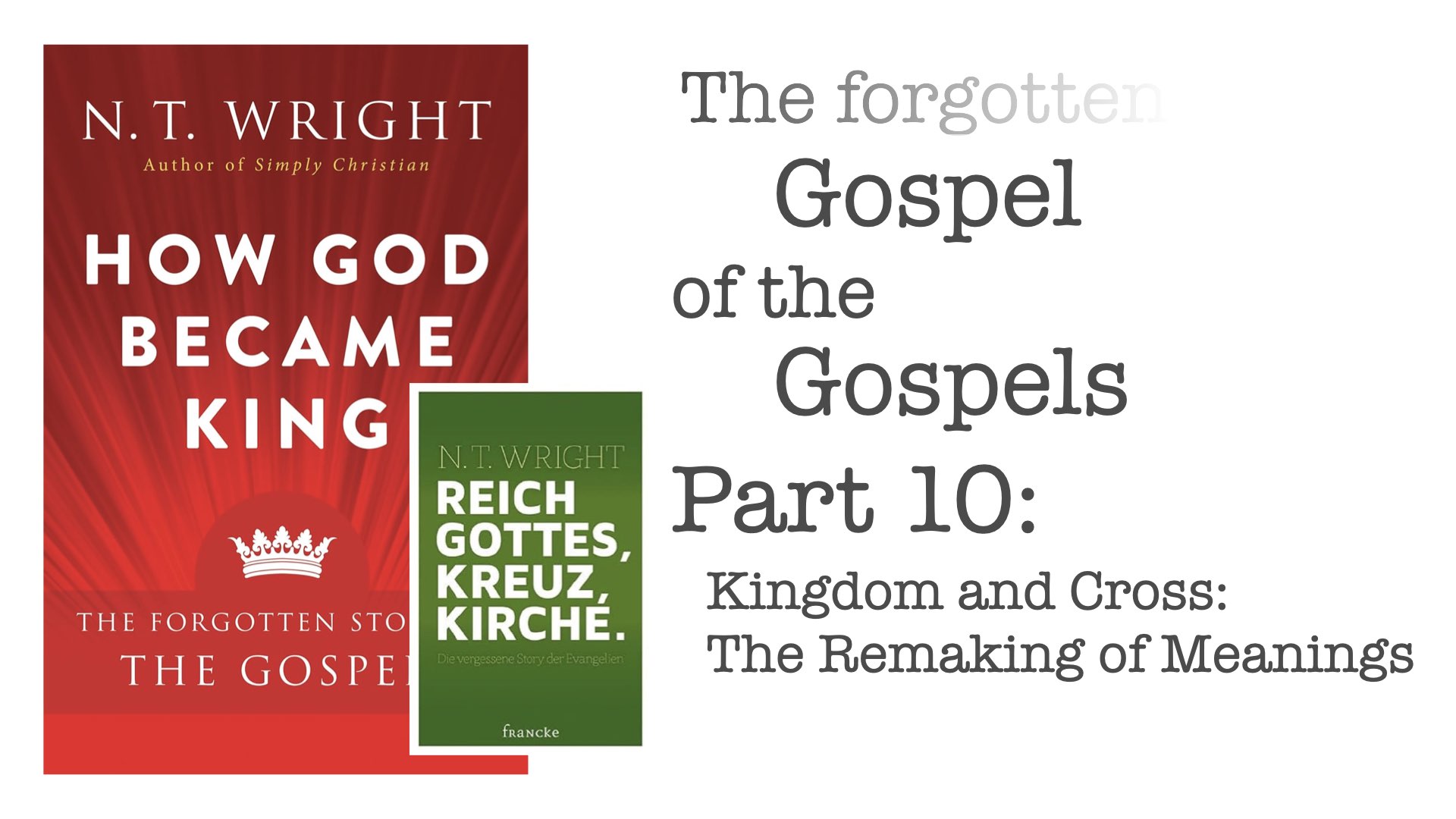
By Christian / N. T. Wright
In the tenth chapter of N.T. Wright’s book How God Became King: The Forgotten Story of the Gospels, he explains why the kingdom and the cross are not as unrelated topics as we might think. I would like to quote his introduction to the chapter directly:
We noted In part I of this book the way in which we have been conditioned to read the gospels as though the themes of the kingdom and the cross could be held at arm’s length from one another. As we have seen, one very popular understanding of the story the gospels tell is that Jesus’s public career began with a time of happy, early fulfillment, when every-thing seemed to be going well, but that it then turned a dark corner and ran into opposition, unpopularity, and finally arrest, trial, torture, and death. As I have tried to explain, this splitting apart of the story in the four gospels has come about because the story the writers actually tell simply didn’t fit the categories that centuries of readers, including some very devout ones, were bringing with them. But we should be in no doubt that, for the gospel writers themselves, there was never a kingdom message without a cross, and Jesus’s crucifixion never carried a meaning divorced from the launching of God’s kingdom. Our task now, having worked our way back into the gospels by means of adjusting the volume on the four crucial speakers, is to offer a positive statement of what happens when we treat kingdom and cross not as two themes, but essentially as one. We begin with two scenes that more or less bookend the whole presentation in each of the gospels: Jesus’s baptism and the „title“ on the cross. In each — and each is decisive as a marker for the writers’ meaning – we see exactly the combination of kingdom and cross that has proved so elusive in the history of interpretation.
N.T. Wright How God Became King, chapter 10
The tenth chapter is quite long – about 15% of the book! Therefore, I will only quote some of the main points and the argumentation leading to these statements will not be mentioned or only very briefly. Since the book is also available in German translation, I would like to refer to this.
Baptism and Kingdom.
The description of the baptism of Jesus in John 1 links these two themes:
Jesus has not come simply as a „superman“ figure, a „divine hero“ parachuted into the world to sort out the mess. He has come – and the gospel story only makes sense if we take this very seriously – as the one who will embody Israel’s ultimate vocation in himself.
The title „son of God“ expresses both halves of this complex and delicately balanced picture.
The heavenly announcement that Jesus is „my son, my beloved one,“ the one with whom God is delighted ,indicates for those with biblically attuned ears that Jesus is marked out as the king of Psalm 2 and the servant of Isaiah 42:
N.T. Wright How God Became King, chapter 10
This reference to Psalm 2 and Isaiah 42 does not allow us to ignore the kingdom theme, since it features so prominently in it.
All the signs are, rather, that the aim of incarnation and cross is precisely to establish God’s kingdom; that, after all, is what Jesus begins to say when, not long after his baptism, he begins his public career (Matt. 4:17, and parallels).
In other words, with the echo of the opening words of the first „servant“ poem, the synoptic writers are not inviting their readers merely to contemplate Jesus as the one who dies so that sinners may be forgiven. They are invoking one of the primary scriptural passages in which Israel’s God, YHWH, establishes his sovereignty over the whole world, doing so indeed despite the failure of his own people to believe in him. He will rescue them through the servant’s work, but merely to do that is „too light a thing.“ He will provide, through the servant, „a light to the nations, that [his] salvation may reach to the end of the earth“ (49:6). At the heart of all this is the ultimate good news: „Your God reigns,“ malak elohayik (52:7). He is king, and has demonstrated this by overthrowing the pagan kingdoms and their idols, unveiling his worldwide justice, and inviting all and sundry to turn to him and enjoy the benefits of his renewed covenant and renewed creation (Isa. 54-55).
The baptism narrative, therefore, in all the gospels, is not simply about Jesus’s „divine identity,“ on the one hand, or a particular program of „atonement,“ in the sense of a rescue from the world of creation, on the other. Yes, the gospels affirm Jesus’s divine identity. Yes, they affirm his death on the cross as the climax of God’s age-old plan of salvation. But the purpose of God coming incognito in and as Jesus and the purpose of this Jesus dying on the cross was – so the gospels are telling us – in order to establish God’s kingdom, his justice, on earth as in heaven. As in Psalm 2, the point is that in this way the nations are to be called to account. This is how the creator is bringing his creation back into proper shape.
I think of the Emmaus road story, where the risen Jesus declares that the divine plan always involved the Messiah suffering and then „coming into his glory“ (Luke 24:26). We note that „coming into his glory“ does not mean simply „going to heaven“ in the normal sense; „glory“ is a way of saying „sovereign majesty,“ so that the saying exactly combines the two themes we are looking at. The crucifixion was the appropriate and long-prophesied way by which the Messiah would come to be king of all the world, and Luke’s second volume, the Acts of the Apostles, describes how that works out.
N.T. Wright How God Became King, chapter 10
The “title” on the cross
The Latin word titulus was used to describe the public announcement of the offense for which the executed person had been held responsible. And Pilate had this proclaimed: “Jesus of Nazareth, King of the Jews.”
In John’s gospel, it is repeatedly made clear that Jesus is the “Messiah”. This title is therefore the opposite pole to the realization of Jesus‘ first disciples in chapter 1 of John’s gospel. Of course, this title is also extremely ironic. Pilate knows that Jesus does not conform to any of the meanings of “king” that Pilate knows. He has redefined the meaning of “being king”. John is dealing with a theology of the kingdom here. As Paul writes, the rulers of the world had no idea what they were doing in the crucifixion. (1 Corinthians 2:8)
The point for our present purpose is that, in all four gospels, readers are strongly urged to see Jesus’s death as explicitly „royal,“ explicitly „messianic“ — in other words, explicitly to do with the coming of the „kingdom.“
Jesus, John is saying, is the true king whose kingdom comes in a totally unexpected fashion, folly to the Roman governor and a scandal to the Jewish leaders.
N.T. Wright How God Became King, chapter 10
“You are the Messiah”
A key passage here is Mark 8:27-30, where Peter says these words: “You are the Messiah.”.
This functions as the midpoint in Mark, looking back to the voice at the baptism and forward to the paradoxical question of Caiaphas at the trial („Are you the Messiah, the Son of the Blessed One?“ 14:61, which is a statement in Greek; it gets turned into a question by the punctuation and presumably the tone of voice) and then the centurion’s statement at the foot of the cross („This fellow really was God’s son,“ 15:39).
The Messiah is to come into his kingdom through a horrible death; and those who not only follow him, but are called to implement his work must expect that their royal task – for such it is– will be accomplished in the same way, by the same means. There is every sign that the earliest church understood this very well indeed, just as there is every sign (alas) that today’s church does not — except, of course, in those parts of the world, like China and the Sudan, where there has been no choice.
N.T. Wright How God Became King, chapter 10
Peter’s words, “You are the Messiah,” therefore mean, “You are Israel’s Messiah,” as Paul confirms in Romans 8:3-4 and Galatians 4:4-7.
What the four gospels are eager to tell us, then, is that the messianic kingdom that Jesus is bringing will come through his suffering and indeed through the suffering of his followers. But it is Jesus’s own suffering in particular, gradually revealed as unique and uniquely effective, that is highlighted as the gospel narratives proceed. The key text of Mark 9:1 and parallels, so often read as an unfulfilled prediction of an imminent „second coming“ or even of the „end of the world,“ was never intended that way by the evangelists or, I believe, their sources or earlier traditions. Coming at the conclusion of Jesus’s prediction of suffering for himself and his followers, this is what the text says:
N.T. Wright How God Became King, chapter 10
„I’m telling you the truth,“ Jesus said; „some people standing here won’t experience death before they see God’s kingdom come in power.“
Mark 9:1
But doesn’t the parallel text in Matthew 16:28 seem to say something different?
„Some of those standing here will not taste death until they see ‚the son of man coming in his kingdom.’“
Matthew 16:28
But this understanding is itself based on an assumption that, however commonplace, is deeply misguided, namely, that „the coming of the son of man“ in the New Testament refers to the „coming“ to earth of one presently in heaven.
In Daniel, „one like a son of man,“ in other words, „a human figure,“ „comes“ from earth to heaven to be presented before the „Ancient of Days.“ It is a move from suffering and humiliation to enthronement and sovereignty.
N.T. Wright How God Became King, chapter 10
Matthew does not think that the words of Matthew 16:28 refer to a time far in the future, but to Jesus‘ death and resurrection, which Jesus referred to only a few verses before. Mark adds “in power” in 9:1 and Luke speaks of “God’s Kingdom” in 9:27.
These parallel verses, in the intention of all three evangelists, are best read as indicating a kingdom fulfillment that they, the authors of the gospels in question, believe had already come to pass in the death and resurrection of Jesus.
They believed this, of course, because of Jesus’s resurrection – just as it was disbelief in the bodily resurrection that made scholars from Reimarus to Bultmann and beyond assume that there must still be some great coming event to which the evangelists were referring. Such scholars have normally supposed this great coming event to be the Parousia. The word parousia is a Greek term meaning „royal presence“ or „divine appearing,“ or perhaps both. It has become the regular technical term used by New Testament scholars to refer to Jesus’s „second coming“ and its supposed attendant phenomena, which, they maintain, the early church believed to be „imminent.“ Early Christians thought, say these scholars, that the Parousia would be the final kingdom-bringing moment. That scholarly mistake has fused with the dispensationalism of popular (mostly American) subculture and speculation to give the present state of confusion about the „end-times“ that is so prominent a feature of today’s American church life.
N.T. Wright How God Became King, chapter 10
Narrating the cross
It has often been assumed that the four evangelists, in recounting the events that led to Jesus’s crucifixion, are doing so with minimal intention to offer theological interpretation of those events. To take a step back once more, when people write about „atonement theology,“ the tendency has been to go to Paul and Hebrews and to come to the gospels only for those detached phrases that will support (or so it seems) the kind of „theological“ construct that has already been culled from Paul. The actual narratives of Jesus’s arrest, trial, and crucifixion have, to be sure, been combed for hints of „meaning,“ and this has been found not least in the use of the Old Testament, of passages like Psalm 22:1.
The trials, in other words, address the theological and soteriological „why“ of the cross, not only the „how.“
N.T. Wright How God Became King, chapter 10
The great scene in John with Jesus and Pilate gives us the reasons for the cross, and these are kingdom reasons. However, N.T. Wright also points out a common misunderstanding here:
Jesus once again takes the initiative in the conversation, introducing the discussion of different types of „kingdoms.“ „My kingdom isn’t the sort that grows in this world,“ he says (18:36). (We note here that the regular translation, „My kingdom is not of this world,“ has contributed to, and in its turn also generated, multiple misreadings of all four gospels, appearing to suggest that Jesus’s „kingdom“ is straightforwardly „otherworldly.“ The Greek for „of this world“ is ek tou kosmou toutou; the ek, meaning „out of“ or „from,“ is the crucial word.) There is no question but that Jesus is speaking of a „kingdom“ in and for this world.
N.T. Wright How God Became King, chapter 10
And so Jesus emphasizes that this is exactly what must happen when God’s kingdom successfully paves its way – not with violence but nonviolently. “And in the broader Johannine perspective, we discover that the only word that does justice to this combination of kingdom and cross is agape, ‘love’.”
I will omit the analysis of John 19 for once and just give his summary:
Gradually, inch by inch, in a narrative heavy with ironic kingdom theology, we discover the theological „why“ of the cross within the historical „how.“ As we should have realized all along, the „lifting up“ of Jesus on the cross is his exaltation as the kingdom-bringing „king of the Jews,“ because the kingdom that ist hus put into effect is the victory of God’s love. Kingdom and cross fully joined.
The famous tetelestai in 19:30 („It’s all done!“) matches the synetelesen in Genesis 2:2 („God finished the work that he had done“)
The cross serves the goal of the kingdom, just as the kingdom is accomplished by Jesus’s victory on the cross.
N.T. Wright How God Became King, chapter 10
Temple, Kingdom and Cross
It is difficult for us to grasp the central importance of a temple and especially of the temple in Jerusalem for devout Jews. If we think of it like a modern religious building – for example, a cathedral or a mosque – then we are quite off base. It is now widely recognized that in ancient times there was no separation of ‚religion‘ and other things such as ‚politics‘, ‚culture‘ or ‚economics‘.
It would have made no sense in Judaism in particular. Not only was the Temple the center of the whole national life. It was, Jews believed (as many ancient peoples believed about their temples) the place where heaven and earth themselves interconnected and overlapped.
„Heaven,“ after all, was seen as the throne room, the place from which „earth“ would be ruled. But if „heaven“ came to be linked with a particular point on“earth,“ then that point was where power was concentrated. Divine power. Theocracy. The kingdom of God.
And the gospels tell the story of Jesus as the story of a one-man walking temple. Early on in the story we find the hints. „Who then is this?“ people ask as Jesus does remarkable things, speaks and acts with authority, behaving as if he is the one who’s now in charge. Jesus is portrayed by the gospels as a one-man apocalypse, the place where heaven and earth meet, the place where and the means by which people come and find themselves renewed and restored as the people of the one God, the place where power is redefined, turned upside down or perhaps the right way up.
The evangelists are in no doubt: Jesus is the reality, the place where Israel’s God now dwells, the human being in and through whom the one who called Abraham and uttered his voice from Sinai had now returned to judge and to save. Jesus is the reality, and the present Temple and its official spokesmen must give way before him. It is no accident, from the evangelists‘ point of view, that when Jesus finally breathes his last, the veil of the Temple is torn in two from top to bottom (Mark 15:38).
For a genuinely Jewish vision of theocracy, you need God in the midst of it. But what the gospels offer us — especially John, but actually all of them — is a God who is in the midst in and as Jesus the Messiah, and a God who is then committed to remaining in the midst, through Jesus, in the person of the Spirit. Jesus himself is the new Temple at the heart of the new creation, against that day when the whole earth shall be filled with the glory of God as the waters cover the sea.
It is much, much more. It is the moment when the story of Israel reaches its climax; the moment when, at last, the watchmen on Jerusalem’s walls see their God coming in his kingdom; the moment when the people of God are renewed so as to be, at last, the royal priesthood who will take over the world not with the love of power but with the power of love; the moment when the kingdom of God overcomes the kingdoms of the world. It is the moment when a great old door, locked and barred since our first disobedience, swings open suddenly to reveal not just the garden, opened once more to our delight, but the coming city, the garden city that God had always planned and is now inviting us to go through the door and build with him. The dark power that stood in the way of this kingdom vision has been defeated, overthrown, rendered null and void. Its legions will still make a lot of noise and cause a lot of grief, but the ultimate victory is now assured. This is the vision the evangelists offer us as they bring together the kingdom and the cross.
N.T. Wright How God Became King, chapter 10
Kingdom and cross in mutual interpretation
Once you realize that the kingdom and the cross are linked in the Gospels, it is possible to look at one from the perspective of the other. N.T. Wright offers three reflections on this. First, the kingdom from the perspective of the cross:
First, the evangelists insist that the kingdom truly was inaugurated by Jesus in his active public career, during the time between his baptism and the cross. That entire narrative is the story of „how God became king in and through Jesus.“
Second, this kingdom is radically defined in relation to Jesus’s entire agenda of suffering, leading to the cross.
Third, the kingdom that Jesus inaugurated, that is implemented through his cross, is emphatically for this world.
N.T. Wright How God Became King, chapter 10
“What, in other words, do we learn about the cross when we discover that the gospels present it as the means by which God (in Jesus) becomes king of the world?”
First, the way we have normally listed options in atonement theology simply won’t do. Our questions have been wrongly put, because they haven’t been about the kingdom. They haven’t been about God’s sovereign, saving rule coming on earth as in heaven. Instead, our questions have been about a „salvation“ that rescues people from the world, instead of for the world. „Going to heaven“ has been the object (ever since the Middle Ages at least, in the Western church); „sin“ is what stops us from getting there; so the cross must deal with sin, so that we can leave this world and go to the much better one in the sky, or in „eternity,“ or wherever. But this is simply untrue to the story the gospels are telling – which, again, explains why we’ve all misread these wonderful texts. … But the idea of messianic victory as a fresh interpretation of an ancient Jewish theme is precisely what the four gospels have in mind.
Second, however, when we see the cross in the light of the kingdom, we discover a fresh and helpful framework for understanding the vexed questions that surround substitutionary atonement. … As for the gospels themselves, there should be no doubt that they follow this line. Jesus, for them, is dying apenal death in place of the guilty, of guilty Israel, of guilty humankind. Through his death, the evangelists are telling their readers there will come the jubilee event, the great redemption, freedom from debts of every kind, which he had earlier announced and which is the central characteristic of the kingdom.
Third, if the cross is to be interpreted as the coming of the kingdom on earth as in heaven, centering on some kind of messianic victory, with some kind of substitution at its heart, making sense through some kind of representation, then the four gospels leave us with the primary application of the cross not in abstract preaching about „how to have your sins forgiven“ or „how to go to heaven,“ but in an agenda in which the forgiven people are put to work, addressing the evils of the world in the light of the victory of Calvary.
N.T. Wright How God Became King, chapter 10
Kingdom, Cross, Resurrection and Ascension
In addition to the kingdom and the cross, we also find the resurrection and the ascension in the gospels. Regarding the resurrection, N.T. Wright has written in more detail about this in his book Suprised by Hope, and I had published a series on it. In this context, the resurrection is important, of course, because without it the evangelists would not have had a story to tell. After all, thousands of other young Jews were crucified at the same time. The evangelists highlight several different aspects:
The resurrection is, from Mark’s point of view, the moment when God’s kingdom „comes in power.“ From John’s point of view, it is the launching of the new creation, the new Genesis. From Matthew’s point of view, it brings Jesus into the position for which he was always destined, that of the world’s rightful Lord, sending out his followers (as a new Roman emperor might send out his emissaries, but with methods that match the message) to call the world to follow him and learn his way of being human. From Luke’s point of view, the resurrection is the moment when Israel’s Messiah „comes into his glory,“ so that „repentance for the forgiveness of sins“ can now be announced to all the world as the way of life, indeed, as they say in Acts, as The Way.
N.T. Wright How God Became King, chapter 10
In fact, the resurrection has further consequences.
Heaven and earth are now joined in the person — in the risen body! – of Jesus himself
He therefore sends out his followers, equipped by his own Spirit (if the ascension locates a part of „earth“ in „heaven,“ Pentecost sends the breath of heaven to earth), to celebrate his sovereignty over the world and make it a reality through the founding of communities rescued by his love, renewed by his power, and loyal to his name.
When, therefore, at the start of Acts, the disciples ask Jesus whether this is the time for him to „restore the kingdom to Israel“ (1:6), his answer is not (as people often suppose) a „no.“ It is a „yes.“ As so often, however, it is a „yes but“:
And that „witness,“ as Luke has made abundantly clear, is not a matter of „telling people about your new religious experience“ or of informing them that there is now a new prospect of a much better other-worldly destiny than anything the bleak pagan world had to offer. The „witness“ of Jesus’s followers is the message that there is now „another king, Jesus“ (Acts17:7). It is the witness according to which the temples that presently exist, whether in Jerusalem, Athens, Ephesus, or anywhere else, are now to be seen as at best redundant (Acts 7) and at worst a blasphemous category mistake (Acts 17; 19). Jesus is the true Temple, now ruling the world as the one who was crucified;
N.T. Wright How God Became King, chapter 10
And with that, we have arrived at the end of chapter 10. There were probably some new, unfamiliar thoughts. I have largely omitted the explanations using the text of the New Testament so that this text does not become too long. And it is probably also better to read these in his book and to understand them at your leisure. The main aim here is to convey these new – or actually very old and only new to us – thoughts. A renewed view of the Gospels that can be seen when the traditional explanations, classifications and interpretations are left out and the text of the Gospels is dealt with directly. In the next part, we will see that even the old creeds can be read and understood again in accordance with and on the basis of the Gospels.