Schlagwort: Christians

  • The Forgotten Gospel of the Gospels – Part 7: The Clash of Kingdoms

    The Forgotten Gospel of the Gospels – Part 7: The Clash of Kingdoms

    Von Christian / N. T. Wright


    In the seventh chapter of N.T. Wright’s book How God Became King: The Forgotten Story of the Gospels, Wright addresses a topic that is usually not discussed at all, even though the Gospels tell of it:

    The fourth topic is the story of Jesus told as the story of the kingdom of God clashing with the kingdom of Caesar.

    N.T. Wright How God Became King, chapter 7

    God and Caesar

    Before we can talk about this clash between the two kingdoms, it is important to understand that the Bible, the New Testament and even the Gospels themselves clearly state something that even many Christians today no longer believe:

    Caesar. The gospels are very much aware of the dark forces that ultimately owe their origin and strength to the power sometimes called “the satan,” “the accuser.” The gospel writers have plenty to say about those dark forces, that dark power. They are quite clear where the ultimate enemy lies.

    N.T. Wright How God Became King, chapter 7

    We will discuss this in more detail later. For now, we would like to draw your attention to the temptations of Jesus. The devil could not offer Jesus less than all the kingdoms of this world, and Jesus did not dismiss this as a lie (Matthew 4:8-10).

    In this respect, these words of Jesus may have a different meaning than we thought: “Do not be afraid of those who kill only the body but cannot harm the soul. But fear the one who can deliver soul and body to ruin in hell.” (Matthew 10:28; Luke 12:4-5) But soul, body and hell would take us too far away from the topic now.

    When Jews of this period spoke about their history, they always did so with an eye to how their God would liberate them from the domination of the evil and powerful pagan empires – as in the Exodus from Egypt. And when the Old Testament speaks of the God of Israel fighting for his people against other powers, it always does so with an eye to their gods (see also Isaiah 40-55).

    God and the Powers in Jewish Tradition

    The Old Testament wastes no time. Right after the rebellion of the people, in the fourth chapter, it draws our attention to forces at work: Cain’s reaction to being convicted for the murder of his brother is to build a city (Genesis 4:17). This is followed by the description of the rebellion of the “sons of God” (Genesis 6:2) together with the humans, which God has to end with a flood. Then, in chapter 11, the third rebellion is described in Babel, which God fights by confusing the languages.

    In chapter 12, we learn that God calls Abram to do in His grace what people with their arrogant power want to achieve themselves. Before the account of the Exodus, we find in Exodus 1:11 that the ruler of the mighty Egyptian empire forces the Israelites to build something: cities. If you take a closer look at the 10 plagues and the devastating defeat of the attacking Egyptian army at sea, you will see that each one was also a blow against one of the Egyptian gods. Including the god-like Pharaoh.

    The rest of Israel’s history until David and Solomon is characterized by the fact that Israel repeatedly comes under the rule of other powers until Yahweh frees them. It is only during this time that there is a safe place for the Ark of the Covenant and the Tent of Meeting in the Temple in Jerusalem, so that God can dwell in the midst of His people.

    However, as we can read in Isaiah 40-55 and Daniel – both books from which the early Christians drew a lot – the ‚climax‘ of this clash between the kingdom of God and the powers that be is that God’s people go into exile. And even when Israel returns from exile, they are still under the rule of the other powers. So that couldn’t be the end of the story:

    He will vindicate his people, rescuing them from their exile (Isa. 52; Dan. 9), exalting them to his right hand (Dan. 7), setting up a kingdom that cannot be shaken (Dan. 2), the true Davidic kingdom, which, built on the renewal of the covenant, will be nothing less than new creation (Isa. 54–55). In Isaiah this will be accomplished through the work of the “servant of the LORD”; in Daniel it will be accomplished through the suffering and faithfulness of God’s people. It’s the same story all the way through. And there is no doubt that this is the story the gospel writers intend, in their different ways, to retell in the basic story of Jesus himself.

    N.T. Wright How God Became King, chapter 7

    Other texts such as Psalm 2 and Psalm 89 also reinforced the Jews in the knowledge that they had not yet reached the end of their story. This is the context in which the Gospels occurred and were written.

    God and Caesar in the Gospels

    “But the gospels do contain a peaceful message, don’t they?” you might think. ‘And didn’t Jesus himself say, ’Give to Caesar what belongs to Caesar, and to God what belongs to God‘?” (Matthew 22:21 NEÜ). However, the issue here is not the behavior of each individual, but the relationship between God and the powers. Perhaps our view is based on a few verses, while other parts of the Gospels receive little attention?

    In fact, the Gospel of Luke begins by mentioning the emperor:

    Now in those days a decree went out from Caesar Augustus, that a census be taken of all the inhabited earth. This was the first census taken while Quirinius was governor of Syria.

    Luke 2:1,2 NASB

    Is Luke just mentioning this to record the historical moment? Or to explain why Joseph and Mary are in Bethlehem? Aren’t we overlooking something? “Tax rolls” – everyone knew what that meant. For us, paying taxes is so routine that we hardly think about it. For any Jewish person hearing this, it meant registration as subjects in a kingdom ruled by a foreign power. Far-fetched? Josephus reports on several uprisings due to such registrations. And at the end of Luke, we find this indictment:

    The whole crowd of them got up and took Jesus to Pilate. They began to accuse him. “We found this fellow,” they said, “deceiving our nation! He was forbidding people to give tribute to Caesar, and saying that he is the Messiah—a king!”

    Luke 23:2 N.T. Wright

    So it is also about the question of who is the rightful king of Israel. And it is therefore not surprising that Luke has his second volume – the Acts of the Apostles – end with: “[Paul] proclaimed the kingdom of God and taught about Jesus Christ, the Lord, openly and without hindrance.” (Acts 28:31).

    Matthew contains similar references, only his focus in the second chapter is on “King Herod”, Herod the Great, and his dynasty. Herod Antipas appears repeatedly during Jesus‘ public ministry and even kills his cousin John. And so at the end of Luke, we find that Herod Antipas and Pontius Pilate, as representatives of the powers of this world, even become friends through their dealings with Jesus: “Now Pilate and Herod Antipas, who had been at enmity until then, became friends that day.” (Luke 23:12)

    In Mark 10:35-45 we also find a concise passage on this topic:

    “You know how it is in the pagan nations,” he said. “Think how their so-called rulers act. They lord it over their subjects. The high and mighty ones boss the rest around. But that’s not how it’s going to be with you. Anyone who wants to be great among you must become your servant. Anyone who wants to be first must be everyone’s slave. Don’t you see? The son of man didn’t come to be waited on. He came to be the servant, to give his life ‘as a ransom for many.’”

    Mark 10:42-45 N. T. Writght

    In Mark’s account, we are reminded of the “deacon of Yahweh” from Isaiah 40-55 and we have the “son of man” from Daniel. And thus the listeners are reminded that the God of Israel will return and claim sovereignty over his people and even all nations.

    There is, in other words, a clear line all the way from Genesis 11, via Isaiah 40–55 and Daniel 7, to Mark 10, and thereby in turn to Mark 14–15, where Jesus meets his captors, his judges, and his death. He not only theorizes about the difference between pagan power and the kind of power he is claiming; he enacts it. The passage just quoted is not a “political” statement (about different types of power) followed by an “atonement” statement (about how sins would be forgiven), as though the two were entirely separate things. As we shall see in the next part of the book, when we put together “kingdom” and “cross” in a way few readers of the gospels have even tried to do, Jesus establishes the new kind of power—God’s kingdom as opposed to Caesar’s, on earth as in heaven—precisely through his (scripturally interpreted) death. And, to put it the other way around, God rescues his people from their sins, through the work of the Isaianic “servant,” precisely in order to establish his rule, his own very different kind of power, in all the world.

    N.T. Wright How God Became King, chapter 7

    A similar train of thought can be found in the Gospel of John:

    “That voice came for your sake, not mine,” replied Jesus. “Now comes the judgment of this world! Now this world’s ruler is going to be thrown out! And when I’ve been lifted up from the earth, I will draw all people to myself.” He said this in order to point to the kind of death he was going to die.

    John 12:30-33 N.T. Wright

    Later, he emphasizes again that the victory of the kingdom of God will be achieved, surprisingly, not by war but by his death:

    And now I have told you before it happens, so that when it happens, you may believe. I will not speak much more with you, for the ruler of the world is coming, and he has nothing in regard to Me, but so that the world may know that I love the Father, I do exactly as the Father commanded Me. Get up, let’s gofrom here.

    John 14:29-31 NASB

    N.T. Wright is fully aware that for many, this connection is outside their usual environment:

    This, no doubt, will already take many modern Western Christians way outside their normal backyard. But there is more. In chapter 16, Jesus declares that when the “helper” comes, the “spirit of truth” of whom he has been speaking, this Spirit will have an extraordinary, complex, and dangerous-sounding task to perform. The Spirit, says Jesus, “will prove the world to be in the wrong on three counts: sin, justice, and judgment” (16:8).

    N.T. Wright How God Became King, chapter 7

    And this is what Jesus says according to the Gospel of John:

    “In relation to sin—because they don’t believe in me. In relation to justice—because I’m going to the father, and you won’t see me anymore. In relation to judgment—because the ruler of this world is judged.”

    John 16:9-11 N.T. Wright

    What does that mean?

    We can perhaps add our own brief further explanations. First, the world (which includes, tragically, most of Jesus’s fellow Jews at the time) doesn’t believe in Jesus. It is therefore heading off on the wrong track, missing the mark. The technical term for that is “sin.” Second, Jesus is going to be vindicated, dramatically proven to be in the right. This will be God’s great act of “justice,” putting everything right and so showing up the injustice, the not putting right or the active putting wrong, of the rest of the world. The world, in other words, is deeply and radically out of joint, with all sorts of things going wrong; God will put it all right. Third, God will pass a sentence of condemnation on the “ruler of this world” (“judgment”).

    How will all this happen? Through the work of the Spirit, whom Jesus is promising to send to his disciples. In other words, it will happen through the Spirit-led work of Jesus’s followers.

    N.T. Wright How God Became King, chapter 7

    N.T. Wright expands on this in the book, but a book is needed for such a large amount of material.

    Finally, Jesus explains that his kingdom, though for this world, is not of this world (18:36). It comes from heaven, from God. John also draws our attention to God and Caesar:

    The Jews answered him, “We have a law, and by that law He ought to die, because He made Himself out to be the Son of God!“ Therefore when Pilate heard this statement, he was even more afraid;

    John 19:7,8a NASB

    Was Pilate even more frightened because the Mosaic Law was at stake? Hardly, because in his world, “Son of God” means nothing less than Caesar! So it is about power, in Greek exousia, which also carries the meaning of authority and authorization. Jesus‘ answer is enlightening:

    So Pilate said to Him, “Are you not speaking to me? Do You not know that I have authority to release You, and I have authority to crucify You?” Jesus answered him, “You would have no authority over Me at all, if it had not been given to you from above; for this reason the one who handed Me over to you has the greater sin.” 

    John 19:10,11 NASB

    Pilate’s power, the rulers of the world, do they have their power and authority from God? In the Jewish context of the time, this follows from the idea that God, as creator, intended for humans to take care of the world, even if the humans called to do so prove to be selfish brutes. God does not just let things happen, but will hold everyone accountable for how they live out this calling. And this is shown in the rest of the gospel.

    In a striking parallel to 1 Samuel 8:4, 20, the religious leaders want to be “like the nations.” They are tired of waiting for the “Son of Man”: “We have no king but Caesar.” (John 19:15) That Pilate had Jesus killed with a sign saying “Jesus of Nazareth, King of the Jews” was both a slap in the face of the Pharisees and a mockery of Jesus. But, as with Caiaphas, it was also much more true than they realized. Jesus is not only King of the Jews, but at his death and resurrection he becomes King of the whole world, through an act of love (13:1).

    Render unto Caesar?

    And how should we act now? Perhaps we should still think of this incident with the coin (Mark 12:13-17, Luke 20:20-36; Matthew 22:15-22). The idea that Jesus is speaking here of a separation of church and state is one that did not arise until the end of the 18th century.

    First of all, we have to realize that this was an extremely dangerous question in the time of Jesus. Everyone knew that people had been crucified for inciting rebellion against these taxes. In view of this, and in the face of a hostile mob, we should hardly expect a long, detailed explanation from Jesus. Nevertheless, there are some interesting details:

    When I translated the New Testament, I didn’t quite have the courage to let this verse say what I suspect it says: “So, you’d better pay Caesar back in his own coin—and pay God back in his own coin!” This saying would then echo a saying that had already become famous in Jewish circles following the Maccabean revolt two centuries earlier. “Pay back the Gentiles in full,” said old Mattathias to Judas Maccabeus and his brothers, “and obey the commands of the law” (1 Macc. 2:68). And he wasn’t telling them to pay the Gentile taxes. The Greek in question uses the same root word for “pay back,” antapodote, cognate with the apodote we find in all three synoptic gospels at this point. I suspect that Mattathias’s double command may already have been proverbial. Jesus may well have been deliberately echoing it.

    N.T. Wright How God Became King, chapter 7

    It is also not the case that Jesus cleverly avoided the problem by saying that he was either for the rebellion or for Rome. His answer is more aimed at showing them that the answer is quite different:

    human being and whose “inscription” is written across the pages of creation and the story of Israel—to receive his due. This is the message of God’s kingdom, all right, but it doesn’t play out in either of the obvious, simplistic ways, either as an “otherworldly” kingdom completely separate from that of Caesar or as a straightforward, old-fashioned violent revolution. For Matthew, Mark, and Luke the story is one of the key pointers, following Jesus’s triumphal entry into Jerusalem and prior to his arrest and death, to what is “going on” throughout: this is the story of how God truly became king, as Jesus offered back to God what was his own, in his obedient suffering and death. And within the new world that was thereby created, the question of Caesar, his power, and his coins looks completely different. There may be a time for confrontation; there may be a time for appropriate collaboration.

    N.T. Wright How God Became King, chapter 7

    All four aspects of the gospels together

    At this point, we should briefly summarize the four aspects of the gospels that we discussed in parts 4 to 7:

    • The long story of Israel, with the Exodus in terms of salvation and the journey. This long story, the evangelists say, has come to its end, has reached its goal.
    • The Exodus is also the story of the God of Israel, Yahweh, the living God, who shows his people his identity in a new way and dwells with them. First in the tent of meeting or tabernacle, then in the temple. In the person of Jesus, the living God has come into their midst again as the fulfillment of the prophecies of Isaiah and Ezekiel.
    • The Gospels also tell the story of the renewed people of God, which reminds us of two elements of the Exodus story: Israel’s calling as a royal priesthood and the gift of the Torah, through which the calling could become reality.
    • And like the Exodus, it is about the powers of this world and God’s kingdom. The story of the Exodus is the story of “how God became king,” as Moses and the Israelites sang (Exodus 15:1-3,18). The story of Jesus is the new and ultimate Exodus.

    Next, we will tie together the threads of our argument as we address the central challenge that the gospel presents, the dramatic and explosive combination of the kingdom and the cross.

  • The Forgotten Gospel of the Gospels – Part 6: The Launching of God’s Renewed People

    The Forgotten Gospel of the Gospels – Part 6: The Launching of God’s Renewed People

    Von Christian / N. T. Wright


    In the sixth chapter of N.T. Wright’s book How God Became King: The Forgotten Story of the Gospels, Wright presents an explanation of the content of the Gospels that has often obscured all other views in modern biblical scholarship: the Gospels are said to be only reflections of the life of the early church, put into the mouth of a fictitious Jesus.

    N.T. Wright discusses this point of view in his book, but I would like to concentrate on the Gospels here.

    The gospel writers were not, then, simply telling the story of Jesus in some “neutral,” “objective,” fly-on-the-wall kind of reportage. Actually, as I and others have often pointed out, there is no such thing as “neutral” reportage. All stories are told from a point of view; without that, you have no principle of selection and are left with an unsorted ragbag of information. No, the gospel writers were telling the story of Jesus, quite deliberately, in such a way as to put down markers for the life and witness of their own communities. The thing to bear in mind, though, …, is this: just because the gospel writers were consciously telling the story of Jesus as the foundation story of the church, that doesn’t mean they weren’t telling the story of Jesus himself. Just because the sports reporter is a thoroughly biased supporter of one team rather than the other, that doesn’t mean he is allowed to get the score wrong.

    So, whether at a scholarly or a popular level, the gospels have been perceived and read as the story of Jesus launching the Christian movement, teaching the early Christians (and by implication their successors), and then dying and rising to save them.

    N.T. Wright How God Became King, chapter 6

    Foundational documents

    The four gospels were deliberately written as foundational documents for the new movement:

    When they told the stories in the gospels, they told them not simply as a way of reminding one another of things that had happened, however interesting. They were reminding one another of things that had happened through which the new movement of which they were a part had come into being and through which it had gained its sense of direction. Their whole raison d’être depended on these stories.

    The early Christians believed that Jesus was Israel’s Messiah, not, as some Jewish apologists today have absurdly said, “the Christian Messiah.” There was, and is, no such independent thing. The fulfillment of Israel’s story in the story of the Messiah is the foundational charter of the church.

    That is why I speak of the gospels as telling the story of the launching of God’s renewed people. It is wrong to imagine that the gospels (or Jesus, for that matter) were concerned with “founding the church,” which is the way some people have said it. There already was a “people of God.”

    Rather, the gospels are consciously telling the story of how God’s one-time action in Jesus the Messiah ushered in a new world order within which a new way of life was not only possible, but mandatory for Jesus’s followers.

    N.T. Wright How God Became King, chapter 6

    The end is the beginning

    The Gospels don’t end the way many stories do. Mark rushes to the end with his “immediately” – a conclusion that unfortunately has been lost. Matthew ends by sending his disciples on their mission in the certainty that he has already been enthroned as the rightful Lord. And John ends with the invitation to follow him and the feeling of reading it all over again… this time with the thought that this is how it all began.

    When we ponder this, and the many other moments in all four gospels that have the same kind of effect, we realize that the scholars’ instincts were in this way right on target: the four gospels were never meant as “historical reminiscence” for its own sake. Just because we are (in my view) right to insist that, in supporting and sustaining the life of the early church, the gospels are precisely telling the story of Jesus, we are not for that reason to swing the other way and imagine that their writers are not aware, constantly, of their task of writing foundational documents for God’s renewed people. The gospels are, and were written to be, fresh tellings of the story of Jesus designed to be the charter of the community of Jesus’s first followers and those who, through their witness, then and subsequently, have joined in and have learned to hear, see, and know Jesus in word and sacrament.

    N.T. Wright How God Became King, chapter 6
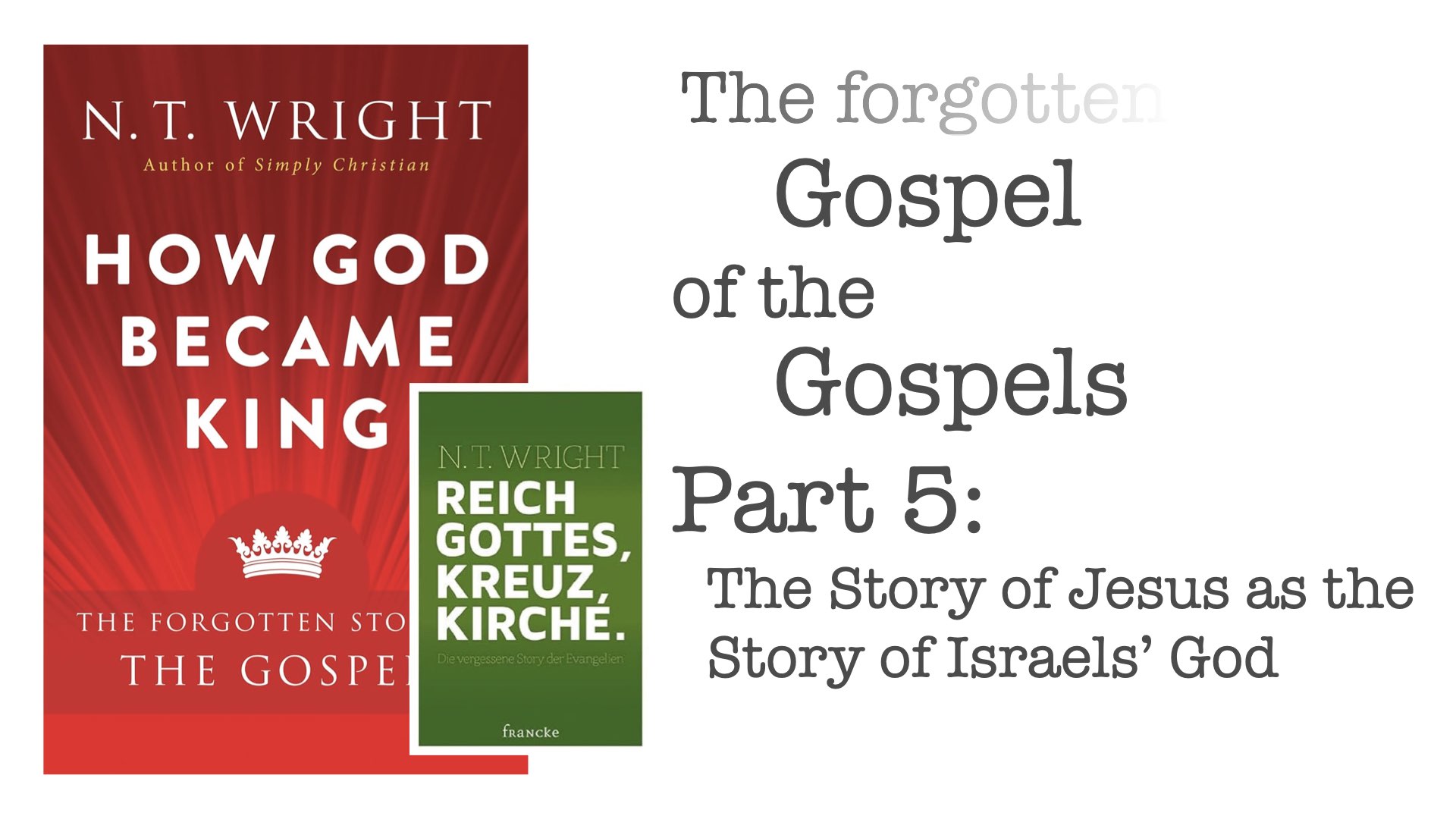
  • The Forgotten Gospel of the Gospels – Part 5: The Story of Jesus as the Story of Israel’s God

    The Forgotten Gospel of the Gospels – Part 5: The Story of Jesus as the Story of Israel’s God

    Von Christian / N. T. Wright


    In the fifth chapter of N.T. Wright’s book How God Became King: The Forgotten Story of the Gospels, the point is that the story of Jesus is the story of the God of Israel, who returns to his people as he has always promised.

    The problem is that one particular aspect of it has been so overemphasized in the Western church in the past few centuries that we no longer hear the quieter tones of the evangelists.

    We have been so concerned to let the gospels tell us that the story of Jesus is the story of God incarnate that we have been unable to listen more carefully to the evangelists telling us which God they are talking about and what exactly it is that this God is now doing.

    N.T. Wright How God Became King, chapter 5

    For far too long, Christians have told the story of Jesus as if it were directly linked to the story of human sin in Genesis 3, skipping over the story of Israel. As if this part was a failed attempt by God and with Jesus, Plan B began, so to speak. But that is not what the Bible says.

    The Biblical Story of God

    God’s covenant with Abraham and the promise to bless all families of the earth through him is a direct response to the wickedness of mankind described in Genesis 3 to 11, which culminates in the dispersion of the people of Babel.

    If we consider the worldview of early antiquity, then in Genesis creation is described as if it were a kind of temple in which God lives among humans. (See the series “Being God’s image”). While there was an image of the god or goddess in the ancient temples for this purpose, this was not the case in Eden and in the temple in Jerusalem: humans were to fulfill this task as the image of God. This is the core of the story, but it is ruined by the rebellion of the creatures bearing the image of God.

    This thought seems to disappear, only to resurface all the more clearly:

    But the astonishing thing about the book of Exodus, doubly astonishing as it turns out, is that God himself accompanies the people on their journey and then gives instructions for the “tabernacle,” the holy tent or “tent of meeting,” where he will be present in their midst and where he will meet, more particularly, with Moses himself.

    N.T. Wright How God Became King, chapter 5

    But very soon the Israelites also rebel. This does not thwart God’s purpose, but a pattern becomes apparent:

    This pattern—God intending to live among his people, being unable to because of their rebellion, but coming back in grace to do so at last—is, in a measure, the story of the whole Old Testament.

    Magnify that exodus story, project it onto the screen of hundreds of years of history, and you have the larger story. Solomon builds the Temple, succeeding generations either corrupt it or try to reform it, but eventually, faced with overwhelming rebellion and idolatry, God abandons the Temple at last, leaving it to its fate when the Babylonians close in. (Note the irony: Babylon, “Babel,” is the place of human pride and idolatry in contrast to which God called Abraham in the first place.) The whole of what we call the Second Temple period, roughly 538 BC onward, is characterized by this sense of divine absence; God is gone, and he hasn’t come back.

    N.T. Wright How God Became King, chapter 5

    ABut it will not remain so, as the prophet Malachi says, for example:

    “Behold, I am sending My messenger, and he will clear a way before Me. And the Lord, whom you are seeking, will suddenly come to His temple; and the messenger of the covenant, in whom you delight, behold, He is coming,” says the LORD of armies.

    Malachi 3:1 NASB

    And that is the story the Gospels want to tell us: how Yahweh finally came back to his people.

    Looking for the right thing

    And that can be found in all the gospels if you are looking for it. If, for example, you assume on the basis of tradition that you will find a high Christology in John and only a low one in the synoptic gospels, then it will be difficult to recognize.

    In Mark, however, Malachi 3:1 is quoted exactly and linked with Isaiah 40:3-11. On closer inspection, we therefore find a Christology in Mark’s first pages, albeit a Jewish Christology.

    Mark’s Jesus goes about doing and saying things that declare that Israel’s God is now becoming king—Israel’s dream come true. But Jesus is talking about God becoming king in order to explain the things he himself is doing. He isn’t pointing away from himself to God. He is pointing to God in order to explain his own actions.

    N.T. Wright How God Became King, chapter 5

    Take, for example, how Jesus acts in Mark 4:35-41 and compare it with statements from the Old Testament:

    And He got up and rebuked the wind and said to the sea, “Hush, be still.” And the wind dieddown and it became perfectly calm.

    Who stills the roaring of the seas, The roaring of their waves,

    LORD God of armies, who is like You, mighty LORD? Your faithfulness also surrounds You. You rule the surging of the sea; When its waves rise, You calm them.

    Then they cried out to the LORD in their trouble, And He brought them out of their distresses. He caused the storm to be still,  So that the waves [s]of the sea were hushed. Then they were glad because they were quiet,  So He guided them to their desired harbor.

    Mark 4:39 NASB; Psalm 65:7;89:8,9;107:28-30 NASB

    Attentive readers of Mark may well wonder at such passages: Is it possible that God will return in this way?

    Finally, we find another interesting clue at the end:

    At the ninth hour Jesus cried out with a loud voice, “ELOI, ELOI, LEMA SABAKTANEI?” which is translated, “MY GOD, MY GOD, WHY HAVE YOU FORSAKEN ME?” …

    And when the centurion, who was standing right in front of Him, saw that He died in this way, he said, “Truly this man was the Son of God!”

    Mark 15:34, 39 NASB

    The term “Son of God” naturally reminds us of God’s voice at Jesus‘ baptism in Mark 1:11. But should a Roman centurion have referred to it? Wouldn’t he rather think of Tiberius Caesar, the son of the ‚divine‘ Augustus, as the Son of God? After all, this was even written on the coins – like the ones they had shown Jesus a few days earlier (12:15-17).

    For Mark and other Christians, ‚Son of God‘ could have four meanings:

    1. First, in the Old Testament Israel itself is “God’s son” (Exod. 4:22; Jer. 31:9).
    2. Second — and this seems to be a primary meaning in the baptism story — it is the messiah, Israel’s anointed king, who is “God’s son” (2 Sam. 7:12–14; Pss. 2:7; 89:26–27).
    3. Third, as we just noted, “son of God” was a regular and primary title taken by the Roman emperors from Augustus on.
    4. But fourth, looming up behind and beyond all of these was the sense we find in the very earliest Christian documents that all of these pointed to a strange new reality: that, in Jesus, Israel’s God had become present, had become human, had come to live in the midst of his people, to set up his kingdom, to take upon himself the full horror of their plight, and to bring about his long-awaited new world. The phrase “son of God” was ready at hand to express that huge, evocative, frightening possibility, without leaving behind any of its other resonances. We can see this already going on in the writings of Paul. It is highly likely that Mark expected his first readers to have the same combination of themes in mind.

    As a secondary thought, I would like to mention something that N.T. Wright does not address in his book. There are all sorts of explanations as to why Jesus says in Mark 15:34, “My God, my God, why have you forsaken me?” Various scholars have rightly pointed out that Jesus here seems to be quoting Psalm 22, which begins exactly like this. What did Jesus or Mark want his readers to remember? Those who knew Psalm 22 well? Let’s look at the end:

    My God, my God, why have You forsaken me?

    For the kingdom is the LORD’S. And He rules over the nations. All the prosperous of the earth will eat and worship,  All those who go down to the dust will kneel before Him, Even he who [w]cannot keep his soul alive. A posterity will serve Him; It will be told of the Lord to the coming generation. They will come and will declare His righteousness To a people who will be born, that He has performed it.

    Psalm 22:1;29-32 NASB

    Well, if that doesn’t fit our topic…

    Matthew and Luke: Seeing Jesus, Thinking God

    After seeing how Mark approaches the subject, it is easier to discover the same thing in Matthew and Luke. After the genealogy, Matthew starts with this topic right away:

    The angel tells Joseph that Mary’s child is to be called “Jesus,” because “he is the one who will save his people from their sins”; the name “Jesus” is here being interpreted as meaning “YHWH saves.” Matthew’s comment fills this in from another angle: All this happened so that what the Lord said through the prophet might be fulfilled: “Look: the virgin is pregnant, and will have a son, and they shall give him the name Emmanuel”—which means, in translation, “God with us.” (Matthew 1:22–23)

    N.T. Wright How God Became King, chapter 5

    The name of Jesus is interpreted here as “Yahweh saves” in accordance with the Hebrew or Aramaic name. And Matthew links this to the idea – however strange it may seem – that the God of Israel is personally present among his people in order to save them.

    This is also reflected at the end of the Gospel of Matthew:

    Jesus came toward them and addressed them. “All authority in heaven and on earth,” he said, “has been given to me! So you must go and make all the nations into disciples. Baptize them in the name of the father, and of the son, and of the holy spirit. Teach them to observe everything I have commanded you. And look: I am with you, every single day, to the very end of the age.” (28:18–20)

    Matthew 28:18-20 N.T. Wright

    “God is with us” has become ‘Jesus is with us.’ If we think of the first disciples of Jesus, who were all devout Jews, waiting for their God to be among them again, then some events take on a different perspective. Like the one where Peter almost perished: ‘They got into the boat, and the wind died down. The people in the boat worshipped him. “You really are God’s son!” they said.” (Matthew 14:32-33 N.T. Wright)

    And so many of Jesus‘ parables make much more sense when he speaks of a noble man in Luke 19:11-27 who went away to attain kingship. In Luke 19:44, Jesus speaks of “you didn’t know the moment when God was visiting you.”. That sounds rather strange. The God of Israel Yahweh “visited” his people by being there. Is this a tendentious translation?

    Actually, the Greek simply says ton kairon tes episkopes sou, “the day of your visitation.” But the word “visitation” here has only one possible meaning. This is the time when God was coming back, coming back at last to see how his people had been doing with their centuries-old commission. This, for Luke, is the meaning of the parable. Jesus is telling a story about Israel’s God coming back to his people to explain what was going on when he himself was arriving in Jerusalem.

    N.T. Wright How God Became King, chapter 5

    And so, according to Luke, Jesus kept drawing attention to this point:

    “Go back to your home,” said Jesus, “and tell them what God has done for you.” And he went off around every town, declaring what Jesus had done for him.

    Lukas 8:39 NEÜ

    Glory Unveiled: John’s temple Christology

    In Eden, the tent of meeting or tabernacle and the Jerusalem Temple were always about a place through which God dwells with people. Therefore, the destruction of the Temple in 587 BC was the greatest disaster for his people. And Yahweh had not yet returned despite the rebuilding of the second Temple.

    And John, more clearly than the others, insists from the start that this promise has been made good in Jesus. The Word became flesh and kai eskenosen en hemin, “set up among us his skene,” his “tent” (it’s the word from which we get “scene”; a theatrical backdrop is a kind of “tent” in which the action takes place). In case there was any doubt, the Greek word skene is (coincidentally?) a close echo of the Hebrew shakan, which means “dwell” or “abide”; when we read of people “abiding” with Jesus or his “abiding” with them later in John, we should almost certainly catch this echo. In particular, in postbiblical Jewish writing the idea of the presence of God in the Temple was given the name Shekinah, the “tabernacling, abiding divine presence,” the personal presence of the glory of God. So, when John continues by saying, “We gazed upon his glory, glory like that of the father’s only son, full of grace and truth” (1:14), we should get the point loud and clear.

    N.T. Wright How God Became King, chapter 5

    As for the relationship between Jesus and Yahweh, we should not jump to any hasty conclusions, however:

    All this means that we should be able to read John with more sensitivity to the nature of his “high Christology.” Obviously he thinks Jesus was and is fully divine (as well as fully human, but he doesn’t need to make that point in the same way). But this doesn’t mean he is simply saying “Jesus is God” in the way of some rationalist apologists. John’s “high Christology” remains very, very Jewish, very much rooted in Israel’s scriptures. His chosen vehicle for his matchless opening statement, the logos, draws not so much on Platonic or Stoic ideas as on the living Word of the Old Testament, as, for instance, in Isaiah 55, where the word goes out like rain or snow and accomplishes God’s work (55:10–11). This work, God’s great act of rescue, rooted in the accomplishment of the “servant of the LORD” in chapter 53 and the renewal of the covenant in 54, brings about the new creation in 55, with the thorns and thistles of Genesis 3 and Isaiah 5 replaced by wonderful trees and shrubs (55:12–13). It is (in other words) the creator God, and it is Israel’s God, who has become human in and as Jesus of Nazareth.

    N.T. Wright How God Became King, chapter 5

    In summary, N.T. Wright describes his proposal as follows:

    The gospels offer us not so much a different kind of human, but a different kind of God: a God who, having made humans in his own image, will most naturally express himself in and as that image-bearing creature; a God who, having made Israel to share and bear the pain and horror of the world, will most naturally express himself in and as that pain-bearing, horror-facing creature. This is perhaps the most difficult thing for us to keep in mind, though the gospels are inviting us to do so on every page.

    N.T. Wright How God Became King, chapter 5
  • The Forgotten Gospel of the Gospels – Part 4: The Story of Israel

    The Forgotten Gospel of the Gospels – Part 4: The Story of Israel

    Von Christian / N. T. Wright


    To hear the gospel of the gospels, the actual story of the gospels, we need to talk about four strands or levels of the gospels, which have either been pushed into the foreground or almost invisibly into the background. Because of this distortion, we find it difficult to recognize the story itself.

    In the fourth chapter of N.T. Wright’s book How God Became King: The Forgotten Story of the Gospels, the story of Israel is the focus. So it is not a historical outline of events, but the story, the deeper content that is to be communicated to us.

    The Gospels as biographies

    The times when scholars could proclaim that the gospels are not biographies of Jesus are long gone. They are not biographies like those written today, but resemble ancient Greek or Roman biographies. And the four gospels are different because they are not just biographies of the person of Jesus, but want to convey a much larger story. And they do that from different angles and with different focal points.

    The four gospels present themselves as the climax of the story of Israel. All four evangelists, I suggest, deliberately frame their material in such a way as to make this clear.

    N.T. Wright How God Became King, Chapter 4

    Unfortunately, generations of Christian readers have virtually ignored this context and connection. We too will only be able to understand this point if we explicitly realize how the story of Israel was told at the time.

    The strange story of Israel

    N.T. Wright summarizes it as follows:

    The story of Israel too is a subject for an entire book. But we can sum it up like this. Israel’s ancient scriptures are framed with a narrative, an unfinished narrative of a certain shape and type. Whether you read the Old Testament as set out in most English Bibles from Genesis to Malachi or whether you read it in the Hebrew canon from Genesis to Chronicles with the prophets in the middle, you are still left with a sense that this story is supposed to be going somewhere, but that it hasn’t gotten there yet. It is an unfinished narrative, an unfinished agenda. Things are supposed to happen that haven’t happened yet.

    N.T. Wright How God Became King, Chapter 4

    Just as Genesis 1-3 tells the story of human plight using the pattern of glorious beginnings, rich callings and then terrible failure and exile, so between Genesis 12 and Chronicles or Malachi we find the same story in relation to Israel. But it is precisely this story of Israel that is ignored by most modern readers of the Bible today.

    And the creeds have a significant part in this, because they do not mention Israel at all. On the contrary, they give the impression that a new beginning was made with Jesus.

    But the evangelists saw it quite differently.

    Matthew: The story reaches its goal

    The Gospel of Matthew, which has always been at the beginning of the canon, begins with what? The family tree of Jesus from Abraham. It thus covers the period from before Israel, from its patriarch Abraham, to after the exile in the time of Jesus. Now it is important to know that in Jesus‘ day, most Jews, even half a millennium after the return from the Babylonian exile, were of the opinion that the exile had not yet really ended (see Nehemiah 9:36). The great prophecies of Isaiah, Jeremiah, Ezekiel and Daniel had yet to be fulfilled.

    In Daniel 9, the prophet asks how much longer it will take before Jeremiah’s prophecy of 70 years will be fulfilled. And the answer is: not 70 years, but 70 weeks of seven years each. But this formulation also reminded of the sabbath and jubilee years, the release of all slaves and the restitution of inherited property. 70 times 7 is indeed a long time, but it indicates a great liberation.

    And Matthew makes it clear beyond cavil, to anyone thinking Jewishly in that period, that the moment had come with Jesus. Instead of years, he does it with generations, the generations of Israel’s entire history from Abraham to the present. All the generations to that point were fourteen times three, that is, six sevens—with Jesus we get the seventh seven. He is the jubilee in person. He is the one who will rescue Israel from its long-continued nightmare. “He,” says the angel to Joseph, “is the one who will save his people from their sins” (1:21). That, to any first-century Jew, didn’t just mean that individuals could turn to him and find personal forgiveness, though that would obviously be true as well. Read Isaiah 40 and Lamentations 4 again and see.

    N.T. Wright How God Became King, Chapter 4

    In this way, we have recognized an idea that Matthew also highlights: the life of Jesus recapitulates key events in the history of Israel! Jesus preaches on a mountain and, at that moment, he is Moses. When he answers his critics about the Sabbath, he is David. He chooses 12 as his apostles, which is reminiscent of Jacob and the 12 patriarchs. He heals the sick and raises the dead like Elijah and Elisha. In the transformation, he even meets Elijah and Moses.

    But far more important than flashbacks, than the picking up of detached themes and hints from long ago, is the towering sense of a single story now at last reaching its conclusion.

    The gospel writers saw the events concerning Jesus, particularly his kingdom-inaugurating life, death, and resurrection, not just as isolated events to which remote prophets might have distantly pointed. They saw those events as bringing the long story of Israel to its proper goal, even though that long story had apparently become lost, stuck, and all but forgotten.

    In Israel’s scriptures, the reason Israel’s story matters is that the creator of the world has chosen and called Israel to be the people through whom he will redeem the world.

    What God does for Israel is what God is doing in relation to the whole world. That is what it meant to be Israel, to be the people who, for better and worse, carried the destiny of the world on their shoulders. Grasp that, and you have a pathway into the heart of the New Testament.

    N.T. Wright How God Became King, Chapter 4

    Mark: Jesus and the breaking in of God’s new world

    In the Gospel of Mark, this is made clear right from the first verses:

    Isaiah the prophet put it like this (“Look! I am sending my messenger ahead of me; he will clear the way for you!”): “A shout goes up in the desert: Make way for the Lord! Clear a straight path for him!” (1:2–3)

    This is how it happened. Around that time, Jesus came from Nazareth in Galilee, and was baptized by John in the river Jordan. That very moment, as he was getting out of the water, he saw the heavens open, and the spirit coming down like a dove onto him. Then there came a voice, out of the heavens: “You are my son! You are the one I love! You make me very glad.” (1:9–11)

    Mark 1:1-3;9-11

    So it starts right away with a reference to an old prophecy of Isaiah. Do we have to look only in the Old Testament to find the story of Jesus?

    Here, to be sure, is a paradox we meet throughout the New Testament: God acts completely unexpectedly—as he always said he would. Just because the new events are able to be seen as the fulfillment of ancient prophecy (and Mark, like the other evangelists, is clear that this is the only right way to see them), that doesn’t mean that one can see a smooth, easy line from the ancient texts to the modern fulfillment. On the contrary, what is being fulfilled is precisely the promise of drastic, unexpected, and perhaps even unwelcome judgment and mercy.

    N.T. Wright How God Became King, Chapter 4

    But now in the gospel of Mark, not just a few fulfillments are constructed. Already in verse 15 of the first chapter, Jesus himself is quoted: “The time is fulfilled, and the kingdom of God is at hand.” (Mark 1:15 Zurich). Mark builds the dramatic events up to 8:29, when Peter states that Jesus is the Messiah. And the transfiguration of Jesus follows in the very next chapter. Jesus talks about his death in 10:45 (alluding to Daniel 7 and Isaiah 53). “Jesus is fulfilling the story of Israel, even though this requires readers to understand Israel’s story in a new way.”

    Luke: The scriptures must be fulfilled

    That the scriptures must be fulfilled in this way is also exactly the point that Luke makes in key passages. This begins in the first chapter with the words of Mary (1:46-55) and Zechariah (1:68-79). And it continues until it is emphasized by Jesus himself in 22:37, for example: “For I tell you, this scripture must still be fulfilled in me: ‘He was numbered with the transgressors.’ And that is now being fulfilled.” (NEÜ). But even Jesus‘ disciples could not initially see the fulfillment of Israel’s story in Jesus‘ death: “We had hoped that he would be the one to redeem Israel.” (24:21) say the two disciples on the road to Emmaus. In this regard, Luke leaves no doubt as to the idea he wants to convey:

    And then He said to them, “You foolish men and slow of heart to believe in all that the prophets have spoken! Was it not necessary for the Christ to suffer these things and to come into His glory?” Then beginning with Moses and with all the Prophets, He explained to them the things written about Himself in all the Scriptures.

    Luke 24:25-27 NASB

    So it was not a matter of course for them to understand this surprising fulfillment of the scriptures. Jesus had to “explain the scriptures” to them (24:27) and “then he opened their minds to understand the scriptures” (24:45).

    across—that the life, death, and resurrection of Jesus is in fact the climax of the story of Israel, even though nobody was expecting such a thing and many didn’t like the look of it when it was presented to them—is something that, like the risen Jesus himself, is visible to the eye of faith. The story makes sense as a whole or not at all.

    N.T. Wright How God Became King, Chapter 4

    John: Creation and New Creation

    The gospel of John is no exception: the events related to Jesus are the fulfillment of the story of Israel – even if the latter neither expected nor desired such a ‚fulfillment‘. The gospel begins with references to Genesis. “In the beginning was…” (1:1) is an echo of the story of creation. In verse 14, we may not immediately notice something in German: “And the word, the Logos, became flesh and dwelt among us, …”. The word for “dwelt” actually means: He pitched his tent, his tabernacle or tabernacle. And with that, he refers to the presence of God among the Israelites from Exodus.

    And even in the Gospel of John, the first chapter does not end without the emphatic indication of what it is about:

    “We’ve found him!” said Philip. “The one Moses wrote about in the law! And the prophets, too! We’ve found him! It’s Jesus, Joseph’s son, from Nazareth!” “Really?” replied Nathanael. “Are you telling me that something good can come out of Nazareth?”

    John 1:45,46

    And so this theme keeps coming up (5:39-40; 7:31-52; 10:22-30; 5:46; 8:30-59). Caiaphas wants to save the nation of Israel and the Temple by having Jesus killed. But John gives this a different meaning, the fulfillment of the story of Israel:

    Now he did not say this on his own, but as he was high priest that year, he prophesied that Jesus was going to die for the nation; and not for the nation only, but in order that He might also gather together into one the children of God who are scattered abroad.

    John 11:51,52 NASB

    The paradox of the two stories remains all the way through, and John claims that Jesus was in line with the ancient prophecies, which always included prophecies about Israel’s failure to see, hear, and understand (12:37-41).

    The result — the climax of the gospel, and for John the climax of Israel’s entire story — is the paradoxical “enthronement” of Jesus on the cross, the final moment of the fulfillment of the great scriptural story (19:19, 24, 28). Jesus’s final word, tetelestai, “It’s all done!” says it clearly. The story has been completed—the story of creation, the story of God’s covenant with Israel. Now new creation can begin, as it does immediately afterwards with Jesus’s resurrection. Now the new covenant can be launched, as the disciples are sent out into the world equipped with Jesus’s own Spirit (20:19–23). This is how Israel’s story has reached its goal and can now bear fruit in all the world.

    N.T. Wright How God Became King, Chapter 4
  • The Forgotten Gospel of the Gospels – Part 3: The Inadequate Answers

    The Forgotten Gospel of the Gospels – Part 3: The Inadequate Answers

    Von Christian / N. T. Wright


    In this part, we will look at answers to the question of why the ‚middle part‘ of the Gospels exists at all. By taking a closer look at them, we will see why they are not completely wrong, but still inadequate. After we have recognized various ideas that may unconsciously block our view, we will then be able to hear the gospels with the ears of the first-century disciples. I am using the book by N.T. Wright: How God Became King: The Forgotten Story of the Gospels (Deutsche Übersetzung: Reich Gottes, Kreuz, Kirche. Die vergessene Story der Evangelien)

    N.T. Wright has repeatedly asked this question, what the ‚middle part‘ of the Gospels is good for, to scholars, pastors and lay people on various occasions. The answers were revealing and can be roughly grouped as follows.

    Going to heaven

    The first answer is often: Jesus came to explain to people how to get to heaven.

    There is no doubt that the New Testament assumes that God has prepared a wonderful future for us after physical death. But ultimately, it is about the resurrection of a new world. I have discussed this at length in another series “Surprised by Hope”, which is about book the by N.T. Wright with the same title „Surprised by Hope“.

    But that is demonstrably not what the four Gospels are about.

    How did it come about that this notion became so widespread in the Western Church? How did translations of the Gospels contribute to this?

    Since the canon of the New Testament was established, the Gospel of Matthew has been placed at the beginning. And the expression “Kingdom of Heaven” is frequently used there, whereas the other Gospels speak of “God’s Kingdom”. Some German translations reinforce this even further by translating it something like this:

    Not everyone who says to Me, ‘Lord, Lord,’ will enter the heavenly kingdom, but the one who does the will of My Father who is in heaven will enter.

    Matthew 7:21 NASB

    In German, the problem is even greater than in English due to the use of the term “Himmelreich” (heavenly kingdom), where “kingdom of heaven” has been used for centuries in the King James Version. Anyone who reads that one goes to the “Himmelreich” (heavenly kingdom) and immediately afterwards reads about the “Father in heaven” will think that he or she will also go to heaven.

    But that was not what Matthew and Jesus meant. In the center of the Sermon on the Mount in Matthew 5-7, Jesus speaks in the so-called ‚Lord’s Prayer‘ that “Your kingdom come. Your will be done, On earth as it is in heaven,” (Matthew 6:10 NASB).

    The “kingdom of heaven” is not about people going to heaven. It is about the rule of heaven coming to earth.

    N.T. Wright How God Became King, Chapter 3

    It is the “kingdom of heaven” because its authority comes from God in heaven.

    Even though this conception of the kingdom had spread early in the history of the church – see, for example, the Te Deum Laudamus from the fourth century – it was still completely different from the first-century understanding.

    A second formulation that is usually misunderstood is that of “eternal life”. Those who read about “eternal life” and “eternity” usually think of a life of the soul in heaven. But that is Plato and not the Gospels of the first century! So we read:

    “For God so loved the world, that He gave His only Son, so that everyone who believes in Him will not perish, but have eternal life.

    John 3:16 NASB

    In Greek, the words here are αἰώνιον ζωὴν aiōnion zōēn. But what did the term zoe aionios mean to both the writers, Matthew and Paul, and their first-century audiences? The use of aion referred to the Jewish concept of an age: ha-olam hazeh, the present age, and ha-olam ha-ba, the coming age. In this coming age, God would bring justice and peace and heal the world. Paul uses the same word in Galatians 1:4, but the translations like the King James Version often obscure this:

    Who gave himself for our sins, that he might deliver us from this present evil world, according to the will of God and our Father:

    Galatians 1:4 KJV

    Other translations renders this better, for example the New King James Version:

    who gave Himself for our sins, that He might deliver us from this present evil age, according to the will of our God and Father,

    Galatians 1:4 NKJV

    In other words, Jesus has inaugurated, ushered in, the “age to come.” But there is no sense that this “age to come” is “eternal” in the sense of being outside space, time, and matter. Far from it. The ancient Jews were creational monotheists. For them, God’s great future purpose was not to rescue people out of the world, but to rescue the world itself, people included, from its present state of corruption and decay.

    N.T. Wright How God Became King, Chapter 3

    In fact, this understanding of aion is confirmed by many scholars. For those who would like to know more about this, I gladly refer you to Jascha Schmitz’s video series “Eternity in the Bible. What is meant?” (In German)

    Jesus’s ethical teachings

    A second popular approach to the material in the middle of the gospels is to point out Jesus‘ teachings, especially what we call ethics. And to some extent that is true.

    „Jesus’s summons to Israel to be Israel indeed, now that he was there, turns directly into a challenge and invitation to a whole new way of being human. This way is characterized especially by forgiveness, God’s forgiveness of people and our forgiveness of one another. All of that formed a quite new agenda for most of Jesus’s hearers. It had to be laid out, explained, repeated, illustrated, and generally taught. So, yes, Jesus was undoubtedly a “teacher.” Indeed, people sometimes addressed him as such, and Jesus never told them they were wrong to do so.“

    But to speak of Jesus only as a “teacher” falls far short of what he did. By ‚teacher‘ we usually mean someone who imparts existing knowledge to others, like a piano teacher or school teacher. But Jesus did much more:

    Jesus was announcing that a whole new world was being born and he was “teaching” people how to live within that whole new world. To that extent, we should both embrace the idea of him as a “teacher” and radically qualify or modify it. In fact, the modification should take place before the embrace. You only understand the point of the “teaching” when you understand the larger picture of what Jesus was doing.

    Without that larger picture, the word “teacher” or “teaching” can result in a severely diminished sense of what the gospels are trying to say about Jesus. The notion of “teaching” can easily collapse into the standard popular picture of Jesus as one of the world’s great “religious teachers” alongside Buddha, Muhammad, and so on. In other words, there are some things called “religious truths,” which some great souls have discovered and taught, and Jesus was simply one of those great souls, one of those great teachers.

    N.T. Wright How God Became King, Chapter 3

    Jesus, the moral exemplar

    A third popular model for explaining why the Gospels write so much about Jesus‘ public career is that they want to give us an example of how to live.

    But is it really particularly encouraging to take Jesus, who is portrayed as perfect, as a role model? Isn’t it rather frustrating because we can never achieve that? “Have you ever tried to copy Jesus, not just in his amazing generosity and kindness, but in his sharp, brightly colored little stories? Very few people throughout history have been able to tell short stories like that, so brief yet so complete. … Again and again in the gospels we find that Jesus is not, in fact, holding himself up as an example to follow or copy. … His task is unique.”

    So that is not a satisfactory approach for explaining the structure of the Gospels either.

    Jesus the perfect sacrifice 

    „A fourth inadequate answer has tried to tie the first and the third together. The aim is still to get us to heaven, but Jesus is not just the moral exemplar—his perfect life means that he can be the perfect sacrifice.“

    „So, yes, Jesus’s own moral perfection does play a role in relation to his death. But, beyond these passages, the gospels show no interest whatever in making the link that much traditional teaching has employed. If that was what they were trying to say, you’d think they would have made it a bit clearer.“

    Stories we can identify with

    N.T. Wright weist noch auf einen fünften Punkt hin: „“The gospels are written,” people have said to me, “so we can identify with the characters in the story and find our own way by seeing what happened to them.” Well, there is once again quite a lot in that. Getting inside the stories in the gospels is indeed an excellent way of coming to understand Jesus better and allowing the power of his life to transform our own..“

    Stories like these are a part of the Gospels and valuable, but is that the whole reason why the Gospels were written? And what about the birth, death and resurrection of Jesus? Why then the interweaving with the Old Testament?

    Proving Jesus’s divinity

    „The sixth standard line has been to say that the gospels were written to demonstrate the divinity of Jesus. This, I suspect, is what many Christians regard as the gospels’ principal purpose. Some would add too the equal purpose of demonstrating his humanity.“

    But was that the question that was important for the disciples in the first century?

    When did people start to talk about Jesus’s “humanity” and “divinity” in this way? Not, I think, in the first century. Don’t misunderstand me. As we shall see, if the question were raised, the New Testament writers would be quite clear that Jesus was indeed fully human and—somehow, strangely, but definitely—truly divine. But that does not seem to be their main point. Even John, who brings his stage-setting prologue to its climax by speaking of the Word becoming flesh, does not make this the main strand in the story he is telling. It is only later, when the church moves out into the wider world of Greek philosophy, that the question gets raised like that, in the abstract. In the middle of the fifth century Chalcedonian Christology declared, in ringing, round, and frankly very paradoxical tones, that Jesus was indeed fully divine and fully human. These abstract categories were in the center of the discussion then, and no mistake. But if you compare Chalcedon with the four gospels, you’ll find that they are very different sorts of documents and that the gospels, though they do indeed have Jesus doing remarkable things, on the one hand, and behaving like an ordinary human being, on the other, do not appear to be written in order to prove that point.

    The point, to repeat, is not whether Jesus is God, but what God is doing in and through Jesus. What is this embodied God up to?

    N.T. Wright How God Became King, Chapter 3

    N.T. Wright then goes into some of the texts in more detail, but this would take us too far afield here. We will come back to this when we combine the various explanations into a surprising overall picture.

    Displacement activities

    The material of the gospels is so extensive that one can deal with each of these topics intensively. But in doing so, the view of the underlying central theme seems to have been lost.

    The result has been a series of displacement activities. The church has said, in effect: (a) we know the gospels are important, because they are the inspired apostolic witness to Jesus; and (b) we know what is important in Christian theology, namely, the divinity of Jesus and his saving death or, as it may be, his moral teaching and example; so (c) we assume that that is the primary message of the gospels.

    N.T. Wright How God Became King, Chapter 3

    And what is the central message of the Gospels? This is what we will discuss in the next episodes:

    In fact, to sum up the proposal toward which I have been working, the four gospels are trying to say that this is how God became king.

    N.T. Wright How God Became King, Chapter 3
  • The Forgotten Gospel of the Gospels – Part 2: Everything but the Middle

    The Forgotten Gospel of the Gospels – Part 2: Everything but the Middle

    Von Christian / N. T. Wright


    In the first part of the series, we realized that the essential story of the Gospels has been forgotten and what role the creeds, for example, have played in this. I am using the book by N.T. Wright for this: How God Became King: The Forgotten Story of the Gospels (Deutsche Übersetzung: Reich Gottes, Kreuz, Kirche. Die vergessene Story der Evangelien)

    This section is about how various overemphasizations or fixations on certain aspects of the gospels, while popular, did not lead to a satisfactory overall understanding of the gospels.

    Jesus without the creeds?

    The creeds address mainly Jesus‘ birth, his death and resurrection and related teachings. What remains when attempts have been made to give more weight to all the other parts of the gospels? Since the 18th century, it has become fashionable to approach the gospels with the ‚historical question‘: Did it really happen? That is the question to this day. And the intellectual answer was and often still is: Yes, he existed, the so-called ‚historical Jesus‘. But the rest never happened. All the miracles and what the creeds contain comes from the church, which wanted to express its own faith. What remains of Jesus then is one of three possibilities:

    1. A revolutionary who took on the Roman Empire to rebuild a Jewish state.
    2. Or a wild, apocalyptic visionary who expected the end of the world.
    3. Or a mild-mannered, reasonable teacher who taught the brotherhood of all people under the Father God.

    Or a combination of all of them. However, he was mistaken. The Romans killed him, the end of the world did not come, and even his disciples did not necessarily stand out in the centuries that followed for their mild, reasonable thinking. And that has essentially been the direction of skeptical or liberal thinkers over the last two hundred years and thousands of academic and popular books. For many, this is the new ‚orthodox‘ belief.

    The idea that Jesus came to teach a new, simple, clear ethic of being nice to people, without any “dogmatic” claims or “supernatural” elements, is so deeply embedded in Western culture that one sometimes despairs, like a gardener faced with ground ivy, of ever uprooting it. To this day there seems a ready market right across the Western world for books that say that Jesus was just a good Jewish boy who would have been horrified to see a “church” set up in his name, who didn’t think of himself as “God” or even the “Son of God,” and who had no intention of dying for anyone’s sins—the church has gotten it all wrong. The authors of such books routinely proclaim themselves “neutral,” “unbiased,” “impartial,” or “independent.” As if.

    N.T. Wright How God Became King, Chapter 2

    The social gospel of Jesus?

    At least this view of Jesus‘ life, without the supernatural elements found in the creeds, also has a positive side. Did Jesus not, in anticipation of what the ‚Kingdom of God‘ would do, also heal the sick, feed the hungry, relieve the poor of their hardship and help widows and orphans to get justice? And towards the end of the 19th century, this became the movement of “Christian socialism”. The problem with this is not only theological – why do people pick and choose certain aspects of the Gospels and ignore others? The real problem is that the high point of this movement was long ago and yet the same problems still exist – even in the Western, Christian world.

    Perhaps we should try to connect the ‚middle part‘ of the Gospels about the life of Jesus with the other part that is emphasized in the creeds.

    Did Jesus talk about himself?

    The ‚liberal‘ reading of the Gospels has led to yet another idea today: Jesus seems to have spoken about God, and his followers and the early church then spoke about Jesus. In particular, the creeds seem to be fixated on the precise ontological relationship of Jesus to God the Father. Something Jesus, according to the Gospels, would not have done in that way. This can be taken to the point where there is a sense of superiority to this point of view. N. T. Wright puts it succinctly:

    “You would-be orthodox Christians stick your noses in the air, because you believe in the divinity of Jesus, whereas we modern historically conscious readers can stick our noses in the air, because we have discovered that Jesus himself never thought of himself that way!” The church’s worship of Jesus can thus be “exposed,” so it is thought, as a falsification of what Jesus himself would have said or thought.

    N.T. Wright How God Became King, Chapter 2

    As is so often the case, there is a grain of truth in this claim. However, it does not stand up to a closer analysis of the texts. This attitude suggests that because Jesus spoke about God, he said nothing at all about himself and his role. But this is not the case. When reading the gospels, we must not only consider the words on the surface, but also the deeper levels of meaning. This will become clearer when we talk about how the evangelists referred to the Old Testament and what Jesus‘ words mean in this context.

    The Hidden Underlying Challenge: Theocracy

    Our perception of the gospels could unconsciously be strongly influenced by the Age of Enlightenment since the 18th century. Over time, God – whatever God may be – has been increasingly ‚transferred‘ to a higher plane. At best to a place of honor, but far away. Far removed from directing the destinies of mankind. That was now left to people themselves. In other words, they didn’t want any hint of theocracy – a government of God – under any circumstances. This separation of church and state may seem plausible after the experiences of history. However, it led even more strongly to faith or religion becoming a matter of private conduct.

    You can see that for yourself if you reflect on Jesus‘ prayer: “Your will be done on earth as it is in heaven.” (Matthew 6:10) How should that be done on earth? How much do the Enlightenment influence our thinking? And how much the Gospels? The text reads in full: “Your kingdom come. Your will be done, as in heaven, so on earth.” (Matthew 6:10 Zurich). For some of the great thinkers of the Enlightenment, this was either a violent military revolution or the end of the world. These ideas could unconsciously prevent us from recognizing the message that the evangelists wanted to convey.

    The Orthodox Response

    Enlightenment and general skepticism pushed the church onto the defensive. The question in the room was: Was Jesus really divine? The result was that people read the gospels to find proof. And they found it: miracles! At least that’s what they thought, and some still reason that way today. But are ‚miracles‘ really proof of Jesus‘ divinity? Is that the essential reason for the text of the gospels between birth and cross? However, what may sound convincing at first glance overlooks the fact that the Old Testament already speaks of miracles performed by Moses, Elijah and Elisha, without in the least claiming that any of them were divine.

    So there were and are a lot of different answers to the question of why the evangelists wrote their gospels in this way and not in another. And although they differ so much and are partly contrary, they seem more like a reaction to the context and developments of their time than like inadequate answers.

    In the next part, we will therefore look at further answers as to why the ‚middle part‘ of the Gospels exists at all. By taking a closer look at these, we will recognize why they are not completely wrong, but nevertheless inadequate. Having recognized so many different ideas that can unconsciously block our view, we will then be able to hear the Gospels with the ears of the first-century disciples.

  • The Forgotten Gospel of the Gospels – Part 1: The Missing Middle

    The Forgotten Gospel of the Gospels – Part 1: The Missing Middle

    By Christian / N. T. Wright


    The Gospels have been read and studied for two millennia now. Surely everything must have been said and written about them by now, right? Is it even possible to discover anything new in them? Even more. In this series, we will consider arguments that show that we even have to rediscover the gospel itself today, the essential story of the Gospels, because it has been forgotten. The weight and attention has been put on various other topics, so that the central message has been lost. These other voices have become so loud and popular, so to speak, that the central theme, which should be supported by the other voices, was no longer perceived.

    However, the topic is not only important in terms of personal belief, where at least for ‚Christians‘ the gospels should play a central role. It also helps us to set the right focus and accept different views. Why should you deny others their faith, call them heretics, apostates or ‚false religion‘ when the different views do not even concern the central message of the gospel?

    But how could it ever come to pass that what the four evangelists so urgently wanted to communicate to others was so completely forgotten? Among other things, creeds – as good as they are or were meant to be – played a role in this, as we shall see in a moment.

    “And why, may I ask, has no one but you noticed this in two thousand years?” I haven’t noticed it at all. What I have become more and more aware of, however, is that for many teachings or even belief systems, only a few Bible texts are used or overemphasized. Or the texts come predominantly or exclusively from one Bible book, some letters of Paul, etc. And how do the Old and New Testaments fit together? Beyond ‚everything points prophetically to Jesus‘, which is not the case at all. If the texts of the New Testament so often refer to the Old or use or reinterpret their images and terms, was there a radical change, something completely new? Or do the two form a unity beyond superficial references? In fact, diligent biblical scholars have made interesting contributions to this, which I will discuss again and again.

    One of them is N. T. Wright, who observed something over and over again that eventually led to this book:

    In this series, I would like to take up the most important arguments from the book so that everyone can form their own opinion. So let’s go back to the roots and read the gospels in the context of the first-century disciples – without having our 21st-century context and any creed in mind. Otherwise, there is a great danger that we will read into them or believe we can find in them teachings that were not developed until centuries later.

    And what happened … in between?

    N. T. Wright introduces the question of this series with a personal experience as a teenager that everyone can easily relate to. He wanted to do a series of studies on Jesus with others, all based on why-questions: Why was Jesus born? Why did Jesus live? Why did Jesus die? Why did Jesus rise? Why will he return?

    If you stop for a moment and think about the answers to the questions, you will come up with a few ideas for almost all of them. And you will recognize a connection to central teachings of Christianity. Only with one question could it have been difficult: Why did Jesus live? Not a difficult question, do you think? Now, would your answers to the other questions or your hope change at all if he had died ‚for our sins‘ shortly after his birth? Or if he had been active for 30 1/2 years instead of 3 1/2 years?

    Perhaps you now have a few reasons in mind. We will discuss some of them later and see that on closer inspection they are not as convincing as one might think. Take, for example, the reason that Jesus, despite all temptations, had to lead a God-pleasing life without sin. Good. Mark, Matthew, Luke and John could have stated that in one sentence. But that is not what the bulk of the text is about. Another example: Jesus showed us how to live. But that is not described in the majority of the text of the gospels either.

    In fact, even the earliest creeds show an interesting pattern. Take, for example, the short fourth-century creed we know as the Apostles‘ Creed:

    I believe…in Jesus Christ, God’s only son, our Lord;
    Who was conceived by the Holy Spirit;
    born of the Virgin Mary;
    Suffered under Pontius Pilate;
    Was crucified, dead and buried;
    He descended into hell;
    On the third day he rose again from the dead;
    He ascended into heaven, and is seated at the right hand of God, the Father almighty;
    From thence he will come to judge the living and the dead.

    N.T.Wright How God Became King, chapter 1, ‚Apostel’s Creed‘

    So many details and yet nothing about Jesus‘ life between his birth and crucifixion! Now compare that with the four gospels. How much text is devoted to the birth and baptism of Jesus? How much to his crucifixion and resurrection? Only a fraction of the text of the gospels:

    How did it come about? Before anyone is quick to jump to the conclusion that the apostasy announced in the New Testament is the reason, we should be aware of a simple mechanism. Initially, the g ospels – like other letters – were regularly read aloud. The believers prayed the ‚Our Father‘ and knew the details of the gospels, which they understood as a basis. The creeds served only as a framework to clearly distinguish important basic teachings from other views, such as those of the Gnostics. There were numerous controversies on various topics. And when these were decided – however, these early formulas became part of creeds and were hung on the clothesline like washed laundry, so to speak. N.T. Wright formulates the change as follows:

    The church provided a “rule of faith” by which, supposedly, to understand the scriptures. But the “rule” in question – the developing creeds and the early formulas that led up to them – turned out to ignore the central theme of the four gospels. Notice what then happens. At some point, perhaps not long after the creeds were written, the clothesline turned into a teaching aid. The list of earlier controversies became a syllabus. “These,” the church declared, “are the things you need to know about God, Jesus, the Holy Spirit, and so on.” And at this point we have crossed a line. Matthew, Mark, Luke, and John say, “These are the things you need to know about Jesus.” The creeds, when taken out of their liturgical context where they belong with the gospels and the Lord’s Prayer and used instead as the basis for a teaching program, say: “No, these are the things you need to know.”

    N.T.Wright How God Became King, chapter 1

    Over time, the center – the story of the gospels – was lost and the results of the controversies came to the fore. This does not make the creeds per se wrong or unnecessary or useless. But they must not replace the story of the gospels.

    In fact, many would only prove ‚the gospel‘ with Paul’s texts such as Romans 3 and Galatians 2-3 – as the early reformers did – without even once referring to one of the gospels!

    It isn’t just that we’ve all misread the gospels, though I think that’s broadly true. It is more that we haven’t really read them at all. We have fitted them into the framework of ideas and beliefs that we have acquired from other sources.

    I want in this book to allow them, as far as I can, to speak for themselves. Not everyone will like the result.

    N.T.Wright How God Became King, chapter 1

    Well, not everyone will like the result, but it promises to be quite interesting – at least I think so.

  • The Zoom Congregation: Text, Context, Consequences – Part 8

    The Zoom Congregation: Text, Context, Consequences – Part 8

    By Christian


    In the last two parts of this series, we will deal with the consequences of wanting to shape our Zoom community ‚exactly like the first Christians‘. In the last part, we had already covered these topics:

    • ‚They devoted themselves to the apostles‘ teaching‘
    • ‚Sharing a meal together‘
    • ‚Breaking bread together‘
    • Baptism
    • Finances, donations, property
    • Apostles, overseers, elders, deacons
    • Women as overseers, elders and deacons

    I would like to take up three further points that pose an enormous challenge for a Zoom community, even more so than for others.

    Doctrines

    What was it like when the first congregation in Jerusalem was founded? Well, actually there was no such moment. At least not like in other congregations that were founded by missionaries like Paul. Was it clear from the beginning what everyone had to believe? Or to put it another way: Was there a list of doctrines that ‚we in this congregation‘ believe? Do these considerations and questions seem strange to you? That’s perfectly fine, because the historical development was different. The first disciples all came from the Jewish religion. And whichever direction they leaned, they had a common foundation. To this were added the teachings of Jesus Christ and the conviction that he had risen from the dead. There was not much more when the Holy Spirit was poured out at Pentecost. What was the central message? “Philip went to a city in Samaria and proclaimed the Messiah Jesus.” (Acts 8:5 NEÜ) And shortly thereafter: ‘Philip began with that very passage of Scripture and told the Ethiopian the good news about Jesus.’ (Acts 8:35 NEÜ) What else did he have to learn and accept as binding beliefs before he was baptized? “As they traveled along the road, they came to some water. ‚There is water here,‘ said the eunuch, ’so why can’t I be baptized?’” (Acts 8:36 NEÜ). Nothing, because we read that he was baptized.

    Why did I mention this? For one thing, it shows us the basic teachings of the first congregations. The scriptures (what is today called the Old Testament) and the gospel of Jesus. Were details asked about or difficult theological questions? Was there a fixed creed? It is interesting here that Acts 8:36,37 is rendered differently in different translations:

    As they traveled along the road, they came to some water. “There is water here,” said the eunuch, “what stands in the way of my baptism?”

    Footnote: Later manuscripts add: “If you believe with all your heart,” Philip said, “you may be baptized.” – “Yes,” said the Ethiopian, “I believe that Jesus Christ is the Son of God.” (This question and answer corresponded to the practice of the early church and probably came from there into some manuscripts.)

    Acts 8:36,37 NEÜ

    Over time, central doctrines of the faith were formalized so that they could be learned by heart. Writings such as the Didaché served as instruction after baptism. But there were already oral creeds that found their way into the text of the New Testament:

    For what I received I passed on to you as of first importance: that Christ died for our sins according to the Scriptures, that he was buried, that he was raised on the third day according to the Scriptures, and that he appeared to Cephas, and then to the Twelve. After that, he appeared to more than five hundred of the brothers and sisters at the same time, most of whom are still living, though some have fallen asleep. Then he appeared to James, then to all the apostles, and last of all he appeared to me also, as to one abnormally born.

    1 Corinthians 15:3-7 NIV

    Beyond all question, the mystery from which true godliness springs is great:

    He appeared in the flesh,
    was vindicated by the Spirit,
    was seen by angels,
    was preached among the nations,
    was believed on in the world,
    was taken up in glory.

    1 Timothy 3:16 NIV

    Who, being in very nature a God,
    did not consider equality with God something to be used to his own advantage;
    rather, he made himself nothing
    by taking the very nature b of a servant,
    being made in human likeness.
    And being found in appearance as a man,
    he humbled himself
    by becoming obedient to death —
    even death on a cross!
    Therefore God exalted him to the highest place
    and gave him the name that is above every name,
    that at the name of Jesus every knee should bow,
    in heaven and on earth and under the earth,
    and every tongue acknowledge that Jesus Christ is Lord,
    to the glory of God the Father.

    Philippians 2:6-11 NIV

    In the last two quotations, the text of the New Testament itself uses an interesting verse form that facilitates memorization and repetition in the congregations. And if we think of the instructions in Acts 15, they were also very concise.

    Now compare that with your Zoom congregation or one you know. Do they think they are doing everything the way the first century congregation did? And in terms of beliefs, are they doing it the way we just read about? Then maybe you should have thoughts like those quoted in the Bible texts, right? Compare it, for example, with this description of a Zoom congregation:

    We are non-Trinitarian Christians.

    Our beliefs are: [I have left out the detailed sub-points]:
    There is only one true God, the Father of all, the Creator of all.
    Jesus is our Lord, King and only Leader.
    The Holy Spirit is used by God to accomplish His will.
    The Bible is God’s inspired word.
    The dead are non-existent; the hope for the dead is resurrection.
    Jesus Christ came to open the way for believers to become God’s children.
    Satan (also known as the devil) was a son of God’s angels before he sinned.
    There is only one Christian hope and only one Christian baptism.

    A Zoom Congregation’s Own Description of Its Core Beliefs

    Do you see the difference? As I said at the beginning of this series, the consequences only really become apparent when you look closely at how it is lived in practice.

    If you ask someone from this Zoom congregation about who is allowed to attend their meetings, you will probably get an answer like, “Anyone can come to our meetings.” And why is it mentioned right away that they are “non-Trinitarian Christians”? Can someone who only agrees with the fundamental teachings that we have just read in the creeds in the New Testament participate repeatedly, but otherwise has different views? What if the person repeatedly comments on texts and expresses an opinion that corresponds to a Trinitarian doctrine? Will he then be allowed to continue to participate in the Lord’s Supper or even remain?

    Now we must not make it easy for ourselves by telling ourselves that the person can go elsewhere. For if the members of the Zoom congregation are convinced that they are led by the Holy Spirit and that their views are part of biblical truth – and the doctrine of the Trinity is not – do we not then exclude the person from the ‚true‘ Christian congregation?

    Who then has established these teachings? The description suggests that everyone is of the same conviction. But did it come about that a group of people unanimously came to this conclusion through the Holy Spirit (as described in Acts 15)? Or did the founder of this Zoom congregation first proclaim his views and then only those who thought similarly joined him? And later it is made clear that in the future only those who agree with certain views are welcome?

    “Christian, aren’t you overdoing it a bit now? Then let them stay in their Zoom congregation and the others in their own. What’s the problem?” Coming right up. We look further into the future. In the non-Trinitarian Zoom congregation, someone expresses the thought that Jesus was a human being and was taken up by God because of his faithfulness to him. ‘No, absolutely not,’ we hear, ”Jesus came from heaven.” Can both views be tolerated? Or does one or the other view also become part of the belief system? Well then, let them give it a rest and divide into two Zoom congregations… And don’t say history doesn’t repeat itself. Isn’t that exactly what happened in the first centuries?

    Is this the model for first-century congregations, or the beginning of the development of the first congregation in Jerusalem into the church? Is it not becoming clear, at the latest now, that we are automatically running into the same problems as the congregations in the first centuries after Christ? Perhaps we should also compare the origin and development of one of the numerous Christian movements in the 19th century. Then we can see even better the mechanisms and circumstances that have been repeated over and over again.

    Who belongs to the Zoom Congregation?

    The question of which teachings are or are not “permissible” also raises another point: Who belongs to the congregation and who does not? Who decides whether and when to exclude someone from the meetings?

    Imagine that at some point, someone starts mentioning more and more often that the relevant Bible texts do in fact speak in favor of the Trinity. Or that women in the Zoom congregation should not pray in public. Or that heaven is not the hope for Christians. Or… you’re sure to come up with more.

    Is it then already a ’sin‘ that is to be dealt with according to Jesus‘ words in Matthew 18? Some say no, and I will address this in the next section. So how did the first-century congregations proceed? I mean, practically, not in the sense of advice and instructions in a letter from Paul or something. Although one should also ask oneself whether one is not putting oneself on a par with a church planter and missionary like Paul when quoting such texts to oneself.

    Does the Zoom Congregation decide then? By majority vote? Absolute or relative majority? And who actually ‚belongs‘ to the Zoom Congregation? Or does the moderator decide alone? If there were elders and overseers, then maybe they? Or is it better to ask the founder of the Zoom Congregation?

    Some have brought up the idea of some kind of ‚domiciliary right‘: whoever organizes the Zoom meeting has the domiciliary right, so to speak, and can decide.

    Good. So that would correspond to the congregation in Rome in the 1st century, which met in the house of Priscilla and her husband Aquila, according to Romans 16:3-5. This would give them the ‚domestic authority‘ to decide who could come and who could not. If the apostle Paul were to write about this in a letter or were even present, would his words only have an advisory function, or? After all, he does not have the authority over the household. So they could have turned Paul out of their house as well – their house. It’s interesting to see what happens when you think through such ideas in concrete terms.

    In other areas, this may be understandable. Take a YouTube channel, for example. If someone feels that it is actually his or her channel and her or she is identified with it, then he or she may decide to delete posts that do not correspond to their views. Or posts from someone who is no longer actually part of the Zoom congregation or no longer wants to be. Although, what does that have to do with the content? Never mind, that’s still understandable.

    But how is that with a Zoom congregation? You can’t think on the one hand that the Zoom congregation is a congregation like the first-century one, but at the same time claim ‚domiciliary rights‘ for yourself, as if you have invited guests into your living room.

    If this matter is complicated, then how much more so when it comes to ’sinners’…

    Dealing with ’sinners‘

    Let us return to the question of how to deal with ’sinners‘. According to some, Jesus‘ words in Matthew 18 are the only relevant statement here. Let us read them in context:

    “If your brother or sister sins, go and point out their fault, just between the two of you. If they listen to you, you have won them over. But if they will not listen, take one or two others along, so that ‘every matter may be established by the testimony of two or three witnesses.’ If they still refuse to listen, tell it to the church; and if they refuse to listen even to the church, treat them as you would a pagan or a tax collector. “Truly I tell you, whatever you bind on earth will be e bound in heaven, and whatever you loose on earth will be f loosed in heaven. “Again, truly I tell you that if two of you on earth agree about anything they ask for, it will be done for them by my Father in heaven. For where two or three gather in my name, there am I with them.”

    Matthew 18:15-20 NEÜ

    I deliberately quoted the second part from verse 18 as context, because there are many very different interpretations of it. And Jesus’s reference to being with his disciples when even two or three come together. So not an easy text if you want to ‚do it exactly as in the 1st century‘. When does a brother ’sin‘ according to Jesus‘ words? Jesus does not elaborate on this. So is that decided in the Zoom congregation? Each person for themselves? Well, then some might think that this is a sin and others don’t? Do you then start to make a list… Well, but I don’t want to go into that at all. I also marked another sentence.

    Even if you ignore the ‚little sins‘ of imperfect people – although Jesus makes no distinction here – then sooner or later there will be someone in a Zoom congregation who does something that quite a few people consider a sin. Then ‚bring the matter before the congregation‘, Jesus says. How should I imagine that in the Zoom congregation? If you claim to do it exactly as in the 1st century or as Jesus said, you would have to do it, wouldn’t you? Who then belongs to the ‚congregation‘? All those who are in the Zoom meeting more or less regularly? Are others allowed to join at this time? Or do you prevent that? Is video recording allowed? Feel free to think about this for a while and then reflect on the statement to ‚do it exactly as in the 1st century‘. If you don’t even know how it was done in the 1st century.

    I think it has become clear that due to the past 2000 years, the different culture and today’s technology, there are new questions and challenges that did not exist back then. But if there can be no concrete derivation from the congregations in the 1st century, then the whole idea of doing it ‚exactly as in the 1st century‘ does not make much sense, does it?

    Conclusion

    As we have seen, it is not possible to ‚do exactly as the first-century church did‘, because the one church did not exist. And the different congregations did not always and everywhere do everything the same way. That would not have made sense either, because the context and circumstances were different and changed.

    Why did we even bother with this claim then? Because the claim “we do it like the congregation of the early Christians” often carries other ulterior motives: Because we do it like the early Christians, we do it right. Emphasis on right. Or also: Because we do it like the early Christians, we do it right. Emphasis on ‚we‘. And that implies that ‚the others‘ are not doing it right. And that creates a boundary in space that strengthens the sense of ‚us‘, but does not necessarily have a biblical basis. And at some point, one might even speak (again) of ‚true‘ and ‚false‘ religion.

    This raises the question of whether, two thousand years later in the internet age, in countries where Christian religions are widespread or predominant, the context is not so different from the first century that the scant information we have cannot be directly applied to our situation. Especially since there is no instruction for this in the New Testament.

    Does it even make sense to try to do it ‚exactly like the congregation of the early Christians‘? Didn’t the believers in the first century and in the time after that have to think again and again about how to organize themselves? Of course. Because if you read the New Testament, as we have done in this series, you will notice that they were supported by the Holy Spirit, but he did not dictate or inspire every little detail. And actually, Jesus leads his church. And sometimes he also used angels for this. The Holy Spirit came into play when it went beyond what they could have done themselves. Peter would never have come up with the idea of baptizing the Gentiles on his own. He would never have taken it upon himself, as his responses to his vision show. And Paul was determined to evangelize in a certain area, until he was clearly directed in a different direction in a nocturnal vision. But otherwise, they had to use what their Creator had given them: their minds.

    In any case, it can’t hurt to broaden your view to include the accounts of the believers in the New Testament and also in the Old Testament. And there is also a lot to be learned from the history of the disciples and the Christians up to the early churches. Yes, even from the further historical development. And the movements that emerged in the 19th century. Ultimately, you will find that the New Testament is not a manual for organizing the meeting. Pretty soon you are faced with questions and decisions, as have all followers of Christ over the centuries. And there are no easy and clear answers in the New Testament. Since our context today is quite different – especially in the case of a Zoom congregation – we need to rethink things. In doing so, we should learn from the decisions and developments of the past. 

  • The Zoom Congregation: Text, Context, Consequences – Part 7

    The Zoom Congregation: Text, Context, Consequences – Part 7

    By Christian


    After examining the text of the New Testament in relation to the congregations of the 1st century and considering the historical context in the first six parts of this series, we can now ask ourselves whether the claim that “we do it the same way as the congregations of the 1st century” can be implemented at all. Apart from the fact that we have already recognized from the scriptures that there was not ‚the one congregation‘.

    So, after the sections “Text” and “Context”, we are now dealing with the “Consequences”.

    Consequences

    What is perhaps not so often considered are the consequences of actually trying to implement the pattern of the 1st century – or rather the patterns.

    Let us recall Acts 2:41-47. We had read about the beginnings of the Jerusalem congregation: (1) they devoted themselves to the apostles‘ teaching; (2) they broke bread (the Lord’s Supper, Eucharist); (3) they shared their meals together; (4) they prayed together; (5) they shared everything in common. And later there were some changes in the congregations.

    Now let’s see which of these are actually implemented in a Zoom congregation.

    “They devoted themselves to the apostles‘ teaching.”

    “We do that too, of course,” someone might think. But let’s note that in this quote from Acts, the 11 faithful apostles were meant. But you will probably also read the letters of Paul, James or Jude, won’t you? But we won’t quibble. At least as a goal in terms of doctrine, we’ll let that pass.

    “Eating together”

    Those who say that they do it exactly as the first-century congregation might still be able to implement that in their home groups. For the Zoom congregation, however, it is likely to be more difficult and is therefore hardly ever done: having meals together. So there we have the first deviation from ‚the pattern of the 1st century‘.

    “Breaking bread together”

    This Lord’s Supper in remembrance of Jesus‘ last supper was actually part of the meal eaten together, and so we have the same problem. But for a Zoom congregation, it is even more difficult. Not because of the physical separation. And because you can hardly pass around a common cup and the same bread. But because of those present. Who is allowed to be there and take of the bread and wine? Only the baptized? Or did other requirements have to be met? The New Testament text does not say this clearly. But the Didaché clearly states that only those baptized in the name of Jesus may eat. Could someone who was new to the group participate in the shared meal and partake of the bread and wine? Or were they just supposed to watch? What do you do when people regularly attend your Zoom congregation for the first time? Do you have ‚observers‘ like the Jehovah’s Witnesses? Or are only ‚participants‘ allowed?

    Then, of course, there are the questions of what kind of bread and wine should be used. The New Testament says nothing about this. And how does your Zoom congregation do it? Like the congregations in the 1st century? Whatever suggestions or rules there are, they cannot be traced back to the congregation in the 1st century on the basis of the text.

    Baptism

    Are people being baptized in your Zoom congregation? And if so, by whom? Can anyone do it, or only ‚elders‘? The New Testament reports don’t say much, but as with John the Baptist, it was done at a body of water and thus in public. The Didachḕ did provide clear instructions regarding the water. And one should fast beforehand. That’s what congregations did in the 1st century. Well, ‚we do it exactly as in the 1st century’… Then you should ask about the water and the fasting next time.

    Did anyone in the first century get baptized again because they felt their baptism was invalid? What was baptism about in the first place? “What stands in the way of my baptism?” asks the Ethiopian in Acts 8. What did he know and why did he want to be baptized? What does the text say? You might be surprised. And that’s why we’ll come back to this text later.

    Should a baptism be broadcast worldwide to Zoom congregations via the internet? Remember what you read about it in the New Testament: Who baptized? And what did Paul say on the subject in his first letter to the Corinthians? “I thank God that I baptized none of you except Crispus and Gaius, so that no one can say that you were baptized in my name.” So if someone has founded a Zoom congregation or congregations or is known in them, it might be a sign of wisdom to consider whether to baptize others yourself and also broadcast this worldwide. Which of course was not possible at all in the 1st century, which brings us back to the topic: “We do it exactly the same way as…”

    And let us recall the words of Paul, which we had already read in the second part of the series:

    Is Christ divided? Was Paul crucified for you? Were you baptized in the name of Paul? I thank God that I did not baptize any of you except Crispus and Gaius, so no one can say that you were baptized in my name. (Yes, I also baptized the household of Stephanas; beyond that, I don’t remember if I baptized anyone else.) For Christ did not send me to baptize, but to preach the gospel—not with wisdom and eloquence, lest the cross of Christ be emptied of its power.

    1 Corinthians 1:13-17 NIV

    Financing, donations, personal property

    There were and are groups in which members are encouraged to hand over all personal property to the community. Supposedly, this is how the first community in Jerusalem functioned in its early days. However, this is not the case in most Zoom congregations or home groups. And it was not the case in the other communities in the first century either. So either one adheres to the one or the other congregation in the 1st century.

    But how do you handle donations in your group? In the New Testament, we read that Paul was supposed to think of the poor – the poor in Jerusalem. And how donations were organized for these people in need in Judea. Because they had become impoverished due to their generosity after Pentecost, persecution or natural disasters. And that Paul himself worked in Ephesus and wanted nothing for himself. He only accepted support in exceptional cases.

    So what should we think of donations for other purposes? If we don’t even know the exact reason? Only vaguely for the ‚promotion of the activity‘? Or for trips to other people in the group? Of course, everyone can do it as they want. If the donations are mainly for that and not for the poor, does that still fit with the 1st-century model? We are considering this in view of the statement: “We do it the same way as the first-century congregation did”.

    But even in the 1st century, the support of traveling preachers (apostles; today we would rather call them missionaries) must have been abused frequently. Otherwise it would not have been mentioned so explicitly in the Didachḕ, as we read in the third part: “Every apostle who comes to you is to be received as the Lord; but he is not to stay longer than one day; if necessary, two days; but if he stays three days, he is a false prophet.” As a Jehovah’s Witness, I should have read this to a circuit or regional overseer earlier…

    Apostles, overseers, elders, deacons

    I’ll ask it straight out: Are there… apostles in your Zoom congregation? Overseers, elders, deacons? If they don’t exist, then that doesn’t correspond to the congregations in the 1st century. The text in the New Testament is unequivocal. And if they do exist, how are they appointed? By ‚laying on of hands‘ by the apostles? Hardly, because they have been dead for a long time. Or ‚by holy spirit‘? In what way? Or are elders elected by the congregation? This is where it gets quite difficult, because we find nothing in the New Testament about this after the death of the apostles (the original ones and those like Paul and Barnabas).

    I will not go into this part in any more detail, because the Zoom congregations and house churches of which I am aware do not follow the example of the 1st century in this regard. They want to be organized differently. Everyone should be equal – perhaps also because of painful experiences in a religion to which they previously belonged.

    Women as overseers, elders and deacons

    This is an exciting topic because there are still heated discussions among scholars and lay people as to whether women are allowed to be overseers, elders and deacons. And how the relevant texts are to be understood. Don’t think for a moment that we can clear this up in a few sentences here. This topic shows, however, that it is not so easy to do it exactly as in the 1st century if you don’t know for sure how it was handled back then. And possibly even differently due to the cultural and historical context.

    Besides, the topic is interesting because you can’t just ignore it – unless there are only men in the zoom community, which would be rather unusual… And certainly not in line with first-century congregations!

    What if women are present, and some have the understanding that women may be overseers or pray, but others are convinced of the opposite? What does the Zoom congregation do then? Do some have to accept the decision in favor of the other view? Who decides then? The majority of those present, i.e. those who are regularly present or those who happen to be present? Or the overseers? If there are any overseers or elders at all, which is often not the case.

    Or was it the person who founded the Zoom congregation? Or moderated? That person has the ‚right to decide who may enter the house‘, doesn’t he? So then Priska and her husband Aquila would have had the right to decide who may enter the meeting in their house (according to Romans 16:3-5)? And they decided what would be taught and whether women would be allowed to pray, etc.? I understand that someone who organizes a Zoom meeting initially sees it as an invitation to their living room. But then it is not a congregation like the disciples in the first century.

    But these are by no means all the challenges faced when growing a Zoom community. A few more and a conclusion will follow in the next and final episode.

  • The Zoom Congregation: Text, Context, Consequences – Part 6

    The Zoom Congregation: Text, Context, Consequences – Part 6

    Von Christian


    After taking a look at both the historical and social context in the last episode, we wanted to at least look at an important writing from the first century that was considered useful and even part of the biblical canon, but was ultimately not included in the final canon.

    The Didachḕ

    The Didachḕ [Διδαχὴ τῶν δώδεκα ἀποστόλων Didaché tõn dṓdeka apostól ōn, ‚Doctrine of the Twelve Apostles‘), consists of a catechism (moral teaching), a divine service order and a “small apocalypse” and was written around 100-110 AD. Initially it was counted among the canonical writings, but later it was no longer.

    The work is divided into 16 chapters, each with three sections and a conclusio.

    • Chapters 1–6: Overview of Christian ethics in two ways: the way of life and death
    • Chapters 7–10: Liturgy of the Sacraments (Baptism, Eucharist, Lent/Fasting, Prayer)
    • Chapters 11–15: disciplinary instructions, church order (itinerant teachers, prophets, divine service, church elections)
    • Chapter 16: Final Chapter: Eschatology

    Some quotations from it (German translation from the ‚Library of the Church Fathers‚ at the University of Fribourg, Switzerland):

    5: Do not be like one who stretches out his hands to receive, but with closed hands refuses to give. If you have something in your hands, give it as an atonement for your sins.

    7: 1. Regarding baptism, do it this way: If you have said all of the above, “baptize in the name of the Father and of the Son and of the Holy Spirit” in running water. 2. But if you don’t have running water, then baptize in any other water; if you can’t do it in cold water, do it in warm. 3. If you have neither, then pour water three times over the head “in the name of the Father, and of the Son, and of the Holy Ghost.” 4. Before baptism, let the baptizer, the person being baptized, and whoever else can fast; let the person being baptized fast for a day or two beforehand.

    9: Concerning the Eucharist, hold it thus: 2. First, concerning the cup: We thank Thee, our Father, for the Holy Vine of David Thy servant, whom Thou didst make known to us through Jesus, Thy servant; to Thee be honor forever. 3. And concerning the broken bread: We thank You, our Father, for the life and knowledge that You have made known to us through Jesus, Your servant; to You be the glory forever and ever. 4. As this broken bread was scattered upon the mountains and gathered together became one, so may Your congregation be gathered together from the ends of the earth into Your kingdom; because Yours is the glory and the power through Jesus Christ forever and ever. 5. But no one may eat or drink of your Eucharist unless they have been baptized in the name of the Lord. For the Lord has also said about this: “Do not give what is holy to dogs.”

    11: As for the apostles and prophets, hold them in high regard in accordance with the command of the gospel. 4. Every apostle who comes to you is to be received as the Lord; 5. but he is not to stay longer than one day; if necessity, then for a second; but if he tarry three days, then is he a false prophet. 6. And if the apostle depart, let him take with him only bread so long as he cometh again; but if he seek money, he is a false prophet. … 12. But if anyone says in the spirit, ‚Give me money or something else,‘ do not listen to him; but if he asks for gifts for others in need, no one shall judge him.

    15: 1. Choose for yourselves bishops and deacons worthy of the Lord, men who are mild and free from greed, who love the truth and are tested; for they are the ones who, for you, provide the (holy) service of the prophets and teachers.

    Didachḕ Chapter 5:5,6; Chapter 7; Chapter 9; Chapter 11, Chapter 15

    You can already see where the journey is headed here. If there are any traditional instructions from Jesus in the New Testament at all, such as those regarding baptism, then they are very brief. And so many questions remain unanswered. And things that need to be decided. And the congregations began to record and pass on certain decisions. Be it in terms of doctrine or procedure. After all, you don’t want to decide one way today and differently tomorrow, do you? And we will see exactly this development again when we look at how it works in a Zoom congregation today.