Schlagwort: Christians

  • Why an Obsession with Eschatology is a Waste of Time, Part 5

    Why an Obsession with Eschatology is a Waste of Time, Part 5

    By Dr. Michael S. Heiser


    This series contains the blog articles by biblical scholar Dr Michael S. Heiser in his blog series on eschatology.


    Why an Obsession with Eschatology is a Waste of Time, Part 5

    Focus: Was the New Covenant of Jeremiah 31 fulfilled at Pentecost? If so, that’s another covenant given to Israel fulfilled in the Church, and so we have no reason to look for a national end times revival in Israel.

    In the last two posts I’ve been making a simple observation: arguments defending a literal millennium that depend on the unconditionality of the Abrahamic and Davidic covenants are poor.  The reasons are twofold: (1) each of those covenants also have clear conditional elements, and (2) Both covenants may be viewed as fulfilled, though this second item is subject to debate. But that’s the point: the premillennial view cannot be defended as self-evident. Possible, yes; self-evident, no.

    I’ll be hitting on the land fulfillment issue in subsequent posts, thus returning to the Abraham covenant. But before that, we need to look at one more important covenant that is typically viewed as unconditional and ultimately future, but which is subject to the same two elements above: it has conditions and it can be viewed as fulfilled.

    The covenant I speak of is the New Covenant.  Here is the prophecy from Jeremiah 31:

    31 Behold, the days are coming, declares the Lord, when I will make a new covenant with the house of Israel and the house of Judah, 32 not like the covenant that I made with their fathers on the day when I took them by the hand to bring them out of the land of Egypt, my covenant that they broke, though I was their husband, declares the Lord. 33 But this is the covenant that I will make with the house of Israel after those days, declares the Lord: I will put my law within them, and I will write it on their hearts. And I will be their God, and they shall be my people. 34 And no longer shall each one teach his neighbor and each his brother, saying, Know the Lord, for they shall all know me, from the least of them to the greatest, declares the Lord. For I will forgive their iniquity, and I will remember their sin no more.

    Let’s note the elements of importance:

    1. The covenant is made with “the house of Israel” (v. 33).

    2. The law of God is written on the heart of the believer/faithful person (v. 33)

    3. “All” will know the Lord – How should “all” be taken? Premillers and pretribbers want to see this as millennial language, but in that case, “all” cannot mean “all” as in “every person in the kingdom” since Rev 20 tells us there are evil people in the millennium (the people who rebel with Satan after the millennium). Therefore “all” is really a subset. Amillers who would take this as already fulfilled in the Church would say this subset = believers (i.e., everyone who has the law written on their heart will know the Lord).  The “all” in this view = the true Israel of Paul — any and every believer.

    4. The covenant with the house of Israel is made “after those days” (v.33). “Those days” refers to the time of exile, as any outline of Jeremiah 30-31 will make evident (meaning the question is “how long after the exile is the rest of this fulfilled?”). Here’s one (you can check your own Bible or study Bible too):

    • a. Return from captivity (Jer. 30:13)
    • b. The time of Jacobs trouble (30:4-7) – note that this section is assumed to be future by premillers and pretribbers, but verses 4-7 could easily be viewed as a “flashback” to what the Lord had said earlier about Israel and Judah, prior to the promise of return. Again, a future interpretation is not at all self evident.
    • c. Freedom from bondage to oppressors (30:8-11)
    • d. Israel’s wounds healed (30:12-17)
    • e. Rebuilt Jerusalem and her ruler (30:18-22)
    • f. Judgment, then blessing (30:23-24)
    • The new covenant (31:1-40)
    • a. God’s mercy for Ephraim (31:1-6) – Since the northern kingdom of Israel (“Ephraim”) no longer existed in Jeremiah’s day, any fulfillment view would be future to Jeremiah’s time. While the premill / pretrib view assumes this refers to a future regathering of Israel, it could also refer to the presence of Ephraimite tribes returning back to the land (there are such tribal affiliations mentioned after the returns of Ezra and Nehemiah, and the tribes are numbered at 12 after the return – see Ezra 6:17; 8:35; Luke 2:36 [Asher]; Neh 10:28ff. [Levi]). Nevertheless, the fact that this passage (see v. 4) talks about the rebuilding of Israel and Paul equates the true Israel with any believer, Jew or Gentile, may make the whole subject moot.
    • b. The restoration of Israel in joy (31:7-14)
    • c. Israel’s amentable present (31:15-22)
    • d. Judah’s bright future (31:23-26)
    • e. National increase in the future (31:27-30)
    • f. God’s new covenant (31:31-34)
    • g. The perpetuity of Israel (31:35-40)

    Now for some discussion. The conditionality aspect with the new covenant is the law of God mentioned in Jer. 31:33. The law refers back to the Law of Moses. Thus the New Covenant relationship presumes obedience to the law. And yet the history of God’s people shows that they cannot keep it. God must do something that makes that possible. He puts the law “in” their heart. In effect, the New Covenant is God’s way not of removing conditions to be his people, but of meeting the conditions for obedience he set long ago for the true children of Abraham (see my earlier post on the Abrahamic covenant) and any descendant of David who would sit on the throne (recall that they would be removed if they were ungodly, despite the Davidic covenant). God meets the demands of his own covenantal requirements through a remnant that he himself calls and instills his law.

    So when is the New Covenant fulfilled? The New Testament uses the phrase “new covenant” several times:

    Luke 22:20 And likewise the cup after they had eaten, saying, This cup that is poured out for you is the new covenant in my blood.

    1 Cor 11:25 In the same way also he took the cup, after supper, saying, This cup is the new covenant in my blood. Do this, as often as you drink it, in remembrance of me.

    2 Cor 3:6 who has made us competent to be ministers of a new covenant, not of the letter but of the Spirit. For the letter kills, but the Spirit gives life.

    Heb 8:8 For he finds fault with them when he says: Behold, the days are coming, declares the Lord, when I will establish a new covenant with the house of Israel and with the house of Judah,

    Heb 8:13 In speaking of a new covenant, he makes the first one obsolete. And what is becoming obsolete and growing old is ready to vanish away.

    Heb 9:15 Therefore he is the mediator of a new covenant, so that those who are called may receive the promised eternal inheritance, since a death has occurred that redeems them from the transgressions committed under the first covenant.

    Heb 12:24 and to Jesus, the mediator of a new covenant, and to the sprinkled blood that speaks a better word than the blood of Abel.

    Clearly, the New Testament sees the New Covenant as fulfilled in the work of Jesus on the cross and through the Church — not in a future millennium. This is not to say that the idea of a millennial kingdom rises or falls on the notion that the New Covenant fulfillment must be yet future. It is to say that argument is lame.  There is only one way to get around a New Covenant fulfillment through the Church — one must argue that the new covenant in these New Testament passages isn’t the New Covenant of the Old Testament — but refers to a “new new covenant.”  Sound crazy? Then don’t read the Ryrie Study Bible or Ryrie’s famous book, Dispensationalism Today, since that’s exactly what he does to get around this problem (some would say to get around the New Testament).  As much as Ryrie deserves respect, what he does with the New Covenant is pure sophistry.

    One last question — and this is the meaty one:  If one can argue so neatly, with plenty of New Testament evidence (see the last two posts plus the above new covenant references) that all three covenants — Abrahamic, Davidic, and New — are fulfilled through Jesus’s work on the cross and his Church, what need is there for anything else?  (or: Why be so resistant to fulfillment in the Church?  Or: What are you losing?)

    I can’t answer this question for you.  I just bring it up to focus again on why I’m doing this series. Everyone brings their bias to eschatology. There are NO self-evident views. Anyone who says otherwise … well, you already know what I think about that from earlier posts.  The only way to escape the bias trap (and not really completely escape) is to junk the systems. That’s what I decided to do a long time ago. Granted, I have to make presuppositional decisions like everyone else. But I can say that I have far fewer problems (in part because I don’t go into defense mode when talking about eschatology — I don’t need to). When we get through all this I’ll tell you where I’m at, but we have a loooong way to go.

  • Why an Obsession with Eschatology is a Waste of Time, Part 4

    Why an Obsession with Eschatology is a Waste of Time, Part 4

    By Dr. Michael S. Heiser


    This series contains the blog articles by biblical scholar Dr Michael S. Heiser in his blog series on eschatology.


    Why an Obsession with Eschatology is a Waste of Time, Part 4

    Focus: Was the Davidic covenant “sinned away” by the apostasy of Israel that resulted in the exile? The writer of Psalm 89 certainly wondered. If it was, there may be no point in a literal millennial reign of Jesus in the future. His reign would be spiritual, fulfilled beginning at the resurrection and Pentecost through the Church.

    In the last post, we talked about how certain views of end times are tied to certain views of the biblical covenants with Abraham and David, as well as the New Covenant. Many Christians want to argue for a literal millennium on the basis of the irrevocable nature of the Abrahamic covenant — the notion that the covenant can never be undone since it was unconditional. The Land promises must therefore come to Israel, and that means a literal millennium is still in the future with respect to biblical prophecy. We saw, however, that the Abrahamic covenant did indeed have conditions, and that it was fulfilled only to Abraham’s “true” children — those who, like Abraham, believe. We saw that the Church fits that nicely per Galatians 3. But we ended with these questions:  Since it is those who believe that inherit the promises, what Paul says in Galatians 3 makes perfect sense but is that the end of the story?  Is the kingdom the Church? On what grounds would we look to a national kingdom in Israel in the future?

    In this post we’ll look at the covenant with David.

    A kingdom naturally needs a king.  The Israelite king had to be an Israelite (a son of Abraham). That goes without saying. But when David finally reached the throne, God issued a covenant with him as well that added to the criteria for kingship. That covenant is recorded in 2 Samuel 7 (and it is repeated with basically the same language in Psalm 89):

    4 But that same night the word of the Lord came to Nathan, 5 Go and tell my servant David, Thus says the Lord: Would you build me a house to dwell in? 6 I have not lived in a house since the day I brought up the people of Israel from Egypt to this day, but I have been moving about in a tent for my dwelling. 7 In all places where I have moved with all the people of Israel, did I speak a word with any of the judges of Israel, whom I commanded to shepherd my people Israel, saying, Why have you not built me a house of cedar? 8 Now, therefore, thus you shall say to my servant David, Thus says the Lord of hosts, I took you from the pasture, from following the sheep, that you should be prince over my people Israel. 9 And I have been with you wherever you went and have cut off all your enemies from before you. And I will make for you a great name, like the name of the great ones of the earth. 10 And I will appoint a place for my people Israel and will plant them, so that they may dwell in their own place and be disturbed no more. And violent men shall afflict them no more, as formerly, 11 from the time that I appointed judges over my people Israel. And I will give you rest from all your enemies. Moreover, the Lord declares to you that the Lord will make you a house. 12 When your days are fulfilled and you lie down with your fathers, I will raise up your offspring after you, who shall come from your body, and I will establish his kingdom. 13 He shall build a house for my name, and I will establish the throne of his kingdom forever. 14 I will be to him a father, and he shall be to me a son. When he commits iniquity, I will discipline him with the rod of men, with the stripes of the sons of men, 15 but my steadfast love will not depart from him, as I took it from Saul, whom I put away from before you. 16 And your house and your kingdom shall be made sure forever before me. Your throne shall be established forever. 17 In accordance with all these words, and in accordance with all this vision, Nathan spoke to David.

    This covenant is unilateral (initiated only by God) and is unconditional in its language. 2 Samuel 7:21 has David responding: “Because of your promise, and according to your own heart, you have brought about all this greatness, to make your servant know it.” There are no conditions placed on David. It can be divided into promises David would see in his lifetime (vv. 8-11a) and promises to be fulfilled after his death (11b-16). The key idea in this covenant is that David’s dynasty is established as the sole legitimate dynasty for kingship in Jerusalem. God guarantees that no one would reign as king in Jerusalem except a descendant of David. David’s throne is therefore eternal.

    But is that it? We saw Abraham’s covenant was BOTH unconditional and conditional. It was unconditional in that God guaranteed its fulfillment regardless of human behavior. It was conditional in that only those who believed and obeyed (“obedience of faith”) would reap any benefit from it.  And it was ultimately fulfilled in Jesus – the perfectly obedient son of Abraham through whom all nations would be blessed (Gen 12:3).

    David’s covenant is the same — it’s actually both unconditional and conditional. Note the conditional language in 2 Samuel 7:12-15

    12 When your days are fulfilled and you lie down with your fathers, I will raise up your offspring after you, who shall come from your body, and I will establish his kingdom. 13 He shall build a house for my name, and I will establish the throne of his kingdom forever. 14 I will be to him a father, and he shall be to me a son. When he commits iniquity, I will discipline him with the rod of men, with the stripes of the sons of men, 15 but my steadfast love will not depart from him, as I took it from Saul, whom I put away from before you.

    The referent is SOLOMON, who succeeded David. Even if Solomon goes astray (which he did), God promised that he would still be loyal to David’s line.

    The conditional idea of loyalty to Yahweh to gain the benefit of the unconditional covenant is evidenced in Psalm 132:11-12 –

    The Lord swore to David a sure oath
    from which he will not turn back:
    One of the sons of your body
    I will set on your throne.
    If your sons keep my covenant
    and my testimonies that I shall teach them,
    their sons also forever
    shall sit on your throne.

    It’s clear – the king was supposed to be righteous, and if he wasn’t, they could expect their immediate line to be cut off. They’d be replaced.

    Look what happened in Israel’s history after Solomon. The kingdom split in two. David’s line (2 tribes; Judah) outlived the rebel kingdom of the north (10 tribes; Israel), but it was indeed destroyed in 586 BC. There has been no king (Davidic or otherwise) that has occupied the throne of Jerusalem since . . . depending on how you look at things.

    What gives with the demise of the kingdom then? Davidic kingship needs a closer look. The covenant with David actually created a “Father-son” relationship between God and the king. This is indicated in Psalm 2:7-8, Psalm 89. God says of the king, “I will be his father, and he shall be my son.” But what about evil, disloyal sons? What about Israelite kings who disobeyed the Abrahamic covenant and Yahweh’s righteous demands? They are cast aside, but (like the Abrahamic covenant) their rejection does not annul the covenant itself — it just means they forfeit kingship and Yahweh’s blessing. Passages like 1 Kings 6:12-13; 1 Kings 9:4-7 tell us that disloyal sons/kings lose Yahweh’s blessing, even if they are from David’s line. Waltke says it this way:

    “YHWH granted both Abraham and David an eternal progeny and fief. Loyal sons . . . would fully enjoy the fief; disloyal sons would lose YHWH’s protection and, if they persisted in their wrongdoing, the possession of the fief itself. The fief, however, would never be confiscated–a promise that opens up the hope that YHWH would raise up a loyal son.”1

    The point of all this can be summarized in two questions:

    1. Since God allowed the nation of Judah and David’s line to be destroyed and displaced, what of the Davidic covenant? Is it over?

    The question is usually answered “no” by Christians, regardless of their end time kingdom views. There is consensus that “God would raise up a loyal son” — Jesus — to fulfill the covenant. That brings us to the second, more weighty, question:

    2. Is it possible that the Davidic covenant was already fulfilled in Jesus, the son of David and messiah?

    If this is the case, the covenant is fully honored by God and fulfilled, and there would be no reason to expect a literal reign of Jesus on earth.  But why?  Many reading this will say, “How can the covenant be fulfilled when Jesus hasn’t come back and occupied the throne? The very question assumes that a literal land and kingdom are required by the ABRAHAMIC covenant — which we saw in the last couple of posts, is NOT a self-evident interpretation of the biblical text.  It may well be that the kingdom = the Church.  But if that is the case, is Jesus king now?

    Isn’t the question interesting? Does anyone really want to deny that Jesus is king NOW?

    Is Jesus on the throne now? According to Hebrews 8:1 and 12:2 he is. He is “seated at the right hand of God.” But that isn’t enough for many Christians. They want the literal reign. Fine. That isn’t a sin. My goal here is only to show that the idea that the Davidic kingship has already been fulfilled can be made with clarity and coherence via the biblical text. The amillennialist can easily argue that both the Abrahamic and Davidic covenants were fulfilled in Jesus, period. Those who want a literal kingship in the future can say “Jesus is king in heaven now and he will be later on earth” — but recognize that such a view depends on one’s view of the Abrahamic covenant’s land promises!  Without that you don’t need this. Since we cannot know absolutely which way it goes, let’s quit talking like there’s only one “biblical” view of eschatology. I hope you can see why I try not to roll my eyes when I hear that sort of thing. And we have a long way to go yet!

    1. Bruce K. Waltke, The Phenomenon of Conditionality within Unconditional Covenants, in Israels Apostasy and Restoration: Essays in Honor of Roland K. Harrison, ed. Avraham Gileadi, Baker: 1988, pp. 131-132. ↩︎
  • Why an Obsession with Eschatology is a Waste of Time, Part 3

    Why an Obsession with Eschatology is a Waste of Time, Part 3

    By Dr. Michael S. Heiser


    This series contains the blog articles by biblical scholar Dr Michael S. Heiser in his blog series on eschatology.


    Why an Obsession with Eschatology is a Waste of Time, Part 3

    Focus: Did the covenants that God made with Abraham and David, and the New Covenant (Jeremiah 31:31-34), come with conditions for fulfillment? Are these covenants conditional or unconditional? The question is critical for knowing if the covenants (tied to the land promise) are still in effect or not (and so fulfilled by the Church).

    To this point, we’ve talked about a single dispute that divides biblical scholars and students on eschatology: whether or Israel and the Church are to be kept distinct when interpretating prophecy. The question matters since any position that wants a literal millennial reign of Christ in the future must (to be coherent) argue that the land promises given to Abraham and his descendants are still in effect — and so literal fulfillment is expected. If the Church has replaced Israel as the people of God, and if the land promises are now fulfilled via the Great Commission to overspread the earth with God’s people (i.e., the Church is the kingdom), then no literal millennium would be expected.

    Or so it goes.

    To be more precise, the ground we’ve covered thus far has effectively raised related questions, both on my part and the part of commenters. And there are some questions that stem from the “Israel and/or the Church: Yes or No?” problem that I haven’t thrown out there yet. For example:

    1. While Galatians 3 explicitly says that the Church (Christians) have inherited the promises given to Abraham, does Paul restrict those promises to those that promise a seed (descendants – literal and/or spiritual) but exclude the land?  In other words, since there is no mention of the land in Galatians 3, might that part of the promises still be out there for national Israel?

    2. While it makes sense that the Great Commission would translate to fulfilling the land element — the oversweeping of the nations via evangelism to reclaim those lost nations — what we we to think of the fact that there is no verse that makes that explicit connection?

    3. Since Paul is clear in Romans 9-11 that

    (a) “Israel” refers to “natural Israelites (Jews); and

    (b) “Israel” also refers to “spiritual Israelites” (believers); and

    (c) “all Israel is not Israel” (that within national Israel there is a spiritual Israel, composed of Jew and Gentile); and

    (d) there is this thing called the Church (Jew and Gentile)

    … then can we really neatly separate OR merge these groups with respect to prophecy? Some would say yes; others, no.  And THAT is the problem. You can make a coherent case in any regard. All we can really say is that, for sure, with respect to the New Testament, Paul (and other writers) do not restrict “Israel” to only ethnic Israelites — the term now means much more.

    The question really comes down to this: Would Paul (or other NT authors) say that national Israel had no eschatological future apart from being members in the new, spiritual Israel, the Church? Are the destinies of the Church and national Israel tied together en toto, or can they be tied together “mostly” and yet there still be an eschatological future involving national Israel?

    Again, there’s no way we can know for sure. So everyone gets to be humble (or ought to). This is just one reason (of a whole list I’m working on here) I just cringe when I get an email from someone utterly captivated by their eschatological position to the exclusion of any other (and they probably don’t even know there are others). I find myself praying and hoping that person’s faith isn’t really built on the latest lame prophecy novel or TV prophecy preacher.

    All of the above takes us into today’s topic: Did the covenants that God made with Abraham and David, and the New Covenant (Jeremiah 31:31-34), come with conditions for fulfillment? Are these covenants conditional or unconditional?

    Seasoned prophecy nerds know this question is important since, if these covenants came with conditions, there may have been a chance that they were dissolved or nullified due to Israel not meeting the conditions. The picture looks bleak, too. Since Israel (all 12 tribes) were exiled, it would be easy to argue that the promises were voided to national Israel and handed over to the Church as recipients of fulfillment. The kind of perfect obedience required by the covenants would be fulfilled in and by Jesus. He is the ultimate son of Abraham, the king in David’s line, and it was he who sent the Spirit after his resurrection to inhabit the hearts of believers according to the New Covenant. Looks pretty tidy. But that would mean that the Church has displaced national Israel in its entirety. Israel (frankly) was no longer useful. The Servant of Isaiah — and chapter 53 is the only place in Isaiah where Servant is a singular person — is actually the representative of the corporate Servant in Isaiah — Israel (the rest of the occurrences of “Servant” in Isaiah refer to the nation of Israel – look it up). Hence Jesus is everything and all the covenants find fulfillment in Him.  And His body is the Church. Again, a very tidy picture — one that would make Left Behinders pretty sullen, since there is no need then for a literal kingdom, and without that, the whole rapture idea doesn’t even make it to the table.

    I hope you see (again) how tenuous the whole framework is for this undeniably common view of end times. It is far from being self evident. But the other views can’t claim absolute certainty, either.  We’ll get to them.  For now, let’s talk about the conditional (C) vs. unconditional (UC) problem.

    The short answer to my question is “yes” – the covenants are BOTH C and UC. Those who believe in a rapture have been taught they are unconditional. Wrong. So let’s start there.1

    The Abrahamic Covenant (Gen 12:1-3; Gen 15)

    For sure there are UC elements in this covenant. God initiates the covenant and its promises. The first six verses deal with the promise of descendants (Gen 15:1-7). Gen 15:7-16 deals with promises of the Land. Then God alone passes through the ritually slain and prepared animals sealing the covenant (Gen 15:17-21). The fulfillment of the covenant’s promises therefore depend on Yahweh alone. Case closed, right? Wrong.

    While the fulfillment of the promises depend on Yahweh’s ability, it is an entirely different question as to WHO will be on the receiving end of the promises Yahweh fulfills. That’s where the conditional elements come in to play. Put succinctly, receving the promises depends on a spiritual relationship with Yahweh — obedience to his revelation.

    In Gen 12:1-3, the first passage concerning the covenant with Abraham, we see Abraham obeying what he is told (“and he [Abraham] went”; Gen 12:4). After the covenant ceremony of Genesis 15, God reiterates the covenant in Genesis 17:2. But Gen 17:1 lays down a clear condition. Here are the two verses together:

    When Abram was ninety-nine years old the Lord appeared to Abram and said to him, I’m God Almighty; walk before me, and be blameless, 2 that I may make my covenant between me and you, and may multiply you greatly.

    Notice that the language of v. 2 is clearly drawn from the covenant of Gen 12 and 15. But this time there is a clear condition. God goes on in Gen 17 to repeat all the elements of the original covenant. Then he demands that Abraham and all in his household be circumcised. Here’s the point: Only Abraham’s circumcised descendants — those who obey — are eligible to receive the promises Yahweh will give. Refusal to obey meant you weren’t going to be part of the promises. God would make sure the promises got fulfilled, but the person who refused to obey wouldn’t be on the receiving end. We see more of this conditionality in Genesis 18. The dual elements are crystal clear:

    17 The Lord said, Shall I hide from Abraham what I am about to do, 18 seeing that Abraham shall surely become a great and mighty nation, and all the nations of the earth shall be blessed in him? 19 For I have chosen him, that he may command his children and his household after him to keep the way of the Lord by doing righteousness and justiceso that the Lord may bring to Abraham what he has promised him.

    To sumamrize all this, Yahweh unilaterally committed himself to do certain things He promised to Abraham. But these promsies only extend to Abraham’s spiritual descendants — those who, like him, would follow Yahweh. At first this was basically operating only within Israel, Abraham’s physical seed. Eventually, it expanded to Gentiles. But the premise was the same: the “obedience of faith” as the apostles liked to call it was necessary to receive the promises. The Abrahamic covenant was both conditional and unconditional.

    And so now the questions: Did national Israel corporately forfeit the promises? Since it is those who believe that inherit the promises, what Paul says in Galatians 3 makes perfect sense — but is that the end of the story?  Is the kingdom the Church? On what grounds would we look to a national kingdom in Israel in the future?  If it is, it isn’t because the covenant was unconditionally given to THE NATION of Israel. Both testaments agree that those who were given the promises were those who BELIEVE.

    It’s about the obedience of faith, not nationality. At least that much is clear. So we can stop now with defending a literal millennium on the basis of convenant unconditionality. For that idea you need a different argument. That one is DOA.

    Next up, the Davidic Covenant.

    1. Readers who would want a more technical discussion of this issue are referred to Bruce K. Waltke, “The Phenomenon of Conditionality within Unconditional Covenants,” in Israel’s Apostasy and Restoration: Essays in Honor of Roland K. Harrison, ed. Avraham Gileadi, Baker: 1988, pp. 123-140. ↩︎
  • Why an Obsession with Eschatology is a Waste of Time, Part 2

    Why an Obsession with Eschatology is a Waste of Time, Part 2

    By Dr. Michael S. Heiser


    This series contains the blog articles by biblical scholar Dr Michael S. Heiser in his blog series on eschatology.


    Why an Obsession with Eschatology is a Waste of Time, Part 2

    Focus: The need for Israel and the Church to be distinct is in part created by the assumption that the land promised to the patriarchs was never inherited and so must still be fulfilled. But there are certain indications in Scripture that might suggest the land promises actually were fulfilled — what if that turns out to be the case?

    In the first installment of this series, I talked about how certain systems of eschatology need the New Testament to distinguish between the Church and national Israel for certain elements of their eschatological system to work. Let me unpack that a bit again here by way of review.

    Certain systems of eschatology (standard premillennialism, any view of a rapture) need Israel and the Church distinguished. For the premillennialist, national Israel must be distinct from the church so that the promise of a literal land (and so, literal millennial kingdom on earth) is still “out there” – a prophecy yet unfulfilled. It needs to be yet unfulfilled or there is no point to waiting for a literal millennium.  If Israel got the land promised to them in the era of the OT, then one cannot use the Abrahamic covenant (Gen 12:1-3; Gen 15:1-6) as the basis for saying “there’s a literal kingdom in the Land still coming.” All rapture positions except the post-trib version need a distinction between Israel and the Church because they see the Church removed from the earth in Revelation 4 — and then it is argued that all the bad stuff in Revelation, the tribulation period, corresponds to “the time of Jacob’s trouble” in the OT – specific curses yet remaining on ISRAEL (not the Church). Then the Jewish Messiah returns to save ISRAEL and usher in the literal millennial kingdom. (Post-tribbers have the Church enduring the trouble with Israel, but still distinguish the Church and Israel because of its need to have a literal millennial kingdom). Daniel’s 70 weeks which are prophesied with respect to Jerusalem and Israel are thought to make this distinction clear. Since these “weeks” (actually periods of seven years) are dtermined upon Israel, and since a 70th week is presumed to still be yet future, there must be a prophetic role for national Israel. The missing 70th week is thought to be the seven year tribulation period noted above (but there is no actual verse in the Bible that makes that equation – we’ll get to that in future posts).

    So, the need for a distinction is apparent. The need is fed (and argued) by certain assumptions: Israel never got the land promise fulfilled to it, so it’s still out there. And the land promises need to be fulfilled else God failed. Daniel’s prophecy forces a distinction between Israel and the Church. Several clear NT passages mar the neatness of all this. I focused a bit on Galatians 3, which explicitly has the Church as the inheritor of the promises to Abraham, thus replacing national Israel as the recipient of those promises. Paul’s statment that Christians (including non-Jews) are inheritors of the promises of Abraham ths raises the spectre that national Israel is displaced by the Church. It is usually objected “well, when did the Church get the promised land?” That’s actually easy to answer by proponents of an Israel=Church equation. They argue:

    (1) the paramters of the kingdom of Solomon match the parameters of the land promises given to Abraham, so Israel did receive that promise;

    (2) the land was promised not only as a place for the people of God to live, but a place for the presence of Yahweh to reside with his people (in a tabernacle and then the temple). The NT is clear that this place is now the whole world. How? The Spirit of Christ (who is Yahweh) descended at Pentecost (Acts 2) and now indwells every believer (Eph 2:22; 2 Tim 1:4; James 4:5; Romans 8:9-11).  Each believer is the temple of Yahweh now (temple of the Holy Spirit) as is the entire Body of Christ (1 Cor 3:16; 6:19). That means wherever Christians are Yahweh is.  And Christians have overspread the earth. This was the point of the great commission – to reclaim the nations for Yahweh. The Promised Land is now the whole earth, not just a plot the size of New Jersey. And the people of God inhabit that land. The Church has inherited the promises given to Abraham. God’s plan was fulfilled.

    And if the above is all true, on what basis should we anticipate a literal earthly millennium? Isn’t the kingdom of the whole earth good enough?

    Now, there are ways to still argue or justify a literal millennium, but my point isn’t to argue for that. It’s only to show that that position is far from being self-evident.

    Next up: the covenants. One of the defenses of distinguishing Israel and the Church is, as we’ve already seen, the Abrahamic covenant. Those who keep Israel and the Church separate argue their position on the basis that Israel never got the land. Why is that important? Because, it is argued, the covenant with Abraham giving Israel the Land was unconditional — it was promised no matter what. God also made a covenant with David, that his dynastic line would never end (or, that one would ever sit on the throne of Israel who was not David’s descendant). That covenant was also uncondtional. Hence, it is argued, Israel MUST still get the land, and a descendant of David MUST sit on the literal throne in a literal kingdom in that literal land for these promises to be fulfilled. It is argued that the land and the throne promises remain unfulfilled — so we look to the future for all that.

    The land part of this, as we have seen, is undermined by Galatians 3. It would also be undermined (potentially) of the covenant was conditional. Many theologians argue the covenant came with obedience conditions, conditions that were broken by Israel’s apostasy. Hence the promises are null and void (actually, they got passed on to the church in this view through the New Covenant of Jer 31). It is also argued that Jesus has already fulfilled the “Davidic dynasty rule” promise of the Davidic covenant.  No need for that in the future in a literal sense. So who’s right? Are the covenants conditional? Is the throne of David already occupied by the messiah?

    In other words, is there more than one way to look at all this, so that no prophetic system is self evident (i.e., has the claim to being “biblical”)? Well, you know I’m going to answer yes to that, but why?

    Stay tuned.

  • Why an Obsession with Eschatology is a Waste of Time, Part 1

    Why an Obsession with Eschatology is a Waste of Time, Part 1

    By Dr. Michael S. Heiser


    This series contains the blog articles by biblical scholar Dr Michael S. Heiser in his blog series on eschatology.


    Why an Obsession with Eschatology is a Waste of Time, Part 1

    Focus: Are Israel and the Church distinct from each other, or does the Church replace Israel in God’s program for the ages? How would we know? Why is it that Galatians 3 has the Church inheriting the promises given to Abraham? Why are believers called the temple of God in 1 Cor 3 and 6 if the temple is supposed to be rebuilt? If Israel and the Church are distinct, it would seem that Israel might still have a national future, apart from the church. Keeping Israel and the Church distinct is key to any view of a rapture (because the Church is taken, not Israel).

    Naked Bible enthusiasts (and despisers) may recall that, long ago, I posted a list of presuppositions that are brought to the Bible that ultimately dictate one’s position on eschatology (“end times”). I posted this because all too many Christians assume that their view is self-evident from the Bible (i.e., that it’s so clearly taught as to make them wonder how anyone else could see end times any other way).  I’d say the position most guilty of this is the pre-tribulational rapture view (the view presented in the Left Behind novel series).

    My goal in the posts that follow is to elaborate on my original list and unpack the items a bit.  My goal isn’t to deny or endorse any position. I don’t like or hate any of them. There are things I like about all of them. I can already hear those married to one view: “how can he say that?!  That’s not possible!  Yeah, it is. And it’s the best perspective. (I’m sure that’ll tick someone off). I’ll explain my own thinking at the end of the series.  For now . . . drum roll, please . . . let’s dive in.

    Presuppositional Issue #1 – Are Israel and the Church distinct from each other, or does the Church replace Israel in God’s program for the ages? If they are distinct, it would seem that Israel might still have a national future, apart from the church. Keeping Israel and the Church distinct is key to any view of a rapture (because the Church is taken, not Israel).

    Let’s unpack this.

    “God’s people” in the first installment of the Bible (the Old Testament) was Israel (and a few Gentile converts here and there, who had to join the nation as Israelites — followers of Yahweh).  God made a series of covenants with Israel to create and certify that bond. These covenants all had certain promises. As Israel came out of Egypt and entered the Promised Land, the nation inherited certain of these promises — or was it ALL of them? (that’s item #2 for next time). Here’s a list of the promises:

    Abrahamic Covenant (Gen 12:1-3; Gen 15:6-7)

    1. They would become a nation whose population would be like the sand of the sea and the stars of heaven.
    2. They would prosper and be a blessing to all who blessed them (or a curse to those who cursed them).
    3. They would inherit a land promised to them (“from the Euphrates to the river of Egypt” – more on that in other installments).

    Sinai (“Mosaic”) Covenant (Exod. 20-24)

    God’s covenant with the nation at Sinai was given in Exodus 20-24. Its focus is the Mosaic Law. God labeled Israel a „peculiar treasure“, a „kingdom of priests“, and a „holy nation“, and gave them the stipulations (laws) that would guarantee the continuance of fellowship between them and their God (continuation of the Abrahamic covenant). The covenant was ratified by a covenant sacrifice and the sprinkling of blood (Ex. 24:4-8). Various Sinai covenant renewals are recorded in the Old Testament. The most important were those on the plains of Moab (Dt. 29), at Shechem in the days of Joshua (Josh. 24), when Jehoiada was able to restore the Davidic line of kings under Joash (2 K. 11), the days of Hezekiah (2 Ch. 29:10), and in the days under the rule of Josiah (2 K. 23:3).

    Davidic Covenant (2 Samuel 7)

    God promised David that his descendants should have an everlasting dynastic rule over the Promised Land and be known as his sons (2 Sam 7:12-17; Psalm 89; Isa. 55).

    The New Covenant 

    Several passages in the prophets, but most explicitly in Jeremiah, speak of a new covenant in the messianic age (Isa. 42:6; Isa 49:6-8; Isa 55:3; Isa 59:21; Isa 61:8; Jer. 31:31, 33; Jer 32:40; Jer 50:5; Ezek 16:60, 62; Ezek 34:25; Ezek 37:26).

    These passages assume a nation in exile due to its sins — its violations of the Sinai covenant. This covenant argues that, though the Sinai covenant was broken, the promise of God would not fail. There would be a remnant through whom God would honor His promises. He would make a new covenant. His law would be written on hearts of flesh. In that day the throne of David would be occupied by one of David’s line (this assume a situation when that was not the case – such as in exile) and the people would enjoy an everlasting covenant of peace in which the nations would also share (Isa. 42:6; Isa 49:6; Isa 55:3-5; cf. Zech 2:11;Zech 8:20-23; 14:16; etc.). In those days worship would be purified (Ezk. 40-48), true theocratic government would be established, and peace would be universal.

    Got all that?  Good. Now here’s the question: Is the nation of Israel (the national ethnic entity) still the focus of these covenant promises (before and after the final New Covenant) or is the Church their focus now?

    Arguments can be made for both sides — depending on presuppositions. We’ll be getting into the details in items # 2 and 3, so let’s preview those items. The two sides of this #1 issue depend on whether one believes the promises of the Abrahamic, Sinai, and Davidic covenant were CONDITIONAL. That is, were there conditions behind receiving the promises (“Israel must do/be X”) or were the promises made without any conditions (“no matter what Israel does in the way of sin, God would still give them the promises”)? If there were conditions, it is obvious that Israel failed (they went into exile at God’s hand). If there were no conditions is that what the New Covenant is about?  Is the New Covenant the answer?

    These questions are important for #1 because they create a construct by which to parse this first issue’s question: Are Israel and the Church distinct from each other, or does the Church replace Israel in God’s program for the ages?

    Jesus very clearly came to establish the New Covenant (“this is the new covenant in my blood” – see Luke 22:20; 1 Cor 11:25; 2 Cor 3:6; Heb 8:13; Heb 12:24). And the Spirit came upon the disciples and their converts after the Day of Pentecost (Acts 2; see the book of Acts thereafter). The church was “circumcision neutral” — it was not only Jews, but also Gentiles, that also was a New Covenant element. But if the Church — and not Israel as a nation — was the focus of the New Covenant, then what purpose is there for national Israel (except to embrace Jesus and become absorbed into the Church)? It also means that the Davidic ruler is Jesus, and the Promised Land is bigger than Israel — it’s the whole world — hence the Great Commission. Let’s ask it this way: Is there any part of the New Covenant *not* answerable by the Church?  One might say the “all nations” part — but that is precisely the point of the Great Commission – given to the fledgling CHURCH, not Israel (Matt. 28:18-20).

    At this point the common objection is the Land — that the Church isn’t a theocratic kingdom. But it is – it’s head is Christ and its land is the whole earth (back to the Great Commission). Why would we insist that the Land promises must be fulfilled in a tiny portion of the earth (Israel) rather than the whole earth?  The answer given would be “well, the Abrahamic covenant guaranteed the Promised Land, and have specific dimensions, and Israel never got all that land … and so they either get *that* land as a national entity, or else God’s promises failed. That, too, is a presupposition. It presupposes that God’s plan doesn’t *succeed* through the New Covenant and the global, Gentile-inclusive Church. It also presumes that Israel never got the land according to the dimensions of Gen 15 (see later on that). But if the covenants were conditional, then Israel sinned the land promises away (they failed; God did not), and this objection about a literal kingdom within the parameters of Genesis 15 may be completley moot.

    One more note on the difference and sameness of Israel and the Church, Galatians 3 (read the whole chapter) is crystal clear that Christians — the Church – “inherited” the promises given to Abraham. Should we exclude the land from land?  If “the Promised land” has been replaced by “the whole earth,” then the answer is yes — and that is the primary argument for saying that we have no reason to look for a literal kingdom in *Israel* (a millennium) in the future.

    So, are Israel and the Church distinct? Yes, one is not the equation of the other. But does the Church replace Israel as the people of God? In one sense, this is clearly the case since the Church inherits the promises given to Israel through Christ (Galatians 3). But what about the land? If the land promise is still out there, waiting to be fulfilled, then Israel as a national entity is still distinct in terms of kingdom prophecy. If the land promise was sinned away and is now replaced by the whole earth, then the nation of Israel itself has no special role in biblical prophecy — it’s all about the Church.

    And believe it or not, if it’s all about the church, there is no seven year tribulation or rapture, since the former is entirely built on the 70 weeks prophecy given to Jerusalem and Israel, and the latter is in turn built on the literal tribulation.


    Stay tuned.

  • Why an Obsession with Eschatology is a Waste of Time: The Hunting of the Snark

    Why an Obsession with Eschatology is a Waste of Time: The Hunting of the Snark

    By Christian


    If you’ve never heard of eschatology and have no idea what the nnark is, let alone what the hunting of the snark is supposed to be: don’t worry, there’s nothing wrong with you. You should be more worried when you’re on this hunt. We’ll explain why in a moment.

    First of all, this beautiful foreign word from the Greek: Eschatology

    Eschatology (/ˌɛskəˈtɒlədʒi/ ⓘ; from Ancient Greek ἔσχατος (éskhatos) ‚last‘ and -logy) concerns expectations of the end of present age, human history, or the world itself.

    Wikipedia

    Okay. So this might have been on your mind before. „When are the end times coming?“ „When is Armageddon coming?“ „When can we expect the return of Christ?“ „When will the end come?“ And so on. If I were to list all the formulations, the time for this part of the series would already be over.

    And to be clear: when it comes to something as important for your own life as the end of the world, it’s understandable that you want to know more about it.

    The only question is: How much can we know about it? Is there anything about it in the Bible? Well, probably nothing as obvious as a date, otherwise it would be clear to everyone. But perhaps we only need to understand and combine the coded terms in the Bible book of Daniel, the New Testament and especially the Book of Revelation to unravel this mystery? There are even said to be signs that we only need to decipher. And many claim to be able to do this! When translating the book „The Gentile Times Reconsidered“, I was shocked, to say the least, by the long list of predicted dates of the end times: From the Reformation to today alone, he lists dozens of predictions and years.

    And that brings us to this strange hunting of the snark. This story by Lewis Carrol is hardly known outside the English-speaking world (Wikipedia). But you do know Alice in Wonderland, don’t you? It’s also by him. The story The Hunting of the Snark (An Agony in Eight Fits) was published in 1876:

    Von Henry Holiday – bookcover front of „The Hunting of the Snark“, Gemeinfrei

    What does this ballad have to do with eschatology? Well, our preoccupation with the subject of eschatology must never develop into such an adventure:

    The poem is a ballad about a strange hunting expedition that sets out with care, hope and a completely blank sea map to catch a mysterious creature called a snark. What exactly they want to do with the snark is left open, but some of its characteristics are listed.

    The crew is led by the bellman with his bell.

    One of the characters (The Baker) had received the warning on the day the hunting party’s ship set sail that some snarks are boojums, and anyone unlucky enough to meet a boojum will immediately disappear „gently and suddenly“. The baker has exactly this bad luck at the end of the ballad, because the snark he finally found was a boojum.

    Die Jagd auf den Snark (Wikipedia)

    Do you see the parallels? I’ll adapt the description to the topic:

    Finding the one correct biblical eschatology is a strange endeavour, which some undertake with meticulous care and great hopes, but only with a vague description in very few biblical texts. What they should then do with this eschatology is an open question.

    The seekers are motivated by charismatic leaders or teachings.

    If you are unlucky, you can disappear „gently and suddenly“ during this search.

    The hunt for the only true eschatology (Christian)

    Now I’m not saying that we don’t find anything about eschatology in the Bible. But an obsessive search to understand the Bible’s statements on the ‚end times‘ and the further course of history precisely and ‚correctly‘, or even to predict a date, has proved to be like searching for the Snark. There are endless interpretations, speculations and you can spend a lot of time on them. And some have disappeared from reality, so to speak.

    Unfortunately, what is often overlooked is the decisive role played by one’s own assumptions and interpretations.

    The biblical scholar Dr Michael S. Heiser has dealt with precisely this topic in a blog series on eschatology, which I would like to reproduce here (and translated into German in the channel ‚Beröer Suche‘).

    He uses some terms relating to eschatology that you may not be familiar with. The following explanations and diagrams are taken from Wikipedia.

    First of all, we will often hear the term millennium. The word is derived from the Latin word for 1000 and refers to a period of 1000 years. Millenarianism (or chiliasm, derived from the Greek word) is the belief that refers to a 1000 year (literal or symbolic) reign of Jesus Christ, which is found in Revelation 20:1-10.

    Essentially, there are these main directions of millennialism:

    https://en.wikipedia.org/wiki/Millennialism

    After the first coming of Christ around 2000 years ago, the following would happen according to the most important main currents:

    Premillenarianism

    The Latin syllable pre means ‚before‘. The idea is that we read in the Bible that there will be a ‚great tribulation‘, followed by Jesus‘ second coming. This is followed by the millennium and then the final judgement.

    Dispensationalism

    The more modern dispensationalism envisages a previous second coming of Christ for the Church. This can be accompanied by a ‚rapture‘ in which the believers are taken from the earth.

    Postmillenarianism

    The Latin syllable post means „after“. In this belief system, Jesus only comes a second time after the millennium and then carries out the final judgement.

    Amillennialism

    The prefix ‚a‘ here means as much as never „not“ or „none“. In other words, no millennium. The number 1000 is understood symbolically and the whole time between the first and second coming of Christ is regarded as the millennium.

    In addition to these views, there are an almost incalculable number of others that differ in certain details.

    But why are there such different views, even though the text of the Old and New Testaments is the same? Dr Heiser explains this in his blog, which we will start with in the next part.

  • The Forgotten Gospel of the Gospels – Part 11: How to celebrate God’s story

    The Forgotten Gospel of the Gospels – Part 11: How to celebrate God’s story

    By Christian / N. T. Wright


    The eleventh chapter of N.T. Wright’s book How God Became King: The Forgotten Story of the Gospels concludes by addressing how the creeds should be read and understood in light of the Gospels.

    The whole and the parts

    As ordinary Christians, we have the New Testament before us and rejoice in this wonderful text. But we are also aware that there are some things we do not understand, the meaning in the context and in the language of the 1st century is foreign to us and we do not even suspect some connections. But that’s not a problem, because biblical scholars have been analyzing these texts for over two millennia, taking them apart, repairing and polishing them, and then presenting us with these wonderful parts and explaining them in detail.

    In the process, scholars and denominations have each interpreted different texts differently, emphasizing different parts of the New Testament. And while we appreciate the efforts of scholars, we may sometimes wonder if they are all really talking about the same text of the New Testament.

    What we need, however, is not the excellently presented individual parts, but the whole reassembled: “The text was ultimately written to be part of the lifeblood of a community.” Later creeds, such as the Nicene Creed, were historical milestones for the Christian community, based on and together with the Gospels. They are not meant to be a substitute for them.

    Let us take a look, for example, at the so-called Apostolic Creed or Apostolicum (in Latin Symbolum Apostolorum or Symbolum Apostolicum), at how it could be read and how it might be better read.

    One way of reading the Creed

    In the following, I will use the English version that N.T. Wright uses in the book.

    I believe in God the Father Almighty, maker of heaven and earth.

    Apostles’ Creed

    We should not immediately slide into a creation-versus-evolution discussion here. But perhaps we are quick to move on here without realizing the significance of this statement: the world is not a dark place made by a lower deity, as taught, for example, by Marcion and others. Many will quickly move on to the next part…

    And in Jesus Christ his only son, our Lord…

    Apostles’ Creed

    Many Christians do this and thus cultivate their quiet and unrecognized Marcionism: that the Old Testament is only a kind of interruption in history between creation and Jesus. N.T. Wright formulates the thoughts of many like this: „Yes, God made the world, but we are sinners, and so God sent Jesus to save us from our sins.“

    But the word Christ in ‚Jesus Christ‘ is not a second first name but the title: “Jesus, the Jewish Messiah”. And ‚our Lord‘ is not vaguely meant as ‚whom we worship and call upon‘. Lord here has the meaning of a true ruler.

    The next part of the creed is the one we mentioned at the beginning of the series, which ignores most of the gospels:

    Who was conceived by the Holy Ghost, born of the virgin Mary, suffered under Pontius Pilate, was crucified, dead and buried.

    Apostles’ Creed

    And why? Interestingly, many people will think of something here that, surprisingly, is not included in these early creeds: “The Apostles‘ Creed does not mention the purpose of the death, as does the Nicene Creed — „who for us men, and for our salvation“ –but most modern creedal Christians will think of it at this point, and be rightly grateful.“ And, like N.T. Wright, you have to ask yourself these questions: “But will they understand the incarnation as Godbecoming human in order to become king? Will they understand the cross as the means by which God completed his incarnate kingdom work? Pretty certainly not.”

    In fact, I can well understand N. T. Wright here: “Indeed, I sometimes fear that people have been all the more eager to affirm the official doctrines in this truncated sense as a way of carefully avoiding the implications of God’s actually being king on earth as in heaven. Far safer to have a superman Jesus who zooms down into the world to snatch us away from it.”

    The next part of the creed will also be understood by very few and quickly passed on:

    He descended into hell. [Latin descendit ad inferos],

    Apostles’ Creed

    Why should Jesus descend to hell? Or to the realm of the dead? ‚Descend‘ is an active action that only the living can perform, but it is said that he had died. It is a good thing that a familiar and beautiful thought comes right after that:

    The third day he rose again from the dead; he ascended into heaven, and sitteth on the right hand of God the Father Almighty.

    Apostles’ Creed

    Are we aware of the symbolic significance of this description? Or do we just get the impression that Jesus is far away? But then comes what many Christians have been waiting for:

    From thence he shall come to judge the quick and the dead.

    Apostles’ Creed

    „Fine, think creedal Christians. Final judgment may be a fearful prospect, but we know that we, having been justified by faith, need fear “no condemnation,” as Paul says (Rom. 8:1)“ And doesn’t that mean we’ll go to heaven? Not according to this, though.

    The Apostolic Creed could have ended there, but it doesn’t:

    I believe in the Holy Ghost, the holy catholic church, the communion of saints, the forgiveness of sins, the resurrection of the body, and the life everlasting.

    Apostles’ Creed

    Now, on the one hand, it should be noted that the Latin “sanctam Ecclesiam catholicam” does not refer to the Catholic Church of today. Rather, catholicam is meant in a general sense. So it is a completely different statement. And what is the “communion of saints”? And at the latest with the “resurrection of the dead and eternal life”, many will think that this refers to eternal life in heaven. But that is not what the early Christians believed, and it is not what is stated in the Gospels or the Apostolic Creed.

    We see that a creed may be helpful to keep in mind some essential core elements of faith. But without the foundation of the Gospels, one does not really know what is meant by this.

    A different way of reading the Creed

    So let’s go over the Apostolic Creed again:

    I believe in God the Father Almighty, maker of heaven and earth.

    Apostles’ Creed

    „Here the wise worshipper will celebrate the God ofAbraham, Isaac, and Jacob, knowing that this confession of him as „father“ resonates back to the Jewish scriptures and that the delight in him as maker of all, heaven and earth, puts us on a level not only with the author of Genesis 1, but also with such majestic writings as Psalm 19 („The heavens are telling the glory of God,“ v. 1) and Isaiah 40 („Lift up your eyes on high and see: Who created these?“ v. 26). This is, in particular, the Israelite and Jewish confession of faith, which carried with it an implicit social, cultural, and political edge: the gods of the nations are mere idols, but our God made the heavens (Ps. 96:5; Ps. 96 is one of the great psalms of creation and its renewal).“

    Maybe you are thinking: ‚But God is not referred to as a father in the Old Testament!‘ He isn’t? Take, for example, Exodus 4:22-23: “Then you shall say to Pharaoh, ‚Thus says the Lord: ‘Israel is My firstborn son. And I say to you, let My son go, that he may serve Me …’ ” (NEÜ) Here he speaks of the close relationship between father and son, and this is how the Israelites felt about it in the Shema Israel according to Deuteronomy 6:4-9.

    And so the whole creation – heaven and earth – will become a temple for God, as Paul wrote: “He wants to carry out his plan when the right time comes and bring everything under the head of Christ, everything that exists in heaven and on earth.” (Ephesians 1:10, NEÜ) Which brings us to the next point in the creed.

    And in Jesus Christ his only son, our Lord.

    Apostles’ Creed

    As already stated, the word Christ in ‚Jesus Christ‘ is not a middle name but the title: “Jesus, the Jewish Messiah” And by ‚our Lord‘ is not vaguely meant ‚whom we worship and call upon‘. Lord here has the meaning of a true ruler. Which should remind us of Psalm 2. “And to call him ‘Lord’ was never a mere honorific in the canon. It was one of the regular imperial titles.”

    Who was conceived by the Holy Ghost, born of the virgin Mary, suffered under Pontius Pilate,was crucified, dead and buried.

    Apostles’ Creed

    The birth of Jesus was a highly political moment, as Matthew and Luke also depict it. He is the one who will establish the kingdom of the one true God.

    The Nicene Creed adds here: “For us humans, and our salvation”. But that puts the emphasis on something quite different from what was said before about the Kingdom of God. N.T. Wright writes: “Yes, indeed, but that „salvation“ is not a rescue from the earth, from God’s creation, but in and for the earth, and for us as creatures of earth.”

    He descended into hell. [Latin descendit ad inferos]

    Apostles’ Creed

    Where does this idea come from that Jesus descended into the “realm of death” or “hell”, as it is often translated, after his execution and before his resurrection? There is only one Bible verse about this: “He went and made proclamation to the spirits in prison, saying…” (1 Peter 3:19 Züricher) Why is it so important that it is in the Creed? Perhaps N.T. Wright’s explanation will help us here as well: “It is principally a statement of Jesus announcing to the „spirits in prison“ that through his death God has won the ultimate victory..”

    The third day he rose again from the dead; he ascended into heaven, and sitteth on the right hand of God the Father Almighty.

    Apostles’ Creed

    N.T. Wright summarizes the full significance of this passage as follows:

    „If Jesus is the one who is carrying the destiny of Israel, and if Israel is the people who are carrying the ultimate purposes of God to bring his justice and new creation to birth, then the resurrection of Jesus is the launching of the new world in which that justice and new creation have arrived at last, on earth as in heaven. „Some people standing here,“ said Jesus, „won’t experience death before they see God’s kingdom come in power.“ Yes, and now they have. And the ascension is then, as Luke certainly intends and John and Matthew hint, not Jesus „going away“ in the sense of being out of sight and out of mind. Heaven, in biblical thought, is after all the „control room“ for earth. For Jesus to be now „at God’s right hand“ is for him to be given full authority over heaven and earth, as Matthew’s Jesus says explicitly. Every line of this section of the creed thus speaks powerfully about the kingdom of God.“

    N.T. Wright, chapter 11

    From thence he shall come to judge the quickand the dead.

    Apostles’ Creed

    The Nicene Creed adds here: “His kingdom will never end.” “The kingdom (which Jesus introduced in his public career and established through his death and resurrection) will never end.”

    II believe in the Holy Ghost, the holy catholic church, the communion of saints, the forgiveness of sins, the resurrection of the body, and the life everlasting.

    Apostles’ Creed

    With the thoughts of the Kingdom of God in mind, one better recognizes why the Holy Spirit was given: There is clearly a missionary mandate that is made possible by the Holy Spirit. (John 20:19-24) It is not primarily about God’s redeemed people feeling comfortable through their presence and love, but what we make of it. The “holy catholic church” is not the institution in which we can settle down and feel safe. It is the worldwide community that exists out of its mission. It is about us forming a community with these ‚kingdom people‘ of all times and feeling solidarity with them.

    And finally, the creed ends with a truly moving statement.

    And so, finally, we come to the „resurrection of the body, and the life everlasting.“ Here we must „festoon“ around the well-known words the great New Testament hope: „the life of the age to come,“ the „coming age“ in which the whole creation will be transformed to share the liberty of the glory of the children of God. And, within that new creation, the coming together of heaven and earth of which Paul spoke (Eph. 1:10), God’s people are promised new bodies. I have written about this elsewhere, but it is perhaps worth reiterating it. If you belong to Jesus the Messiah, if his Spirit dwells in you, if you are a worshipper of the one true God, maker of heaven and earth – then however you may feel at the moment, whether you are sick or healthy, handsome or jaded, you are simply a shadow of your future self. God intends to transform the „you“ you are at the moment into a being – a full, glorious, physical being – who will be much more truly „you“ than you’ve ever been before.

    N.T. Wright, chapter 11

    Summary

    At this point, I would like to let N.T. Wright himself summarize his thoughts:

    I understand the frustration of those who are now saying we should, as it were, start with the creeds, so that we shall at least read the Bible in a „believing“way. But if we start with the creeds, granted the way our Western Christianity is now more or less bound to read them, we will never understand the gospels, and hence the whole canon itself. If, however, we start with the gospels, which form the heart and balance point of the whole Christian canon, and if we understand them to be telling the story of how God, the creator God, Israel’s God, became in and through Jesus the king of all the world, then we can return to the creeds and say them in a very different spirit. Put tradition first, and scripture will be muzzled and faded. Put scripture first, and tradition will come to new life. Better still, as Jesus himself said, put God’s kingdom first – put first the revelation that, as the gospels have been eager to tell us, this is the story of how God became king! – and all these things will be added to you..

    N.T. Wright, chapter 11

    This whole book has been about new reality, the new reality of Jesus and his launching of God’s kingdom. The new reality of a story so explosive (unlike the muddled, murky, „self-help“ world of the noncanonical gospels!) that the church in many generations has found it too much to take and so has watered it down, cut it up into little pieces, turned it into small-scale lessons rather than allowing its full impact to be felt. Part of the tragedy of the modern church, I have been arguing, is that the „orthodox“ have preferred creed to kingdom, and the „unorthodox“ have tried to get a kingdom without a creed. It’s time to put back together what should never have been separated. In Jesus, the living God has become king of the whole world. These books not only tell the story of how that happened. They are the central means by which those who read and pray them can help to make that kingdom a reality in tomorrow’s world. We have misunderstood the gospels for too long. It’s time, in the power and joy of the Spirit, to get back on track.

    N.T. Wright, chapter 11
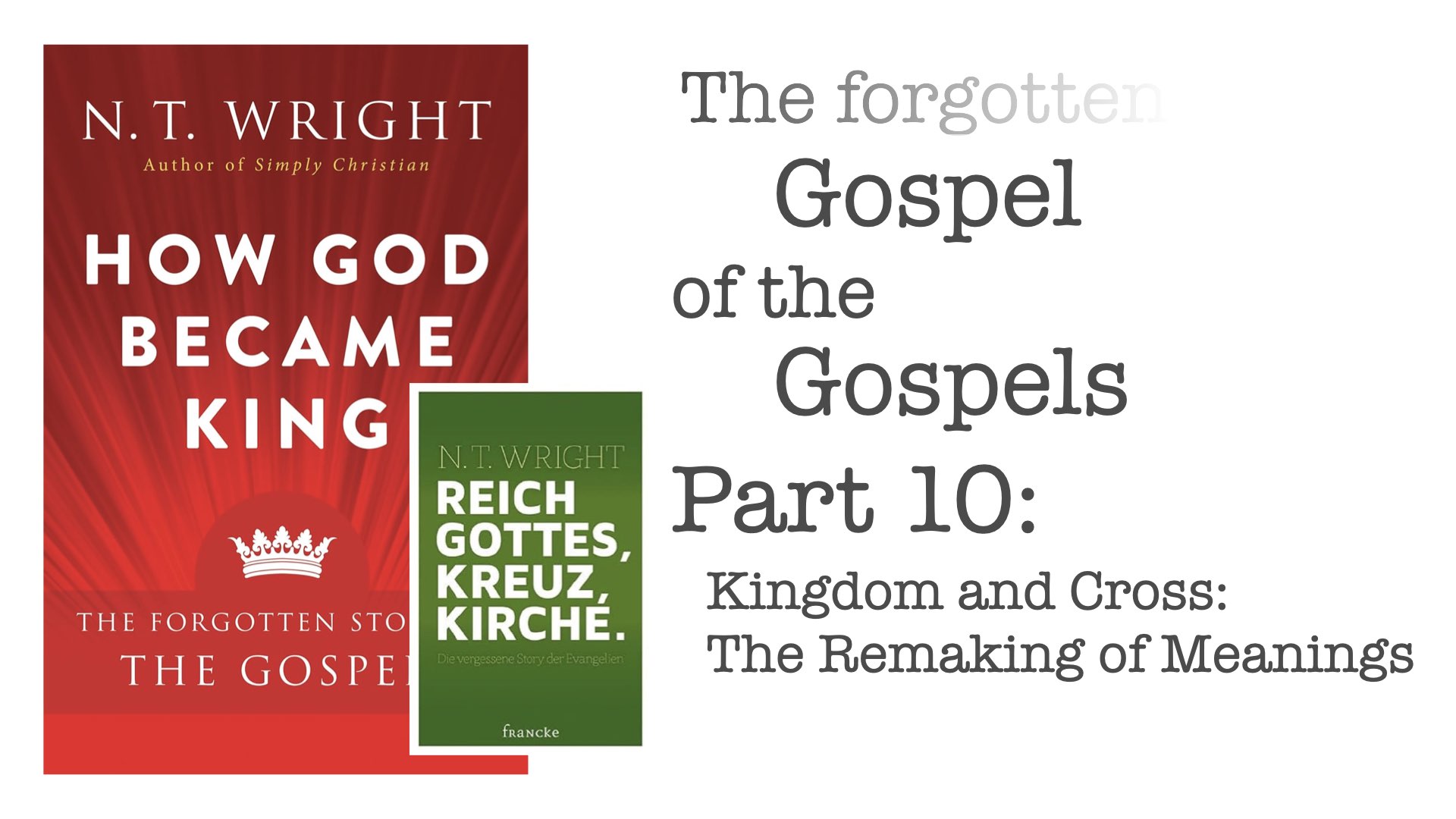
  • The Forgotten Gospel of the Gospels – Part 10: Kingdom and Cross: The Remaking of Meanings

    The Forgotten Gospel of the Gospels – Part 10: Kingdom and Cross: The Remaking of Meanings

    By Christian / N. T. Wright


    In the tenth chapter of N.T. Wright’s book How God Became King: The Forgotten Story of the Gospels, he explains why the kingdom and the cross are not as unrelated topics as we might think. I would like to quote his introduction to the chapter directly:

    We noted In part I of this book the way in which we have been conditioned to read the gospels as though the themes of the kingdom and the cross could be held at arm’s length from one another. As we have seen, one very popular understanding of the story the gospels tell is that Jesus’s public career began with a time of happy, early fulfillment, when every-thing seemed to be going well, but that it then turned a dark corner and ran into opposition, unpopularity, and finally arrest, trial, torture, and death. As I have tried to explain, this splitting apart of the story in the four gospels has come about because the story the writers actually tell simply didn’t fit the categories that centuries of readers, including some very devout ones, were bringing with them. But we should be in no doubt that, for the gospel writers themselves, there was never a kingdom message without a cross, and Jesus’s crucifixion never carried a meaning divorced from the launching of God’s kingdom. Our task now, having worked our way back into the gospels by means of adjusting the volume on the four crucial speakers, is to offer a positive statement of what happens when we treat kingdom and cross not as two themes, but essentially as one. We begin with two scenes that more or less bookend the whole presentation in each of the gospels: Jesus’s baptism and the „title“ on the cross. In each — and each is decisive as a marker for the writers’ meaning – we see exactly the combination of kingdom and cross that has proved so elusive in the history of interpretation.

    N.T. Wright How God Became King, chapter 10

    The tenth chapter is quite long – about 15% of the book! Therefore, I will only quote some of the main points and the argumentation leading to these statements will not be mentioned or only very briefly. Since the book is also available in German translation, I would like to refer to this.

    Baptism and Kingdom.

    The description of the baptism of Jesus in John 1 links these two themes:

    Jesus has not come simply as a „superman“ figure, a „divine hero“ parachuted into the world to sort out the mess. He has come – and the gospel story only makes sense if we take this very seriously – as the one who will embody Israel’s ultimate vocation in himself.

    The title „son of God“ expresses both halves of this complex and delicately balanced picture.

    The heavenly announcement that Jesus is „my son, my beloved one,“ the one with whom God is delighted ,indicates for those with biblically attuned ears that Jesus is marked out as the king of Psalm 2 and the servant of Isaiah 42:

    N.T. Wright How God Became King, chapter 10

    This reference to Psalm 2 and Isaiah 42 does not allow us to ignore the kingdom theme, since it features so prominently in it.

    All the signs are, rather, that the aim of incarnation and cross is precisely to establish God’s kingdom; that, after all, is what Jesus begins to say when, not long after his baptism, he begins his public career (Matt. 4:17, and parallels).

    In other words, with the echo of the opening words of the first „servant“ poem, the synoptic writers are not inviting their readers merely to contemplate Jesus as the one who dies so that sinners may be forgiven. They are invoking one of the primary scriptural passages in which Israel’s God, YHWH, establishes his sovereignty over the whole world, doing so indeed despite the failure of his own people to believe in him. He will rescue them through the servant’s work, but merely to do that is „too light a thing.“ He will provide, through the servant, „a light to the nations, that [his] salvation may reach to the end of the earth“ (49:6). At the heart of all this is the ultimate good news: „Your God reigns,“ malak elohayik (52:7). He is king, and has demonstrated this by overthrowing the pagan kingdoms and their idols, unveiling his worldwide justice, and inviting all and sundry to turn to him and enjoy the benefits of his renewed covenant and renewed creation (Isa. 54-55).

    The baptism narrative, therefore, in all the gospels, is not simply about Jesus’s „divine identity,“ on the one hand, or a particular program of „atonement,“ in the sense of a rescue from the world of creation, on the other. Yes, the gospels affirm Jesus’s divine identity. Yes, they affirm his death on the cross as the climax of God’s age-old plan of salvation. But the purpose of God coming incognito in and as Jesus and the purpose of this Jesus dying on the cross was – so the gospels are telling us – in order to establish God’s kingdom, his justice, on earth as in heaven. As in Psalm 2, the point is that in this way the nations are to be called to account. This is how the creator is bringing his creation back into proper shape.

    I think of the Emmaus road story, where the risen Jesus declares that the divine plan always involved the Messiah suffering and then „coming into his glory“ (Luke 24:26). We note that „coming into his glory“ does not mean simply „going to heaven“ in the normal sense; „glory“ is a way of saying „sovereign majesty,“ so that the saying exactly combines the two themes we are looking at. The crucifixion was the appropriate and long-prophesied way by which the Messiah would come to be king of all the world, and Luke’s second volume, the Acts of the Apostles, describes how that works out.

    N.T. Wright How God Became King, chapter 10

    The “title” on the cross

    The Latin word titulus was used to describe the public announcement of the offense for which the executed person had been held responsible. And Pilate had this proclaimed: “Jesus of Nazareth, King of the Jews.”

    In John’s gospel, it is repeatedly made clear that Jesus is the “Messiah”. This title is therefore the opposite pole to the realization of Jesus‘ first disciples in chapter 1 of John’s gospel. Of course, this title is also extremely ironic. Pilate knows that Jesus does not conform to any of the meanings of “king” that Pilate knows. He has redefined the meaning of “being king”. John is dealing with a theology of the kingdom here. As Paul writes, the rulers of the world had no idea what they were doing in the crucifixion. (1 Corinthians 2:8)

    The point for our present purpose is that, in all four gospels, readers are strongly urged to see Jesus’s death as explicitly „royal,“ explicitly „messianic“ — in other words, explicitly to do with the coming of the „kingdom.“

    Jesus, John is saying, is the true king whose kingdom comes in a totally unexpected fashion, folly to the Roman governor and a scandal to the Jewish leaders.

    N.T. Wright How God Became King, chapter 10

    “You are the Messiah”

    A key passage here is Mark 8:27-30, where Peter says these words: “You are the Messiah.”.

    This functions as the midpoint in Mark, looking back to the voice at the baptism and forward to the paradoxical question of Caiaphas at the trial („Are you the Messiah, the Son of the Blessed One?“ 14:61, which is a statement in Greek; it gets turned into a question by the punctuation and presumably the tone of voice) and then the centurion’s statement at the foot of the cross („This fellow really was God’s son,“ 15:39).

    The Messiah is to come into his kingdom through a horrible death; and those who not only follow him, but are called to implement his work must expect that their royal task – for such it is– will be accomplished in the same way, by the same means. There is every sign that the earliest church understood this very well indeed, just as there is every sign (alas) that today’s church does not — except, of course, in those parts of the world, like China and the Sudan, where there has been no choice.

    N.T. Wright How God Became King, chapter 10

    Peter’s words, “You are the Messiah,” therefore mean, “You are Israel’s Messiah,” as Paul confirms in Romans 8:3-4 and Galatians 4:4-7.

    What the four gospels are eager to tell us, then, is that the messianic kingdom that Jesus is bringing will come through his suffering and indeed through the suffering of his followers. But it is Jesus’s own suffering in particular, gradually revealed as unique and uniquely effective, that is highlighted as the gospel narratives proceed. The key text of Mark 9:1 and parallels, so often read as an unfulfilled prediction of an imminent „second coming“ or even of the „end of the world,“ was never intended that way by the evangelists or, I believe, their sources or earlier traditions. Coming at the conclusion of Jesus’s prediction of suffering for himself and his followers, this is what the text says:

    N.T. Wright How God Became King, chapter 10

    „I’m telling you the truth,“ Jesus said; „some people standing here won’t experience death before they see God’s kingdom come in power.“

    Mark 9:1

    But doesn’t the parallel text in Matthew 16:28 seem to say something different?

    „Some of those standing here will not taste death until they see ‚the son of man coming in his kingdom.’“

    Matthew 16:28

    But this understanding is itself based on an assumption that, however commonplace, is deeply misguided, namely, that „the coming of the son of man“ in the New Testament refers to the „coming“ to earth of one presently in heaven.

    In Daniel, „one like a son of man,“ in other words, „a human figure,“ „comes“ from earth to heaven to be presented before the „Ancient of Days.“ It is a move from suffering and humiliation to enthronement and sovereignty.

    N.T. Wright How God Became King, chapter 10

    Matthew does not think that the words of Matthew 16:28 refer to a time far in the future, but to Jesus‘ death and resurrection, which Jesus referred to only a few verses before. Mark adds “in power” in 9:1 and Luke speaks of “God’s Kingdom” in 9:27.

    These parallel verses, in the intention of all three evangelists, are best read as indicating a kingdom fulfillment that they, the authors of the gospels in question, believe had already come to pass in the death and resurrection of Jesus.

    They believed this, of course, because of Jesus’s resurrection – just as it was disbelief in the bodily resurrection that made scholars from Reimarus to Bultmann and beyond assume that there must still be some great coming event to which the evangelists were referring. Such scholars have normally supposed this great coming event to be the Parousia. The word parousia is a Greek term meaning „royal presence“ or „divine appearing,“ or perhaps both. It has become the regular technical term used by New Testament scholars to refer to Jesus’s „second coming“ and its supposed attendant phenomena, which, they maintain, the early church believed to be „imminent.“ Early Christians thought, say these scholars, that the Parousia would be the final kingdom-bringing moment. That scholarly mistake has fused with the dispensationalism of popular (mostly American) subculture and speculation to give the present state of confusion about the „end-times“ that is so prominent a feature of today’s American church life.

    N.T. Wright How God Became King, chapter 10

    Narrating the cross

    It has often been assumed that the four evangelists, in recounting the events that led to Jesus’s crucifixion, are doing so with minimal intention to offer theological interpretation of those events. To take a step back once more, when people write about „atonement theology,“ the tendency has been to go to Paul and Hebrews and to come to the gospels only for those detached phrases that will support (or so it seems) the kind of „theological“ construct that has already been culled from Paul. The actual narratives of Jesus’s arrest, trial, and crucifixion have, to be sure, been combed for hints of „meaning,“ and this has been found not least in the use of the Old Testament, of passages like Psalm 22:1.

    The trials, in other words, address the theological and soteriological „why“ of the cross, not only the „how.“

    N.T. Wright How God Became King, chapter 10

    The great scene in John with Jesus and Pilate gives us the reasons for the cross, and these are kingdom reasons. However, N.T. Wright also points out a common misunderstanding here:

    Jesus once again takes the initiative in the conversation, introducing the discussion of different types of „kingdoms.“ „My kingdom isn’t the sort that grows in this world,“ he says (18:36). (We note here that the regular translation, „My kingdom is not of this world,“ has contributed to, and in its turn also generated, multiple misreadings of all four gospels, appearing to suggest that Jesus’s „kingdom“ is straightforwardly „otherworldly.“ The Greek for „of this world“ is ek tou kosmou toutou; the ek, meaning „out of“ or „from,“ is the crucial word.) There is no question but that Jesus is speaking of a „kingdom“ in and for this world.

    N.T. Wright How God Became King, chapter 10

    And so Jesus emphasizes that this is exactly what must happen when God’s kingdom successfully paves its way – not with violence but nonviolently. “And in the broader Johannine perspective, we discover that the only word that does justice to this combination of kingdom and cross is agape, ‘love’.”

    I will omit the analysis of John 19 for once and just give his summary:

    Gradually, inch by inch, in a narrative heavy with ironic kingdom theology, we discover the theological „why“ of the cross within the historical „how.“ As we should have realized all along, the „lifting up“ of Jesus on the cross is his exaltation as the kingdom-bringing „king of the Jews,“ because the kingdom that ist hus put into effect is the victory of God’s love. Kingdom and cross fully joined.

    The famous tetelestai in 19:30 („It’s all done!“) matches the synetelesen in Genesis 2:2 („God finished the work that he had done“)

    The cross serves the goal of the kingdom, just as the kingdom is accomplished by Jesus’s victory on the cross.

    N.T. Wright How God Became King, chapter 10

    Temple, Kingdom and Cross

    It is difficult for us to grasp the central importance of a temple and especially of the temple in Jerusalem for devout Jews. If we think of it like a modern religious building – for example, a cathedral or a mosque – then we are quite off base. It is now widely recognized that in ancient times there was no separation of ‚religion‘ and other things such as ‚politics‘, ‚culture‘ or ‚economics‘.

    It would have made no sense in Judaism in particular. Not only was the Temple the center of the whole national life. It was, Jews believed (as many ancient peoples believed about their temples) the place where heaven and earth themselves interconnected and overlapped.

    „Heaven,“ after all, was seen as the throne room, the place from which „earth“ would be ruled. But if „heaven“ came to be linked with a particular point on“earth,“ then that point was where power was concentrated. Divine power. Theocracy. The kingdom of God.

    And the gospels tell the story of Jesus as the story of a one-man walking temple. Early on in the story we find the hints. „Who then is this?“ people ask as Jesus does remarkable things, speaks and acts with authority, behaving as if he is the one who’s now in charge. Jesus is portrayed by the gospels as a one-man apocalypse, the place where heaven and earth meet, the place where and the means by which people come and find themselves renewed and restored as the people of the one God, the place where power is redefined, turned upside down or perhaps the right way up.

    The evangelists are in no doubt: Jesus is the reality, the place where Israel’s God now dwells, the human being in and through whom the one who called Abraham and uttered his voice from Sinai had now returned to judge and to save. Jesus is the reality, and the present Temple and its official spokesmen must give way before him. It is no accident, from the evangelists‘ point of view, that when Jesus finally breathes his last, the veil of the Temple is torn in two from top to bottom (Mark 15:38).

    For a genuinely Jewish vision of theocracy, you need God in the midst of it. But what the gospels offer us — especially John, but actually all of them — is a God who is in the midst in and as Jesus the Messiah, and a God who is then committed to remaining in the midst, through Jesus, in the person of the Spirit. Jesus himself is the new Temple at the heart of the new creation, against that day when the whole earth shall be filled with the glory of God as the waters cover the sea.

    It is much, much more. It is the moment when the story of Israel reaches its climax; the moment when, at last, the watchmen on Jerusalem’s walls see their God coming in his kingdom; the moment when the people of God are renewed so as to be, at last, the royal priesthood who will take over the world not with the love of power but with the power of love; the moment when the kingdom of God overcomes the kingdoms of the world. It is the moment when a great old door, locked and barred since our first disobedience, swings open suddenly to reveal not just the garden, opened once more to our delight, but the coming city, the garden city that God had always planned and is now inviting us to go through the door and build with him. The dark power that stood in the way of this kingdom vision has been defeated, overthrown, rendered null and void. Its legions will still make a lot of noise and cause a lot of grief, but the ultimate victory is now assured. This is the vision the evangelists offer us as they bring together the kingdom and the cross.

    N.T. Wright How God Became King, chapter 10

    Kingdom and cross in mutual interpretation

    Once you realize that the kingdom and the cross are linked in the Gospels, it is possible to look at one from the perspective of the other. N.T. Wright offers three reflections on this. First, the kingdom from the perspective of the cross:

    First, the evangelists insist that the kingdom truly was inaugurated by Jesus in his active public career, during the time between his baptism and the cross. That entire narrative is the story of „how God became king in and through Jesus.“

    Second, this kingdom is radically defined in relation to Jesus’s entire agenda of suffering, leading to the cross.

    Third, the kingdom that Jesus inaugurated, that is implemented through his cross, is emphatically for this world.

    N.T. Wright How God Became King, chapter 10

    “What, in other words, do we learn about the cross when we discover that the gospels present it as the means by which God (in Jesus) becomes king of the world?”

    First, the way we have normally listed options in atonement theology simply won’t do. Our questions have been wrongly put, because they haven’t been about the kingdom. They haven’t been about God’s sovereign, saving rule coming on earth as in heaven. Instead, our questions have been about a „salvation“ that rescues people from the world, instead of for the world. „Going to heaven“ has been the object (ever since the Middle Ages at least, in the Western church); „sin“ is what stops us from getting there; so the cross must deal with sin, so that we can leave this world and go to the much better one in the sky, or in „eternity,“ or wherever. But this is simply untrue to the story the gospels are telling – which, again, explains why we’ve all misread these wonderful texts. … But the idea of messianic victory as a fresh interpretation of an ancient Jewish theme is precisely what the four gospels have in mind.

    Second, however, when we see the cross in the light of the kingdom, we discover a fresh and helpful framework for understanding the vexed questions that surround substitutionary atonement. … As for the gospels themselves, there should be no doubt that they follow this line. Jesus, for them, is dying apenal death in place of the guilty, of guilty Israel, of guilty humankind. Through his death, the evangelists are telling their readers there will come the jubilee event, the great redemption, freedom from debts of every kind, which he had earlier announced and which is the central characteristic of the kingdom.

    Third, if the cross is to be interpreted as the coming of the kingdom on earth as in heaven, centering on some kind of messianic victory, with some kind of substitution at its heart, making sense through some kind of representation, then the four gospels leave us with the primary application of the cross not in abstract preaching about „how to have your sins forgiven“ or „how to go to heaven,“ but in an agenda in which the forgiven people are put to work, addressing the evils of the world in the light of the victory of Calvary.

    N.T. Wright How God Became King, chapter 10

    Kingdom, Cross, Resurrection and Ascension

    In addition to the kingdom and the cross, we also find the resurrection and the ascension in the gospels. Regarding the resurrection, N.T. Wright has written in more detail about this in his book Suprised by Hope, and I had published a series on it. In this context, the resurrection is important, of course, because without it the evangelists would not have had a story to tell. After all, thousands of other young Jews were crucified at the same time. The evangelists highlight several different aspects:

    The resurrection is, from Mark’s point of view, the moment when God’s kingdom „comes in power.“ From John’s point of view, it is the launching of the new creation, the new Genesis. From Matthew’s point of view, it brings Jesus into the position for which he was always destined, that of the world’s rightful Lord, sending out his followers (as a new Roman emperor might send out his emissaries, but with methods that match the message) to call the world to follow him and learn his way of being human. From Luke’s point of view, the resurrection is the moment when Israel’s Messiah „comes into his glory,“ so that „repentance for the forgiveness of sins“ can now be announced to all the world as the way of life, indeed, as they say in Acts, as The Way.

    N.T. Wright How God Became King, chapter 10

    In fact, the resurrection has further consequences.

    Heaven and earth are now joined in the person — in the risen body! – of Jesus himself

    He therefore sends out his followers, equipped by his own Spirit (if the ascension locates a part of „earth“ in „heaven,“ Pentecost sends the breath of heaven to earth), to celebrate his sovereignty over the world and make it a reality through the founding of communities rescued by his love, renewed by his power, and loyal to his name.

    When, therefore, at the start of Acts, the disciples ask Jesus whether this is the time for him to „restore the kingdom to Israel“ (1:6), his answer is not (as people often suppose) a „no.“ It is a „yes.“ As so often, however, it is a „yes but“:

    And that „witness,“ as Luke has made abundantly clear, is not a matter of „telling people about your new religious experience“ or of informing them that there is now a new prospect of a much better other-worldly destiny than anything the bleak pagan world had to offer. The „witness“ of Jesus’s followers is the message that there is now „another king, Jesus“ (Acts17:7). It is the witness according to which the temples that presently exist, whether in Jerusalem, Athens, Ephesus, or anywhere else, are now to be seen as at best redundant (Acts 7) and at worst a blasphemous category mistake (Acts 17; 19). Jesus is the true Temple, now ruling the world as the one who was crucified; 

    N.T. Wright How God Became King, chapter 10

    And with that, we have arrived at the end of chapter 10. There were probably some new, unfamiliar thoughts. I have largely omitted the explanations using the text of the New Testament so that this text does not become too long. And it is probably also better to read these in his book and to understand them at your leisure. The main aim here is to convey these new – or actually very old and only new to us – thoughts. A renewed view of the Gospels that can be seen when the traditional explanations, classifications and interpretations are left out and the text of the Gospels is dealt with directly. In the next part, we will see that even the old creeds can be read and understood again in accordance with and on the basis of the Gospels.

  • The Forgotten Gospel of the Gospels – Part 9: Kingdom and Cross in 4 Dimensions

    The Forgotten Gospel of the Gospels – Part 9: Kingdom and Cross in 4 Dimensions

    By Christian / N. T. Wright


    In the ninth chapter of N.T. Wright’s book How God Became King: The Forgotten Story of the Gospels, we now come to the central message of his book:

    All four gospels are telling the story of how God became king in and through this story of Jesus of Nazareth.

    The story Matthew, Mark, Luke, and John tell is the story of how God became king—in and through Jesus both in his public career and in his death.

    N.T. Wright How God Became King, chapter 9

    Since this is already episode 9 of this series, but only about half of the 300 pages have been covered, I will now be more brief. The English book is also available in German translation as a paperback.

    Kingdom, Cross and Israel

    earlier, offering the story of Jesus as the completion of the story of Israel, in what sense is it now complete? How has it been fulfilled? The answer seems to lie, for the gospel writers themselves, in the dark strand that emerges at various stages of the tradition of ancient Israel. As the psalms and prophets sharpen up their vision of how God’s kingdom is to come to the world, there emerges a strange and initially perplexing theme: Israel itself will have to enter that darkness.

    N.T. Wright How God Became King, chapter 9

    As evidence for this, N.T. Wright cites Psalm 22. And that both Matthew 27:46 and Mark 15:34 quote the opening words of Psalm 22 as Jesus‘ words on the cross. This suffering is also found in Isaiah 52 and 53, which is followed by true triumph in 54 and 55.

    When we see the story of Jesus as the climax of the story of Israel, we should not be surprised to discover that the suffering of Israel and of Israel’s supreme representative is to be understood as part of the longer and larger purposes of Israel’s God, in other words, the establishment of his world-wide healing sovereignty. Conversely, we should not be surprised to discover that when this God finally claims the nations as his own possession, rescuing them from their evil ways, the means by which he does it is through the suffering of his people – or, as in the story the gospels themselves are telling, the suffering of his people’s official, divinely appointed representative.

    N.T. Wright How God Became King, chapter 9

    Kingdom, Cross and God

    N.T. Wright proves that God is the savior of his people with Isaiah 63 and Ezekiel 34. The reference is found especially in John 10 (but also Luke 15:3-7 for example). The way the story of Jesus is developed, it exactly reflects the return of the God of Israel. How is that to be understood?

    To be sure, neither John nor any of the others makes the mistake one often encounters in popular parlance, of saying „Jesus is God“ without remainder. Jesus constantly refers to „the father“ both as distinct from himself and as bound with him in a tight bond of love and obedience. And the point to be made here for our present purposes is that in this central „incarnational“ passage we find the themes of cross and kingdom once more tightly interwoven. This reinforces the warning we gave earlier, that it is possible to state the doctrine of Jesus’s „divinity“ in such a way as to let it float loose from both kingdom and cross, but this is what the New Testament never does. The „God“ who has become human in Jesus is the God who, as he had always promised, was returning to claim his sovereignty over the whole world (note the „other sheep“ in John 10:16) and would do so by himself sharing the pain and suffering of his people, „laying down his life for the sheep.“

    How can we even begin to understand this? Perhaps we should say that, with the hindsight the evangelists offer us, God called Israel to be the means of rescuing the world, so that he might himself alone rescue the world by becoming Israel in the person of its representative Messiah.

    N.T. Wright How God Became King, chapter 9

    For further explanations and supporting documents, I would like to refer you to the book by N.T. Wright (there are quite a few pages, in fact…).

    Kingdom, Cross and Church

    The activity of Jesus is presented in the Gospels as it was by the earlier prophets: Israel must turn back and live according to its true calling. His followers were convinced that this renewal had indeed begun. “Israel had not been rejected. It has not been ‘replaced’. It has been transformed.” His first disciples did not understand this:

    Part of the meaning of the kingdom, in the four Gospels, is precisely the fact that it bursts upon Jesus’s first followers as something so shocking as to be incomprehensible.

    N.T. Wright How God Became King, chapter 9

    It took his death, resurrection, ascension and the dramatic events of Pentecost. “The story of the gospel of Jesus, seen as the beginning of the renewed people of God, includes as a central element the lack of understanding, the failure and the rebellion of this people, until it is transformed by the resurrection into a new faith and inspired by the Spirit to new obedience.” It was not about abstract theology, but a pattern for their lives. And they were well aware that this pattern would also include suffering as a central and meaningful element: lack of understanding, their own suffering and perhaps even death.

    N.T. Wright expands on this idea in the book with many more details..

    Kingdom and Cross in Caesar’s World

    From all that we examined in Chapter 7, it is clear that all four gospels regard the story of Jesus not only as the confrontation between God’s kingdom and Caesar’s kingdom, but as the victory of the former over the latter.

    Jesus, after all, has come to Jerusalem and found the Temple no longer to be the place where heaven and earth do business, but the place where mammon and violence are reigning unchecked, colluding with Caesar’s rule. Jesus himself, the evangelists are saying, is now the place where heaven and earth come together, and the event in which this happens supremely is the crucifixion itself. The cross is to be the victory of the „son of man,“ the Messiah, over the monsters; the victory of God’s kingdom over the world’s kingdoms; the victory of God himself overall the powers, human and supra human, that have usurped God’s rule over the world. Theocracy, genuine Israel-style theocracy, will occur only when the other „lords“ have been overthrown.

    Without the cross, the satanic rule remains in place. That is why the cross is, for all four gospels (and, as I have argued else where, for Jesus himself) the ultimate messianic task, the last battle. The evangelists do not suppose that the cross is a defeat, with the resurrection as the surprising overtime victory. The point of the resurrection is that it is the immediate result of the fact that the victory has already been won. Sin has been dealt with. The „accuser“ has nothing more to say. The creator can now launch his new creation.

    N.T. Wright How God Became King, chapter 9

    This, too, is explained in more detail, of course, so I would like to refer to the book itself.

  • The Forgotten Gospel of the Gospels – Part 8: Where we got stuck: Enlightenment, Power, and Empire

    The Forgotten Gospel of the Gospels – Part 8: Where we got stuck: Enlightenment, Power, and Empire

    By Christian / N. T. Wright


    In the eighth chapter of N.T. Wright’s book How God Became King: The Forgotten Story of the Gospels, the point is to become aware of the multi-layered, complex and rich content of the Gospels. Because in the past, exactly the opposite has happened.

    Making the gospels ordinary

    N.T. Wright formulates the problem as follows:

    Near the heart of my purpose in this book is to suggest that not only have we misread the gospels, but that we have made them ordinary, have cut them down to size, have allowed them only to speak about the few concerns that happened to occupy our minds already, rather than setting them free to generate an entire world of meaning in all directions, a new world in which we would discover not only new life, but new vocation.

    N.T. Wright How God Became King, chapter 8

    This happened, for example, because the topics “kingdom” and “cross” are considered separately, although the Gospels bring both together.

    The separation of the kingdom and the cross

    First of all, we need to recognize that the four gospels effortlessly bring together many things into a rich unity that later traditions separated from each other. For a long time, there have been the opposing positions of “Kingdom Christians” with their social gospel and “Cross Christians” with their “save your soul for heaven” agenda.

    But first-century Greeks, Romans and Jews did not think in separate categories such as politics and religion.

    Likewise, modern philosophers today separate the question of the “problem of evil” from what modern theologians call “atonement”. In the Gospels, the two topics are linked. N.T. Wright has written about this in his book Evil and the Justice of God, which I might do a series on at some point.

    „But the problem we face lies deeper within the mind-set of the critical scholarship of the past two hundred years.“ If Jesus was talking about God’s kingdom, it was understood in terms of the usual armed revolution, and that couldn’t have happened yet. And if it was understood as a reference to the end of the world – well, that hadn’t happened yet either. Although the words in Mark 9:1 are quite clear: “Some people standing here, won’t experience death before they see God’s kingdom come in power.”

    obscure, but because the philosophy of the European Enlightenment demanded that they close their eyes to it, was that Jesus announced and inaugurated a vision of God’s kingdom that he was constantly redefining, through actions and parables, and that would be inaugurated by his own vindication. The importance of Daniel 7, of the exaltation and vindication of the “one like a son of man,” cannot be over-stressed here—and of course it is at that very point that critical scholarship has again done its best to neutralize a central element of the evidence.

    N.T. Wright How God Became King, chapter 8

    The writers of the New Testament, on the other hand, did their best to make this point clear. Matthew thought that Jesus had already achieved this: it: “All authority,” declares Matthew’s Jesus, “in heaven and on earth has been given to me”. (Matthew 28:18) You cannot understand Paul’s letters like Romans, 1 Corinthians and Philippians without this understanding. And in the Revelation of John, the sovereignty of Jesus is celebrated from the first to the last page. But of course, not for a second did any of these authors think that utopia had already arrived.

    The early Christian writers were, of course, setting forth an eschatology that had been inaugurated, but not fully consummated; they were celebrating (Paul is quite explicit on this point in 1 Cor. 15:20–28) something that has already happened, but at the same time something that still has to happen in the future. They believed themselves to be living between Jesus’s accomplishment of the reign of God and its full implementation.

    New creation itself has begun, they are saying, and will be completed. Jesus is ruling over that new creation and making it happen through the witness of his church. “The ruler of this world” has been overthrown; the powers of the world have been led behind Jesus’s triumphal procession as a beaten, bedraggled rabble. And that is how God is becoming king on earth as in heaven. That is the truth the gospels are eager to tell us, the truth the past two hundred years of European and American culture has been desperately trying to stifle.

    N.T. Wright How God Became King, chapter 8

    For the disciples of Jesus in the first century, this was the turning point in human history. Christianity was supposed to be an eschatology: “This is how history should turn out, despite appearances!” But since the thinkers of the Enlightenment to this day believe that their time is the turning point in human history, after which everything will be better, Christianity was reduced to a religion: “Here is a way to be spiritual.”

    How did Christians react to this?

    Christian reactions

    One reaction over the past two hundred years has been to say that it’s not really that important, because we’re going to heaven anyway. But that is not at all what the evangelists thought; rather, it is closer to Gnosticism. You can find more about this in the series on N.T. Wright’s book “Surprised by Hope”.

    Another school of thought says that the church should simply keep its house in order and be a shining example for others. And otherwise, please do not get involved in the world. However, this does not fit with Jesus‘ claim in Matthew 28 and runs the risk of ignoring the part of Christian thinking in relation to creation.

    A third and fourth reaction has simply sanctioned the right or left wing of the political spectrum (especially in the USA).

    Behind these different reactions, however, one can also recognize one of the modern contexts with which the Gospels are then read. But if we want to let the Gospels speak for themselves, then we have to read them in their context.

    Power and empire within first-century Judaism

    In the period after the exile and up to the first century, the Jews had a fairly clear idea of the relationship between God and the kingdom: although many were waiting for the predicted complete rule of God, they also believed that He was somehow sovereign over the nations even now. Since God did not want the world to plunge into utter chaos, He allows kings to rule. Even if he does put them in their place, as in the case of Nebuchadnezzar and Belshazzar in the Book of Daniel.

    The Jews assumed, on the basis of their strong creational theology, that the creator had made the world in such a way as to be properly ordered and run by human beings. The Jewish vision of theocracy, of God being in charge, was always one of a rule mediated through his image-bearers, that is, through human beings.

    society. In a genuinely creational monotheism, the world works best when ruled by wise stewards, human beings who are humble before God and hence effective in bringing fruitful order to his world.

    N.T. Wright How God Became King, chapter 8

    The Jews also didn’t seem to be particularly interested in how a ruler came to power, but rather in what he did afterwards. And the Jews in the first century also knew all about bad rulers – Jewish or pagan. What many wanted was a theocracy. But this was neither a theocracy like the one Calvin enforced in Geneva, nor like the one that is enforced today by no less radical Muslims. In the Psalms, in Isaiah and in many other biblical and later texts, the Messiah, the anointed king, is the central figure. And in Psalm 2, 72 and similar passages, it becomes clear that the Messiah would become the anointed king not only for God’s Jewish people.

    N.T. Wright summarizes it as follows:

    So, to sum up this very long but necessary introduction. Judaism always assumed that the creator God wanted the world to be ordered and ruled by his image-bearing humans. The world, heaven and earth, was created as God’s temple, and his image-bearers were the key elements in that temple. But the world was out of joint through the failure of humans in general and Israel in particular, so God the creator would have to act in judgment and justice to hold them to account. And the sign of that coming judgment was that at the heart of the world God had placed his covenant people, gathered around the Temple, which was the microcosm of creation, to celebrate his true order and to pray for it to come on earth as in heaven.

    The significance of the Temple as the fulcrum of ancient Jewish theocracy, actual and eschatological, cannot be overemphasized.

    N.T. Wright How God Became King, chapter 8

    That is the context of the people with whom Jesus spoke, and the context of Jesus‘ disciples and the evangelists.

    As we turn now, none too soon, to consider the themes of kingdom and cross, we note that for all the evangelists, as for Paul, there is no sense of the kingdom not after all having appeared. Yes, it has been redefined. Yes, there is still more to do, as long as evil continues to stalk the earth. But the early Christians all believed that with Jesus’s death and resurrection the kingdom had indeed come in power, even if it didn’t look at all like they imagined it would. The hope had been realized, even though it had been quite drastically redefined in the process. A new theocracy had indeed been inaugurated, because the Temple where God lived among his people had been radically redefined. A new empire had been launched that would trump Caesar’s empire and all those like it, not by superior force but by a completely different sort of power altogether. And the place where this vision is set out is, to the great surprise of many who at one level know these documents well, the collection of the four gospels we find in the New Testament.

    N.T. Wright How God Became King, chapter 8