
By Christian
Other important contributions to the new perspective on Paul came from N. T. Wright. „One of the characteristics of his position is how he sets Paul’s theology within the larger biblical story (narrative) of God’s work with Israel.“
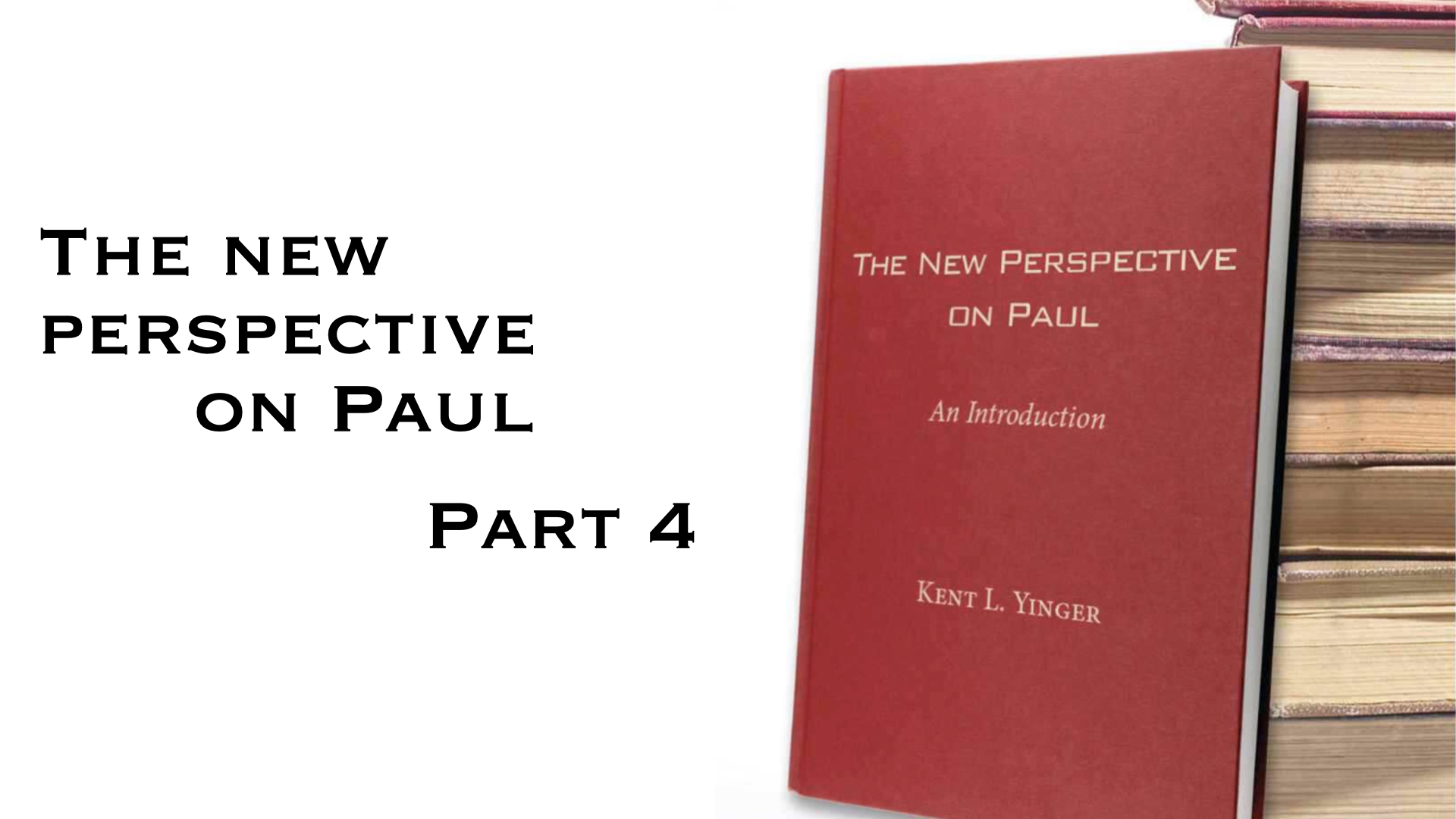
[Also in this part, the quotes are from the book „The New Perspective on Paul – An Introduction“ by Prof. Kent L. Yinger, which forms the basis for this series.]
Paul’s letters should be understood with this context in mind:
God’s intention for humanity and creation was temporarily derailed through Adam’s sin (Gen 1–11). The resolution of this dilemma was the family of Abraham, Israel, through whom the divine blessing was to extend to all humanity (Gen 12).
However, the Jewish people failed as well to fulfill their role as the instrument of God’s blessing to the world. Instead of being the light for the nations, they wandered from their covenant obligations, ultimately into exile. It would, thus, be left up to Israel’s representative to fulfill Adam’s originally intended role under God. Messiah Jesus is Israel, the seed of Abraham, the son of God, and his obedience, death, and resurrection are Israel’s obedience, death, and resurrection. He is the climax of God’s covenantal dealings with Israel and humanity (Adam). Notice, for Wright the story is less about sinful individuals being rescued from judgment for guilt (although it is, for him, also about that),2 and more about God’s fulfillment of his purposes for all creation through Israel.
Chapter 4
How does this relate to the topic of rescue?
Israel’s failure was not “legalism” or “works-righteousness,” but “national righteousness, . . . the belief that fleshly Jewish descent guarantees membership of God’s true covenant people.”3 Elsewhere Wright terms this a “charter of national privilege.” Rather than fulfilling her vocation as a light to the nations, Israel viewed herself in exclusive possession of God’s blessings; and only those who became a member of Israel (signified for males by circumcision) could have access to these same blessings. (This corresponds to Dunn’s take on “works of law.”) However, as John the Baptist had already stated to the nation,
Chapter 4
Do not presume to say to yourselves, “We have Abraham as our ancestor”; for I tell you, God is able from these stones to raise up children to Abraham. Even now the ax is lying at the root of the trees; every tree therefore that does not bear good fruit is cut down and thrown into the fire.
Matthäus 3:9-10 NRSV
We have thus outlined the essential parts of the new view of Paul, at least as far as the mainstream is concerned:
- First-century Judaisms were not legalistic, but were characterized by covenantal nomism—saved by God’s grace and obligated to follow his ways.
- Since Jews were not espousing works-righteousness, Paul was not opposing legalism in his letters.
- Instead, at issue was a question of social identity: “Who belongs to the people of God and how is this known?” i.e., does one have to be Jewish—be circumcised, keep food laws, celebrate Sabbath, etc.—in order to inherit the promises to Abraham?
- Paul does not differ from most other Jews as to the roles of grace, faith, and works in salvation; where he differs is the conviction that Jesus is Israel’s Messiah and the Lord of all creation. No longer is Torah the defining center of God’s dealings; what counts now is belonging to Christ.
Various scholars have also dealt intensively with certain formulations and frequently used terms:
Don Garlington, for instance, has explored the importance of Paul’s phrase, “the obedience of faith” (Rom 1:5; 16:26). His work highlights the eschatological, or already/not-yet nature of justification. Believers are already justified by grace through faith in Christ. Yet, they still await final justification (or vindication, deliverance from final wrath). This makes sense, according to Garlington, once we see that all of Christ’s benefits are available only “in Christ,” that is, via union with Christ. Thus, for Paul it is necessary not only to begin the journey of faith in Christ, but equally to persevere in “the obedience of faith” to the end, that is, to remain “in Christ.”
Chapter 4
My own [Yinger] work also falls clearly within the NPP camp. In particular, Paul, Judaism and Judgment According to Deeds attempts to demonstrate that Paul did not break with his Jewish convictions regarding the role of works, or obedience, in final salvation. His insistence that Christ-believers would be judged according to their deeds (for salvation) reiterates both the language and the concepts he had earlier learned.
Chapter 4
For all of us must appear before the judgment seat of Christ, so that each may receive recompense for what has been done in the body, whether good or evil.
2. Corinthias 5:10 NRSV
There are several other scholars with additional, further or divergent interpretations, which I will not go into here for the sake of time.
As a scholar, it is best to be somewhat cautious with one’s assertions and limit oneself to what one can prove with certainty. However, since this is also to a large extent about the interpretation of Paul’s texts, I would like to conclude this section with a somewhat pointed formulation.
Anyone who believes that faith in Christ alone is necessary for salvation (*) in order to receive this grace, and that one’s own works are completely unimportant, is not following Christ or Paul, but Martin Luther and traditional Protestantism.
(*) I will leave out theological subtleties such as justification, sanctification, synergism etc. here.
„But what about this text….“ I can already hear. That comes in the next part.