
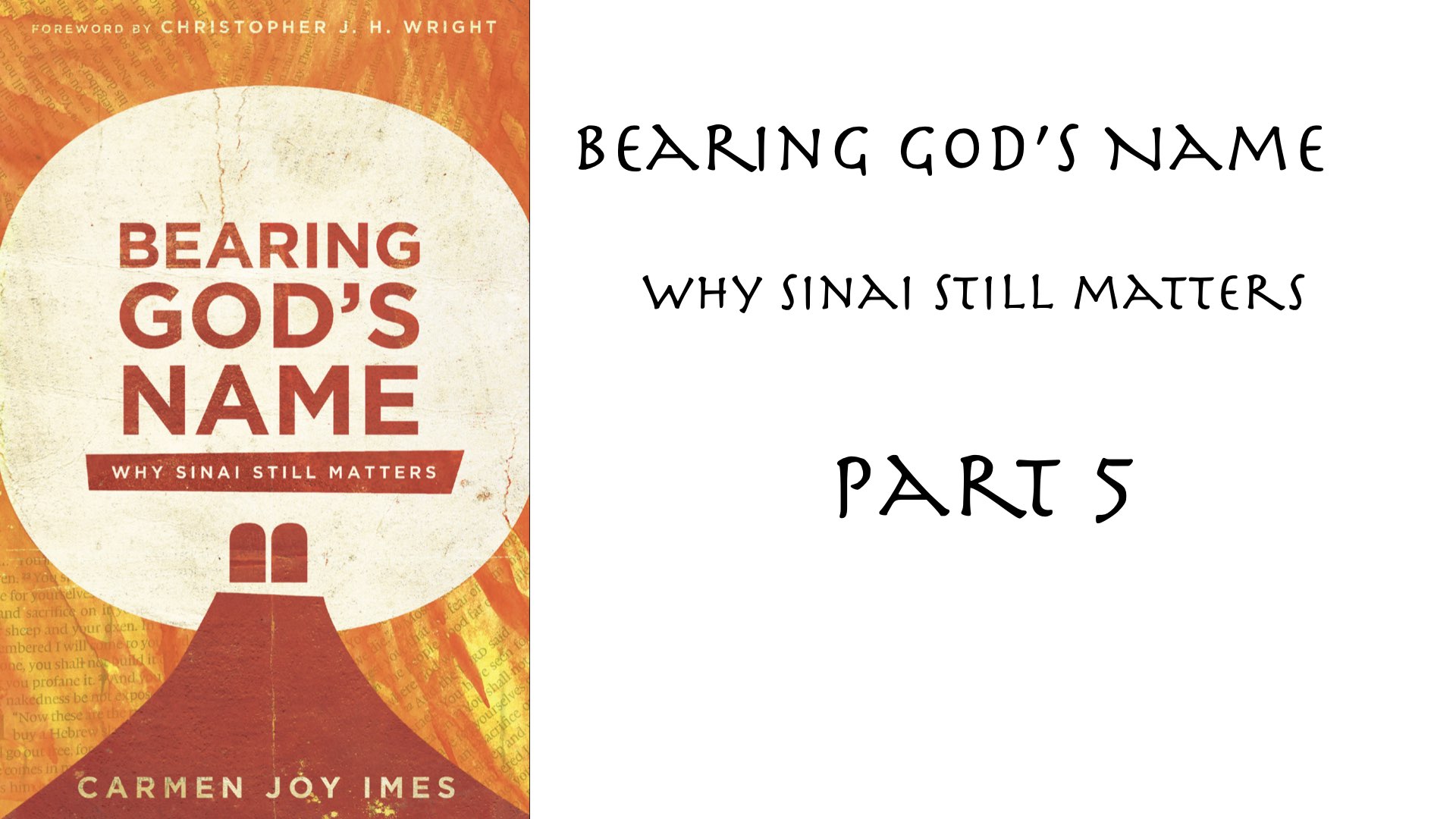
By Christian / Carmen Joy Imes
In this series, we are looking at thoughts from the book Bearing God’s Name – Why Sinai still matters by Carmen Joy Imes.
In view of what we have looked at in the first 4 parts, the question arises all the more: was that the end of the covenant between God and the Israelites? But then what about the promise he had already made to Abraham that this would be a blessing for all people?
Who let you in? – Gentiles and the Mission of God
In 1 Peter 2:9-10 we find the answer, although it could easily be missed by someone who only knows the New Testament. But now that we have already dealt with this topic in the Old Testament, we can recognize what came to the minds of Jewish Christians in the first century when they heard this passage:
And now you’ve become a chosen race, a royal priesthood, a holy nation, and a people who were specially selected to announce the virtues of the One who called you out of darkness and into His wonderful light. So, although you haven’t always been a nation, you’re now a nation of God! And although you once knew no mercy, you’re the ones who are now being shown mercy!
1 Peter 2:9-10 2001 Translation
Do the words sound familiar? We have quoted them before:
Now, if you’ll listen to what I say and keep My Sacred Agreement, you’ll be a special people to Me that will be higher than all other nations! ‘And because the whole earth is Mine, you’ll become My holy nation and a Kingdom of Priests.’ ‘Now, [go] and tell this to the children of IsraEl!’
Exodus 19:5-6 2001 Translation
By naming the titles from the covenant and thus referring to Exodus 19:5, we also have a reference to Yahweh’s segullah – his personal, special property But to whom are the words in 1 Peter addressed? To the disciples of Jesus in Asia Minor, who are Gentiles! That is why we also read: „In the past you were not his people.“.
But 1 Peter goes one better: „you are a chosen race“. γένος (genos) „offspring, race, people, nation“ Where does this come from and to whom did it refer exclusively until now?
Then, all the wild beasts will give praise to Me… Even ostrich daughters and those who are chained. ‘For, into their deserts, I will bring water… Yes, rivers into [all the] dry places For My chosen people to drink. For, they are the people I purchased, And they should describe all My virtues!
Isaiah 43:20,21 2001 Translation
The reason for being chosen is still the same: to bear God’s name and thus proclaim his glory.
And there is another reference, namely to Hosea. Hosea was to name a son as follows: „And he said: Give him the name Lo-Ammi [The name Lo-Ammi means ’not my people‘], for you are not my people, and I am not one of you [It is possible that „I am not one of you“ in Hebrew is an allusion to the explanation of the name of God YHWH in Exodus 3:14 („I will be“)]!“ (Hosea 1:9 Züricher) Only later was he to change this: „And I will sow them for myself in the land, and I will have mercy on Lo-Ruchamah, and to Lo-Ammi I will say, ‚You are my people,‘ and they will say, ‚My God! (Hosea 2:25 Züricher) Peter argues: If God re-adopts his rebellious people, why shouldn’t he do the same with people from the Gentiles?
1 Peter 2:9 therefore contains a bold formulation: λαὸς εἰς περιποίησιν (laos eis peripoiēsin) „a people for his personal possessions“. Whereby the Greek λαὸς (laos) and the corresponding Hebrew ‚am were previously used in the Scriptures exclusively for Israel. But now the Gentiles also have the same commission: „If you are insulted because of the name of Christ, you are blessed, for the Spirit of glory and of God rests on you. …However, if you suffer as a Christian, do not be ashamed, but praise God that you bear that name.“ (1 Peter 4:14,16 NIV)
When Peter speaks of a „royal priesthood“ and „holy nation“, his wording corresponds exactly to the Greek translation of Exodus 19:5,6. But not so with „treasured possession“. Carmen Imes writes about this:
Peter doesn’t use the Greek word that translates the Hebrew segullah in every other passage (periousios), which would highlight the uniqueness of the treasure itself. Instead, Peter emphasizes the process of becoming Yahweh’s possession by using a slightly different phrase (eis peripoiēsin) found only in Malachi 3:17. This slight shift in phrasing opens up a profound theological possibility.
Peter’s citation of Malachi is significant because it is the only Old Testament passage where the term segullah refers to a righteous remnant, rather than the entire nation of Israel. In light of Israel’s covenant unfaithfulness, the prophet Malachi had envisioned a future day when Yahweh would select a new segullah made up only of those who fear his name. Malachi had said, “‘They will become mine,’ says Yahweh of Armies, ‘On the day when I prepare a segullah’” (3:17, author’s translation).
By quoting Malachi directly, Peter shows us that he sees this very promise as having been fulfilled in the believing community made up of both Jews and Gentiles.
Imes, Carmen Joy. Bearing God’s Name: Why Sinai Still Matters (English Edition)
How does Peter come to this conclusion? This is not explained further in 1 Peter. But for the apostle Peter it was clear according to the account in Acts. According to Peter’s vision in Acts 10, he should no longer call anything unclean that is no longer unclean for God. And if God has poured out his Spirit on the Gentiles, then they are part of his people. There is no longer any difference between Jews and Gentiles. The only difference that now exists is the one in Malachi 3:17,18 concerning God’s segullah: not everyone in the community automatically belongs to God’s segullah.
“On the day when I act,” says the Lord Almighty, “they will be my treasured possession. I will spare them, just as a father has compassion and spares his son who serves him. And you will again see the distinction between the righteous and the wicked, between those who serve God and those who do not.
Malachi 3:17,18 NIV
And Peter argues accordingly at the meeting in Jerusalem according to Acts 15:
God, who knows the heart, showed that he accepted them by giving the Holy Spirit to them, just as he did to us. He did not discriminate between us and them, for he purified their hearts by faith.
Acts 15:8,9 NIV
And James agrees with him:
Simon [Peter’s Aramaic name] has described to us how God first intervened to choose a people for his name from the Gentiles.
Acts 15:14 NIV
This must have come as a surprise to his listeners: Because until now, a clear distinction had always been made between „God’s people“ and the Gentiles. Either you are part of Yahweh’s people or you are not. And James justifies this with a quote from Amos 9:12, the text in the Old Testament, which indicates that Gentiles will be included in the covenant without converting to Judaism. Carmen Imes explains this text:
The Hebrew reads, “that they may possess the remnant of Edom and all the nations upon whom my Name will be invoked” (author’s translation). This could imply military domination. The Greek Septuagint reads, “that the remnant of humankind, and all the Gentiles who are called by my name, may earnestly seek me.” Rather than military domination, the Greek translation suggests global conversion. Still, both versions refer to the Gentiles as those “over whom my Name is invoked,” which is the principal point on which James depends. In Hebrew, “Edom” and “humankind” are almost identical, as are “possess” and “seek,” which partly explains the Greek translation.
Imes, Carmen Joy. Bearing God’s Name: Why Sinai Still Matters (English Edition)
With what the apostles, the elders and the whole assembly in Jerusalem then decide, they do not set aside Sinai. What they abolish are the laws whose purpose was to distinguish the Israelites ethnically from the Gentiles. What this may have meant for the Gentile disciples when they heard of the decision can perhaps be better understood if we look at Carmen Ime’s formulation:
You’re invited! You can follow Jesus just as you are. We discovered that hundreds of years ago the prophets looked ahead to this day, speaking of you who bear Yahweh’s name—Gentiles who belong. Welcome to the family!
Imes, Carmen Joy. Bearing God’s Name: Why Sinai Still Matters (English Edition)
This is also the goal of Paul’s ministry, as he says in Romans 1:5-8, for example, by incorporating well-known formulations from the Old Testament. And Paul is not preaching a new gospel either, as we have seen in the series „The new perspective on Paul„.
Our mission
What does this mean for us today? Carmen Imes sums it up like this:
Because of the faithfulness of Jesus, we can be marked with God’s name and participate in his mission to bring blessing to all nations.
Rather than asking if we have to obey Old Testament law, we need to ask what our relationship is to Israel’s covenant.
Because of the life, death, and resurrection of Jesus, Israel’s Messiah, we have been granted membership in the covenant. We have been incorporated into his renewed covenant community. His sacrifice ushered in a new era. That reality, paired with our changed cultural situation, means that many of the Old Testament laws no longer function for us as they did for Israel. Obeying them by the letter would not uphold the purpose for which they were given.
The need for a temple has disappeared, fulfilled in Christ, and therefore sacrifices are no longer necessary.
Laws that were designed to keep Israel separate as an ethnic group have also been set aside.
As members of his new covenant community, we have the privilege — the grace — of living as his treasured people.
Far from irrelevant or obsolete, the Old Testament story tells us who we are. It tells us whose we are. And that changes everything.
Imes, Carmen Joy. Bearing God’s Name: Why Sinai Still Matters (English Edition)