
Von Christian / N. T. Wright
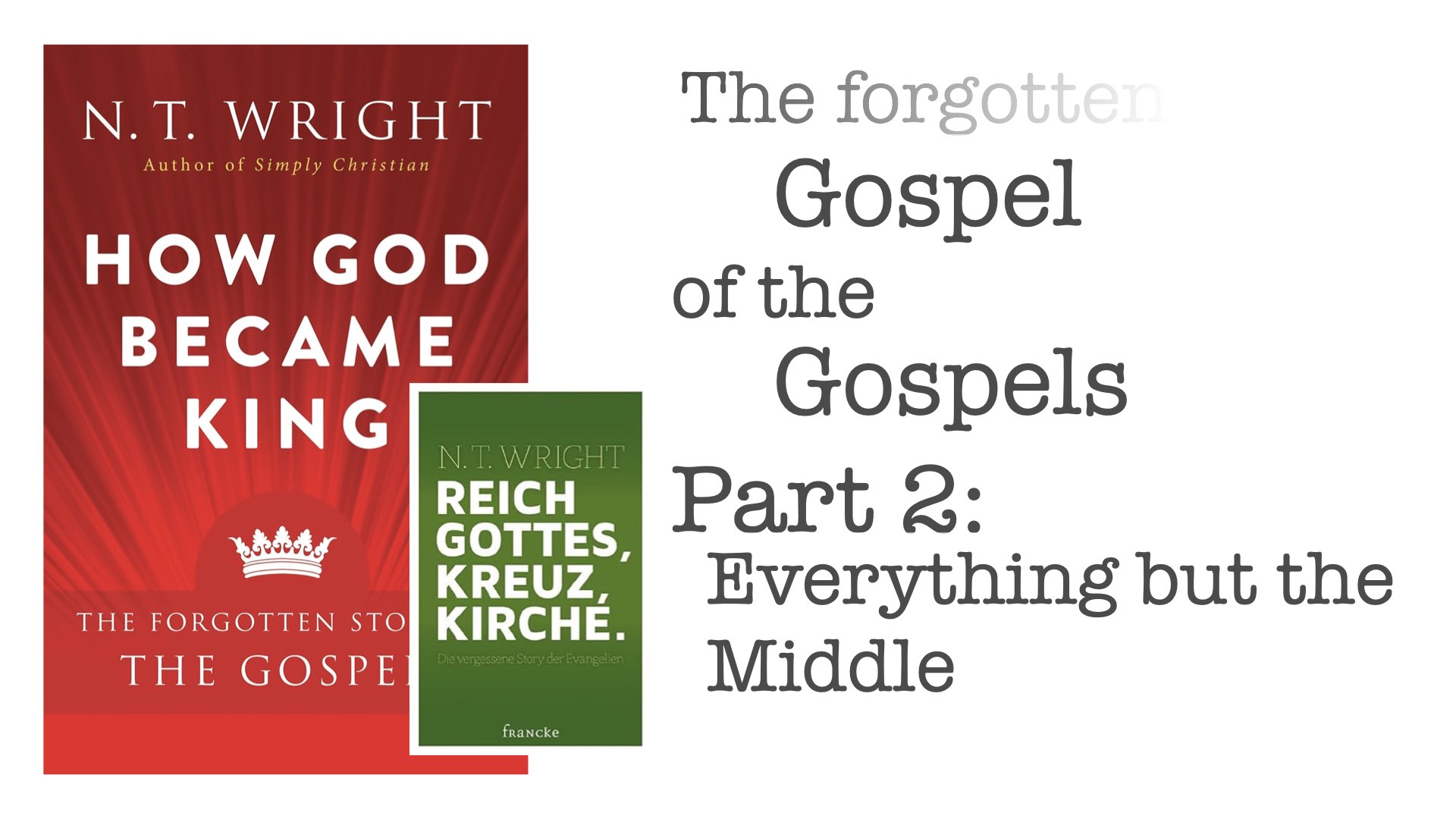
In the first part of the series, we realized that the essential story of the Gospels has been forgotten and what role the creeds, for example, have played in this. I am using the book by N.T. Wright for this: How God Became King: The Forgotten Story of the Gospels (Deutsche Übersetzung: Reich Gottes, Kreuz, Kirche. Die vergessene Story der Evangelien)
This section is about how various overemphasizations or fixations on certain aspects of the gospels, while popular, did not lead to a satisfactory overall understanding of the gospels.
Jesus without the creeds?
The creeds address mainly Jesus‘ birth, his death and resurrection and related teachings. What remains when attempts have been made to give more weight to all the other parts of the gospels? Since the 18th century, it has become fashionable to approach the gospels with the ‚historical question‘: Did it really happen? That is the question to this day. And the intellectual answer was and often still is: Yes, he existed, the so-called ‚historical Jesus‘. But the rest never happened. All the miracles and what the creeds contain comes from the church, which wanted to express its own faith. What remains of Jesus then is one of three possibilities:
- A revolutionary who took on the Roman Empire to rebuild a Jewish state.
- Or a wild, apocalyptic visionary who expected the end of the world.
- Or a mild-mannered, reasonable teacher who taught the brotherhood of all people under the Father God.
Or a combination of all of them. However, he was mistaken. The Romans killed him, the end of the world did not come, and even his disciples did not necessarily stand out in the centuries that followed for their mild, reasonable thinking. And that has essentially been the direction of skeptical or liberal thinkers over the last two hundred years and thousands of academic and popular books. For many, this is the new ‚orthodox‘ belief.
The idea that Jesus came to teach a new, simple, clear ethic of being nice to people, without any “dogmatic” claims or “supernatural” elements, is so deeply embedded in Western culture that one sometimes despairs, like a gardener faced with ground ivy, of ever uprooting it. To this day there seems a ready market right across the Western world for books that say that Jesus was just a good Jewish boy who would have been horrified to see a “church” set up in his name, who didn’t think of himself as “God” or even the “Son of God,” and who had no intention of dying for anyone’s sins—the church has gotten it all wrong. The authors of such books routinely proclaim themselves “neutral,” “unbiased,” “impartial,” or “independent.” As if.
N.T. Wright How God Became King, Chapter 2
The social gospel of Jesus?
At least this view of Jesus‘ life, without the supernatural elements found in the creeds, also has a positive side. Did Jesus not, in anticipation of what the ‚Kingdom of God‘ would do, also heal the sick, feed the hungry, relieve the poor of their hardship and help widows and orphans to get justice? And towards the end of the 19th century, this became the movement of “Christian socialism”. The problem with this is not only theological – why do people pick and choose certain aspects of the Gospels and ignore others? The real problem is that the high point of this movement was long ago and yet the same problems still exist – even in the Western, Christian world.
Perhaps we should try to connect the ‚middle part‘ of the Gospels about the life of Jesus with the other part that is emphasized in the creeds.
Did Jesus talk about himself?
The ‚liberal‘ reading of the Gospels has led to yet another idea today: Jesus seems to have spoken about God, and his followers and the early church then spoke about Jesus. In particular, the creeds seem to be fixated on the precise ontological relationship of Jesus to God the Father. Something Jesus, according to the Gospels, would not have done in that way. This can be taken to the point where there is a sense of superiority to this point of view. N. T. Wright puts it succinctly:
“You would-be orthodox Christians stick your noses in the air, because you believe in the divinity of Jesus, whereas we modern historically conscious readers can stick our noses in the air, because we have discovered that Jesus himself never thought of himself that way!” The church’s worship of Jesus can thus be “exposed,” so it is thought, as a falsification of what Jesus himself would have said or thought.
N.T. Wright How God Became King, Chapter 2
As is so often the case, there is a grain of truth in this claim. However, it does not stand up to a closer analysis of the texts. This attitude suggests that because Jesus spoke about God, he said nothing at all about himself and his role. But this is not the case. When reading the gospels, we must not only consider the words on the surface, but also the deeper levels of meaning. This will become clearer when we talk about how the evangelists referred to the Old Testament and what Jesus‘ words mean in this context.
The Hidden Underlying Challenge: Theocracy
Our perception of the gospels could unconsciously be strongly influenced by the Age of Enlightenment since the 18th century. Over time, God – whatever God may be – has been increasingly ‚transferred‘ to a higher plane. At best to a place of honor, but far away. Far removed from directing the destinies of mankind. That was now left to people themselves. In other words, they didn’t want any hint of theocracy – a government of God – under any circumstances. This separation of church and state may seem plausible after the experiences of history. However, it led even more strongly to faith or religion becoming a matter of private conduct.
You can see that for yourself if you reflect on Jesus‘ prayer: “Your will be done on earth as it is in heaven.” (Matthew 6:10) How should that be done on earth? How much do the Enlightenment influence our thinking? And how much the Gospels? The text reads in full: “Your kingdom come. Your will be done, as in heaven, so on earth.” (Matthew 6:10 Zurich). For some of the great thinkers of the Enlightenment, this was either a violent military revolution or the end of the world. These ideas could unconsciously prevent us from recognizing the message that the evangelists wanted to convey.
The Orthodox Response
Enlightenment and general skepticism pushed the church onto the defensive. The question in the room was: Was Jesus really divine? The result was that people read the gospels to find proof. And they found it: miracles! At least that’s what they thought, and some still reason that way today. But are ‚miracles‘ really proof of Jesus‘ divinity? Is that the essential reason for the text of the gospels between birth and cross? However, what may sound convincing at first glance overlooks the fact that the Old Testament already speaks of miracles performed by Moses, Elijah and Elisha, without in the least claiming that any of them were divine.
So there were and are a lot of different answers to the question of why the evangelists wrote their gospels in this way and not in another. And although they differ so much and are partly contrary, they seem more like a reaction to the context and developments of their time than like inadequate answers.
In the next part, we will therefore look at further answers as to why the ‚middle part‘ of the Gospels exists at all. By taking a closer look at these, we will recognize why they are not completely wrong, but nevertheless inadequate. Having recognized so many different ideas that can unconsciously block our view, we will then be able to hear the Gospels with the ears of the first-century disciples.


Du muss angemeldet sein, um einen Kommentar zu veröffentlichen.