
By Christian
Is the earth flat and what does the Bible say? I know that this topic is a ‚hot potato‘, so to speak, which is better not to touch. And it’s a topic that can’t be covered comprehensively in a single video. Besides, there are already more than enough videos and reading material on the subject. So why another video? Because this isn’t about giving you an answer – enough people are already trying to do that. Instead, we’re looking at a few ways in which you can find answers and gain insights for yourself.
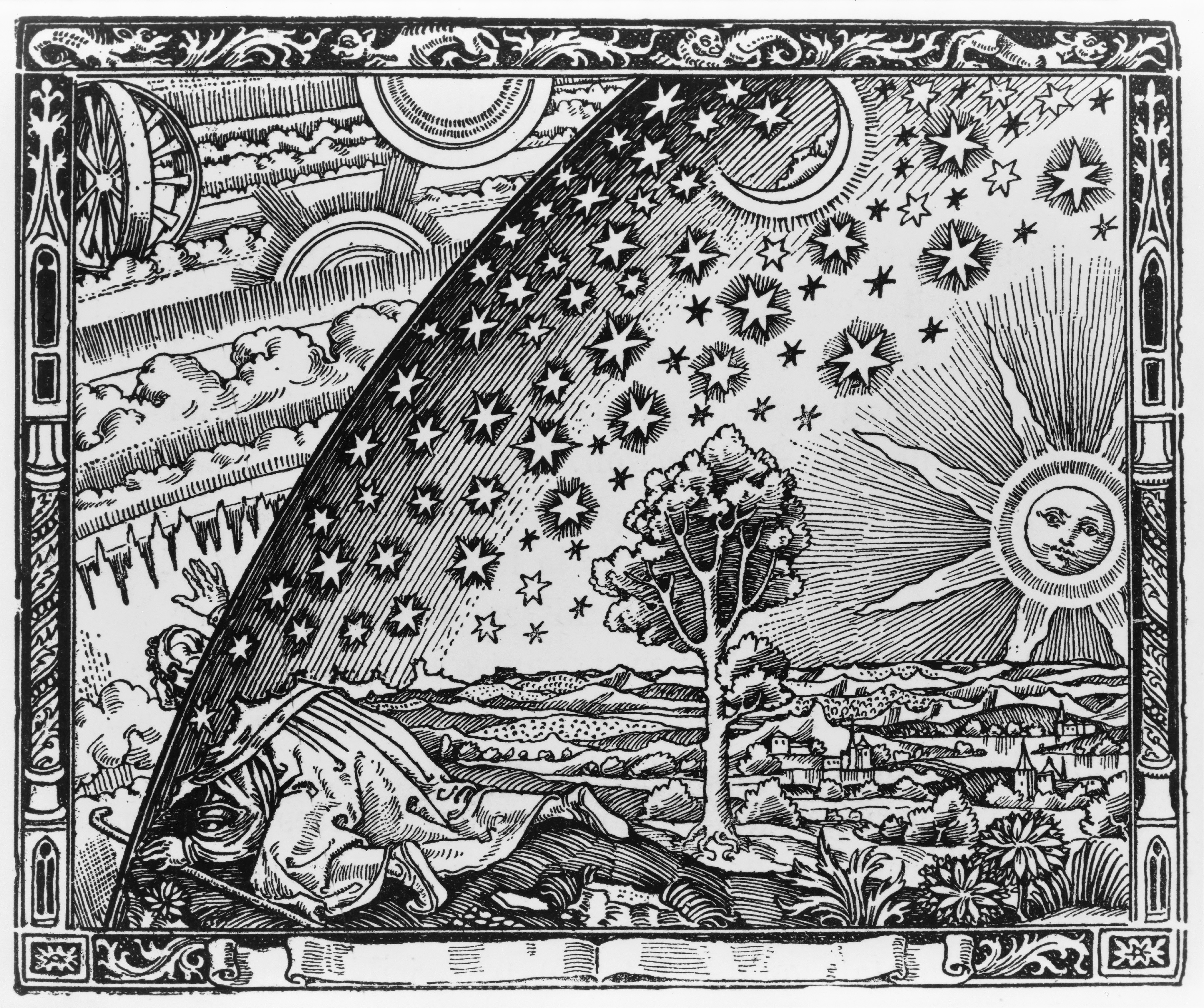
Perhaps you have already seen this wood engraving, which is also called „Wanderer on the Edge of the World“.

If you now think that this is a medieval representation and that people and scholars back then thought that the earth was flat, …, then you should find out for yourself whether this is correct. If you don’t have a large library with historical editions nearby, take a look at Wikipedia, for example. The picture is from 1888! But because of its style, many in the 20th century thought it was a medieval depiction of what people believed. So it’s good not to jump to conclusions.
So again the question: Is the earth flat and does the Bible even say so? That’s actually two questions. And for the impatient, I’ll give you the answers: yes and no and yes and no. Excuse me? 🤷♂️ No, that’s not nonsense but an indication that there is no other way to answer the question. The context of the question is missing. And that is crucial for the answer, as we will see. We can already see that in the first part of the question..
Is the earth flat? Yes and no, somehow it is and then again it isn’t
Perhaps you live in an area with hills and mountains or a plain. Let’s take a look at the Rhine-Neckar region in Germany, because it has both: the Rhine Valley, which is around 40 km wide and framed on both sides by chains of hills. And on one edge lies Heidelberg with its famous castle at the transition from the plain to the hills:

If you cycle in the Rhine valley, you won’t find it so strenuous because it’s a flat route. A flat route! If you look up and down the Rhine plain, the earth is flat. Flat as far as the eye can see! But if you run up the Philosophenweg, then down again, across the Neckar and then up to Heidelberg Castle, you won’t feel that way. But it’s on a hill on an otherwise flat earth. In fact, I’m sure that everyone in everyday life constantly assumes that the earth is flat. Why? Because everything you do is based on this experience – and it works!
Let’s take the rooms in your home as an example. If you have four straight walls, you would expect the walls in the four corners to be at a right angle:

If you place a device like this against the walls in one corner and then hold it in the other corners, it should always feel the same:

But even if everything is not so straight, you will find that the sum of the angles is always 360°. Mathematicians prefer to deal with the area with the fewest corners. So let’s stretch a rope across the room and measure it:

Then the sum of the angles in the corners is 180°. Always! Even if your room is crooked, as long as the walls are reasonably straight and there are only straight walls and corners. This was already known in ancient times and Euclid wrote it down in his textbook and today it is called Euclidean geometry:
The sum of the angles of a triangle is always 180°. Always. No matter what you do, as long as the sides are straight.
Euclidean geometry
However, this not only works in your home, but also between buildings and even between towns. We have proven this:
Is the earth flat? Yes! The earth is flat! [Context: As far as your eye can see …]
And that’s what all the people on earth say! [Context: As far as their eyes can see …]
And even if you travel far, your surroundings are flat. [Context: As far as your eye can see there …]
If we now tell ourselves that we only have to rely on our sensory perceptions, which show that the earth around us is flat, then the whole earth is flat too. Mr. Melchior Dönni from Lucerne thought along similar lines and registered his „Weltall-Erd-Relief“ with the Office for Intellectual Property in Bern in 1902. If our eyesight were better, he believed, we could see from Mount Pilatus all the way to New York. He built his relief with a great deal of effort and clay:

The North Pole is in the center of the disc, around it the continents known at the time and at the edge the South Pole. The Swiss flag at the North Pole was perhaps a little bold, but that’s another story. As for the South Pole, he certainly hadn’t seen it with his own eyes. In fact, no one had ever explored the South Pole! This is why Dönni predicted in 1902 that as soon as naturalists had reached the South Pole, they would come across the insurmountable masses of ice that formed the edge of the world. Roald Amundsen reached the South Pole in 1911. The ring of insurmountable ice masses had not been found. Dönni did not live to see it – he had died years earlier.
But even in ancient times, some people were able to travel further than the next village. And over time, measuring instruments became more and more accurate. And if you measure entire countries or continents in this way … a problem arises. The measurement margins of the angles are always too large. No matter how you do it. And the further the distances are, the worse it gets! How can that be?
Now it’s time to be creative. And there are a lot of creative ideas. If you have a certain idea, take it and test it under all possible circumstances. You should expect the same from anyone who has a different idea.
I would like to introduce you to an idea that a clever Greek in ancient times and others since then have come up with. You can test the idea yourself if you have a ball at home, for example. Draw the lines on the ball like this and measure the angle at the corners:

From one point to the ‚center‘ and further to the beginning, as in this picture. This does not result in 180° but 270°. But if the ball is large and the triangle is small, then you will always get closer to 180°. No matter how you draw it! Clever people have now called the ball a globe, entered all their measurements and found that it works pretty well!
Is the earth flat? No! It’s a sphere [context: as far as your feet can carry you and you can walk quite far].
Incidentally, the clever people have always measured better and realized that the explanation with a perfect sphere is not so perfect. But if you deform the globe a little, it fits quite well again. And then people from the coast ask you why the sea rises and falls regularly in their area. And not once every 24 hours, but twice! Twice low tide, twice high tide … But that’s another topic.
In case that example was too abstract for you. Here is another one from real life that I have already experienced myself. As you know, an airplane consumes fuel. The longer it flies, the more it consumes. Until the tanks are empty. Of course, you want to avoid this if you want to take people from Frankfurt am Main to San Francisco, for example. If the weather cooperates, the pilot tries to fly the most direct route from Frankfurt to San Francisco in order to use as little fuel as possible. So I would have had to see France, the North Atlantic and the USA from the east to the west coast:

What the pilot announced and what I saw was rather this route:

I saw England, Scotland, Iceland, Greenland, Canada and the west of the USA. The route seems much longer, which means a longer flight time and higher fuel consumption. Was this due to a storm or did the pilot simply want to show us these beautiful areas? Again, there are a lot of other possibilities besides these explanations. How about this one? How about drawing the flight route on the globe that cartographers have come up with. Unfortunately, I don’t have such a spherical ball at home, but you can have it displayed on the computer as if you were looking at the globe. You are welcome to try it out yourself on a globe:

Fascinating, isn’t it? If I extend my idea – we physicists would call it a model or theory – so that the earth appears flat to me when I’m traveling on foot, but draw it on a sphere (globe) for distances I can cover by plane, then the pilot really did fly the shortest route. As quickly as possible and with as little fuel as possible, because, as we all know, fuel costs money.
Is the earth flat? No! It’s more round like a sphere. [Context: If you fly all over the continents and oceans in an airplane].
As I said. There could have been other reasons. And you can choose a different model to explain the flight. But your model – your concept – should then be able to explain all flights on earth. And then compare this explanation with the rather simple one of a globe. This does not mean that the explanation with the globe is ‚correct‘ or ‚true‘ just because it is simpler or can explain more. But this brings us into the area known as epistemology.
How can we know whether the idea we have is ‚real‘? Some people only accept what they can grasp with their own senses. The approach is somewhat radical, but you can decide for yourself. Some also start with this approach to show that the earth as a whole is flat. But now you should use your critical thinking and recognize the contradiction: If someone only accepts what you can perceive yourself, then your knowledge only extends as far as you can see. But then you shouldn’t make a claim about the whole earth if you can only see a fraction of it or have only seen it yourself.
If you do it, should you also compare it with our environment? You form an idea – a model or hypothesis – from your experiences and assume that it applies always and everywhere. And now comes the crucial part: knowing full well that the hypothesis will probably no longer work if you measure in much larger or much smaller areas. And the idea should be so concrete and verifiable that others may have fun to break it if they extend the idea to areas beyond the original one. This is exactly what happens when we no longer travel on foot but by plane.
A whole series of arguments for or against a flat earth also go in precisely this direction: How can I determine what the world around us is like?
A good model or concept must be able to explain as much as possible as simply as possible. If we imagine a flat earth, there must also be a sun, moon and stars somewhere. So how do day and night come about in different parts of the world? And the different position of the sun during the seasons? And what about the phases of the moon? Or solar eclipses? Have it explained to you or make a flat earth and sun and moon out of cardboard and try it out. Once you have found a mechanism, add the planets and their observable orbits. At least some of them can be observed with the naked eye – the Babylonians already did this and kept very precise records of them, which are still preserved today.
I deliberately spoke of observable orbits of the planets. Sunrise and sunset as well as their position in the sky can also be observed directly. The same observations can also be made directly of the moon. And then we also mentioned the ebb and flow of the tides. So this is all within the realm of what can be explained, even for those who only accept what can be perceived with their own senses.
In principle, this is an empirical approach: Perceiving things with your own senses and checking your own ideas against the results of your observations. Sounds reasonable at first. It is then often stated that, according to everyone’s observations, the earth is flat in the surrounding area. We have already recognized this as correct. At least within the limits of the accuracy of our senses. And then other things are cited. But what is not cited – and this is where our critical thinking should start again – are the observations of the sun, moon and planets and stars and ebb and flow, etc. Everyone can still observe this for themselves with their own senses. But can this also be explained by a flat earth? Try it … And then try it with a globe.
However, the idea of only accepting what everyone can perceive with their own senses has its limits. Has anyone ever seen the earth as a whole at once? If this is not the case, how can you claim on this basis that the whole earth is flat? You are then extrapolating from a small part to the whole earth – in contradiction to the idea that you only accept what you can perceive with your own senses.
Is it a contradiction that everyone on earth perceives their surroundings as flat, but the whole earth is not flat? You can practically ask everyone on earth: In my environment, everyone speaks my language (I know there are exceptions). Does this mean that everyone on earth speaks the same language? You just have to go far enough away from your place and at some point they won’t speak your language anymore. And if you ask someone (assuming you can communicate with the person), they will tell you that everyone there speaks that language. But it’s even easier if you take a big ball and put a flat piece of cardboard on it and look closely.
Does anyone live strictly according to the principle of only accepting what they can perceive with their senses? Does the sun also exist at night when you can’t see it? Strictly speaking, you can’t say that. If you talk to someone and the person then walks away, does they still exist? Telephoning doesn’t count, because there’s a lot of technology involved. And if someone has never been to the USA in person, then its existence and that of over 300 million people, as well as that of Mr. Trump and Mr. Biden, cannot be accepted.
Ultimately, the discussion is often about whether you and I can trust the evidence that others have produced with or without technology. And there is a grain of truth in that too. Because even in today’s science, no explanation (theory) or observation (experiment) is accepted if only one person or group presents it. Others must be able to understand it and reproduce it. At least that is the ideal.
We could talk about these aspects for a long time. But let’s get back to the actual topic. Why is the question of whether the earth is flat or not so hotly debated? In everyday life, you couldn’t care less. So it must be about something else. Could it be that the second part of the question is the reason for you: doesn’t the Bible say that the earth is flat? And if the Bible is God’s inspired book, then it must be true. So is it a question of whether you believe God and the Bible or secular science? We shall see. And again, recognize the importance of context.
What does the text of the Bible say?
To answer this question, we would need to understand the ancient Hebrew, Aramaic and Greek of the different eras and regions. And also the cultural context of the people by whom and for whom the text was primarily written. Who can do that? Even the experts have to reconstruct this information as best they can. The translation into our language therefore brings the text from its ancient context into our context and this can have a considerable influence on the message. Therefore, let us first try to better understand the text itself. Here are a few examples:
They move to and fro as he directs them, / to work all that he commands them / to do on the circle of the earth.
… over the surface of the earth’s circle.
… on the whole earth.
It changes direction, turning around by His guidance, That it may do whatever He commands it On the face of the inhabited earth.
… face of the world in the earth.
Job 37:12 Einheitsübersetzung 2016, Elberfelder, NEÜ, NASB, KJV
A number of German Bible translations render this text in the sense of a circle of the earth. Many English translations rather translate with ‚inhabited earth‘. And what does the Hebrew text say?

So it says something like ‚the face of the whole earth‘. The word used for earth is אֶרֶץ erets (Strong’s 776), which according to this lexicon is used 2503 times and is translated as ‚earth‘ from Genesis 1:1 onwards. The Brown-Driver-Briggs lexicon shows the related words in other Semitic languages. If one analyzes the many other texts with this word, this meaning emerges:
earth, whole earth (opposed to a part)
earth, opposed to heaven, sky
earth = inhabitants of earth
land, country, territory
etc.
What do you conclude about its meaning from the use of the word in all these usages – I hope you have read all 2503 passages? You don’t have to be a linguist to realize that this word is not meant to describe a geometric shape. It’s about describing our living space as distinct from something else.
Let’s take a look at other uses. So it’s best to use a passage that is often quoted in the context of this topic:
He’s the One who holds fast the curve of the earth, …
He sits enthroned above the circle of the earth, …
It is he that sitteth upon the circle of the earth, …
Isaiah 40:22 2001 Translation, NIV, KJB
And in Hebrew?

What are you reading? Firstly, the same word for earth. And then the addition ח֣וּג ḥūḡ, which is translated as circle. What does that mean? Again, you don’t have to be a linguist. If it was necessary to add the word for ‚circle‘ in this text, then it means that the word for earth אֶרֶץ erets says nothing about the shape. Otherwise the addition would be unnecessary. And what is the meaning of the word for circle? How often do you think it is used in the Bible? What do you mean? Exactly three times – including Isaiah 40:22, so it won’t be so easy to deduce the exact meaning from the usage. So let’s take a look at the other two texts:
Thick clouds cover Him, so that He cannot see, And He walks above the circle of heaven.’
Job 22:14 NKJV
before he had made the earth with its fields, or the first of the dust of the world. When he established the heavens, I was there; when he drew a circle on the face of the deep, …
Proverbs 8:26,27 ESV
Does the Bible say that the earth is flat? Yes and no! At least we read about a circle of the earth [context: Book of Job]
But also about the circle of the sky and the circle of the surface of the deep.
Does that make it clear to you? If you say that these texts make a statement about the geometry of the earth (flat or spherical), then you must also do so with this text:
He established the earth upon its foundations, So that it will not totter forever and ever.
Psalm 104:5 NASB
Again, the same word for earth אֶרֶץ erets (Strong’s 776). And if the earth has a solid foundation, then it can’t be a sphere in the void, can it? Then what about the context of this verse?
Bless the LORD, my soul!
Psalm 104:1-3 NASB
LORD my God, You are very great;
You are clothed with splendor and majesty,
Covering Yourself with light as with a cloak,
Stretching out heaven like a tent curtain.
He lays the beams of His upper chambers in the waters;
He makes the clouds His chariot;
He walks on the wings of the wind;
So heaven has the shape of a tent roof. Is it similar to the tabernacle?

You can’t have it both ways. Take verse 5 literally as a statement about the shape of the earth and then not verse 2 in context. But then the heavens don’t fit with a round, circular earth, do they? But it goes even further in verse 3, here in the Interlinear translation:

„With water, You’ve filled its ‘roof’ and ‘upper rooms,’ And as Your ‘chariot,’ You created the clouds, Which You ride on the wings of a breeze.“ (Psalm 104:3 2001 Translation) Yahweh makes the clouds his chariot! Do you really think that Yahweh is being told here that he is driving a chariot in the sky? „But that’s a vision!“ you might think. No, it’s not. The psalm is not a vision but a description. And everything is in the same context. So does the text make any sense at all? Yes, but you have to understand what the context is. The context is not our desire that there is a statement here about the geometry of the earth or Yahweh’s fleet of vehicles. The context was the worshippers of Yahweh at that time. And if you ask the Bible scholars about this, you can learn that this is a theological statement. Other nations were of the opinion that their god Baal rides in his chariot in the sky. In the text of the Bible, the Israelites at that time were assured that it was not Baal who was responsible for nature, rain and the fertility of the land. If anyone at all rides in a chariot in the sky, it was Yahweh. End of the metaphor.
We could analyze many other texts in this way. But as I said, this video is not intended to draw conclusions for you, but to help you do it yourself. The important thing is not to pick out individual texts that fit your own ideas and ignore the others. Or to arbitrarily interpret texts as ‚literal‘ or ’symbolic‘ or ‚allegorical‘, especially not within a sentence or a passage.
What we want to look at now is the context in which the texts were written down. So what is the context of the texts that deal with the earth?
How is the text of the Bible to be understood in its historical context?
What do we know about the historical and cultural context of the people who wrote down the text and heard it back then? Is it really so different from today?
An example will perhaps convince you that there can be ‚worlds‘ in between. Please note what thoughts come to your mind in the first few seconds after you read or hear a word. What images then appeared in your mind? And now the word: Christmas!
If you come from Europe or North America, you may have immediately thought of this: images of a winter landscape with snow, a decorated Christmas tree in the living room, the smell and taste of Christmas cookies. If you come from Australia, South Africa or South America, you probably didn’t have a snowy landscape in mind. And instead of contemplative Christmas carols, it’s more likely to be a festive parade with floats like the ones I know from carnival, including rhythmic dance music (I experienced this on Fuerteventura).
Now you write this sentence in a novel: „It was a beautiful day, it felt like Christmas.“ And we send the novel 200 years back in time. People can read the sentence, but have no idea what you had in mind. Not even what you meant. Now the Bible has been handed down to us from the past. Can’t the meaning of words have changed or been lost? Take the English word gift, for example. This was also used in German a long time ago. After all, we still speak of a Mitgift (dowry) today. However, the meaning of the German word Gift, which Goethe still had as „gift, present, endowment“, has changed dramatically. Today, it means poison! And yet when we think of Mitgift (dowry), we don’t think of someone being killed.
And what idea of the world did the Israelites of antiquity have? Based on the ideas of the peoples around them and according to the account in Genesis and many other texts of the Old Testament, approximately this one:

As I said, we should not be too quick to dismiss this idea as ‚unscientific‘, primitive, naive and wrong, because people were concerned with completely different questions. Today’s scientific world view only answers part of the how and the why within the limited framework of the laws of nature. And even in the standard model in physics, there are laws and constants for which there is no further justification. The ancient worldview of the Israelites, on the other hand, contains everything that was known to them and the reason why it was like this: the why and wherefrom and the reason why everything is ordered in this way and not otherwise. Everything was described in such a way that even the last Israelite could understand why things are the way they are.
Why is the creation account still formulated in this way? Because God did not want to make it clear to the Israelites how it was all ’scientifically correct‘ in contrast to the myths that had long been passed down among the peoples. We might welcome such an explanation, but it was the last thing the Israelites needed after their liberation from Egypt in the desert. God merely took up the idea they knew and corrected the important points: No pantheon of gods provided for the order of the world – only he alone. There were also no battles between gods before creation. Nor did he use the body of a slain god or goddess as a substance for the earth. This is the case, for example, in the Babylonian creation myth Enuma Elish. He alone is the Creator, the God who showed himself superior to all the gods of Egypt, who freed them from Egypt and made a covenant with them so that they would be his people – bearing his name (see the future video series Bearing God’s Name).
Further arguments in favor of this understanding of Genesis can be found in many different scholars, including John H. Walton’s The Lost World of Genesis One. Jascha Schmitz has published a video series in German about this: Genesis – Creation account of the Bible critically scrutinized
So before we examine biblical texts, whether they speak of a flat earth or not, we should consider what the original context of the texts is:
Is the aim of the Bible to proclaim a statement about the geometry of the earth? No! [Context: The simple Israelite in the desert].
The textual and historical context show that it is about the order of things and their purpose. Every being and thing has its place and purpose.
It would also be good to think about what really constitutes a ‚literal‘ interpretation of the Bible. Let me make an assertion:
Interpreting the Bible ‚literally‘ does not mean reading the Bible word-for-word and interpreting it word-for-word with our context and our concepts and ideas of today.
This point could also unconsciously influence our understanding of what the Bible says about the earth. „If I don’t take the text of the Bible literally, am I not betraying the inspired word of God?“ No, we would rather do that if we use the texts in a way that God did not intend. So that’s what we need to find out. I showed more about this in the series The Canon of the New Testament.
If you have followed my explanations up to this point, then I am quite confident that you are also prepared to rethink your views on this issue, to question them critically and to ask yourself the question: Why do I actually believe this? Why do I think this way? And I hope to have given you some food for thought here.
Du muss angemeldet sein, um einen Kommentar zu veröffentlichen.