
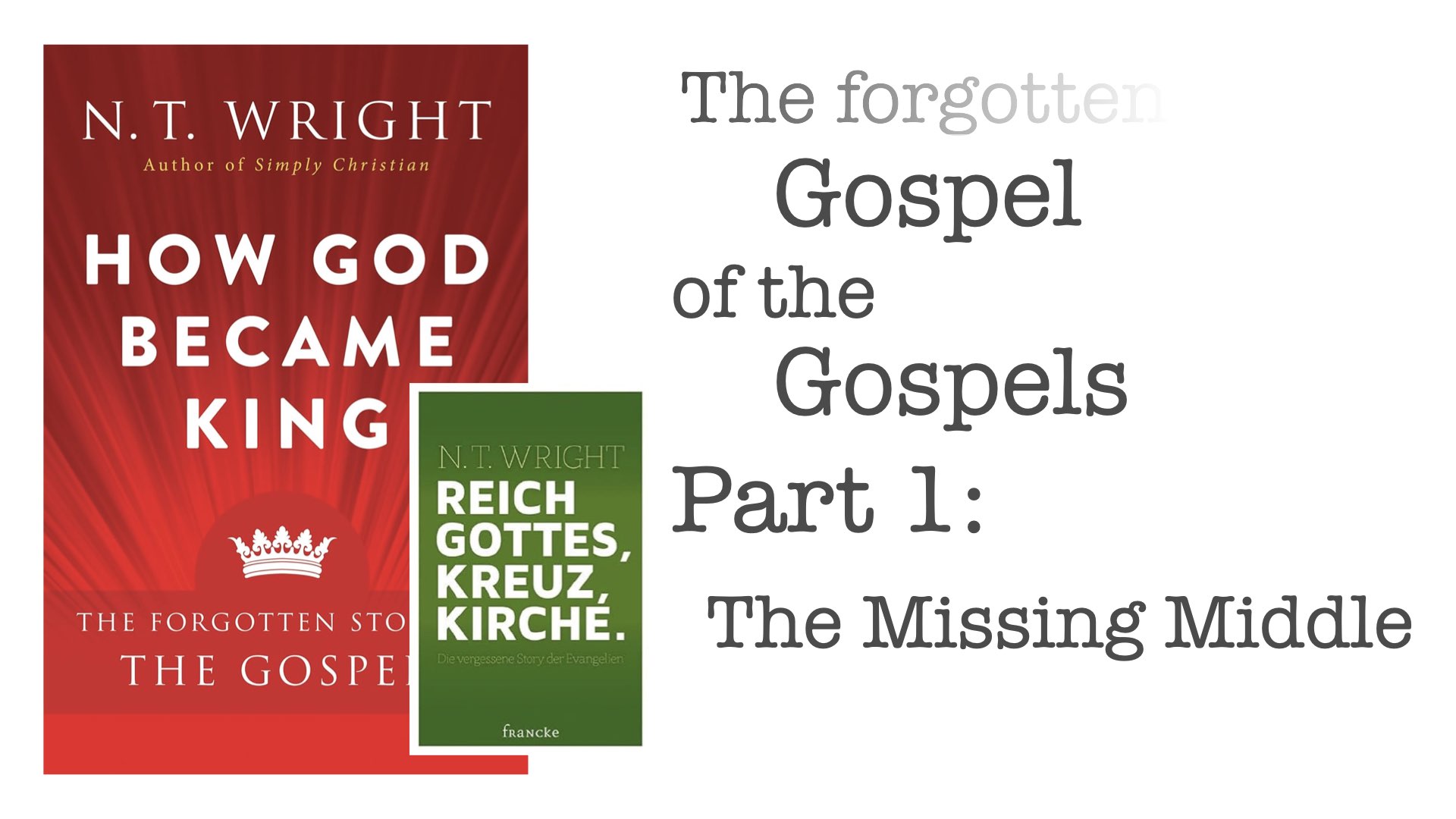
By Christian / N. T. Wright
The Gospels have been read and studied for two millennia now. Surely everything must have been said and written about them by now, right? Is it even possible to discover anything new in them? Even more. In this series, we will consider arguments that show that we even have to rediscover the gospel itself today, the essential story of the Gospels, because it has been forgotten. The weight and attention has been put on various other topics, so that the central message has been lost. These other voices have become so loud and popular, so to speak, that the central theme, which should be supported by the other voices, was no longer perceived.
However, the topic is not only important in terms of personal belief, where at least for ‚Christians‘ the gospels should play a central role. It also helps us to set the right focus and accept different views. Why should you deny others their faith, call them heretics, apostates or ‚false religion‘ when the different views do not even concern the central message of the gospel?
But how could it ever come to pass that what the four evangelists so urgently wanted to communicate to others was so completely forgotten? Among other things, creeds – as good as they are or were meant to be – played a role in this, as we shall see in a moment.
“And why, may I ask, has no one but you noticed this in two thousand years?” I haven’t noticed it at all. What I have become more and more aware of, however, is that for many teachings or even belief systems, only a few Bible texts are used or overemphasized. Or the texts come predominantly or exclusively from one Bible book, some letters of Paul, etc. And how do the Old and New Testaments fit together? Beyond ‚everything points prophetically to Jesus‘, which is not the case at all. If the texts of the New Testament so often refer to the Old or use or reinterpret their images and terms, was there a radical change, something completely new? Or do the two form a unity beyond superficial references? In fact, diligent biblical scholars have made interesting contributions to this, which I will discuss again and again.
One of them is N. T. Wright, who observed something over and over again that eventually led to this book:


In this series, I would like to take up the most important arguments from the book so that everyone can form their own opinion. So let’s go back to the roots and read the gospels in the context of the first-century disciples – without having our 21st-century context and any creed in mind. Otherwise, there is a great danger that we will read into them or believe we can find in them teachings that were not developed until centuries later.
And what happened … in between?
N. T. Wright introduces the question of this series with a personal experience as a teenager that everyone can easily relate to. He wanted to do a series of studies on Jesus with others, all based on why-questions: Why was Jesus born? Why did Jesus live? Why did Jesus die? Why did Jesus rise? Why will he return?
If you stop for a moment and think about the answers to the questions, you will come up with a few ideas for almost all of them. And you will recognize a connection to central teachings of Christianity. Only with one question could it have been difficult: Why did Jesus live? Not a difficult question, do you think? Now, would your answers to the other questions or your hope change at all if he had died ‚for our sins‘ shortly after his birth? Or if he had been active for 30 1/2 years instead of 3 1/2 years?
Perhaps you now have a few reasons in mind. We will discuss some of them later and see that on closer inspection they are not as convincing as one might think. Take, for example, the reason that Jesus, despite all temptations, had to lead a God-pleasing life without sin. Good. Mark, Matthew, Luke and John could have stated that in one sentence. But that is not what the bulk of the text is about. Another example: Jesus showed us how to live. But that is not described in the majority of the text of the gospels either.
In fact, even the earliest creeds show an interesting pattern. Take, for example, the short fourth-century creed we know as the Apostles‘ Creed:
I believe…in Jesus Christ, God’s only son, our Lord;
N.T.Wright How God Became King, chapter 1, ‚Apostel’s Creed‘
Who was conceived by the Holy Spirit;
born of the Virgin Mary;
Suffered under Pontius Pilate;
Was crucified, dead and buried;
He descended into hell;
On the third day he rose again from the dead;
He ascended into heaven, and is seated at the right hand of God, the Father almighty;
From thence he will come to judge the living and the dead.
So many details and yet nothing about Jesus‘ life between his birth and crucifixion! Now compare that with the four gospels. How much text is devoted to the birth and baptism of Jesus? How much to his crucifixion and resurrection? Only a fraction of the text of the gospels:

How did it come about? Before anyone is quick to jump to the conclusion that the apostasy announced in the New Testament is the reason, we should be aware of a simple mechanism. Initially, the g ospels – like other letters – were regularly read aloud. The believers prayed the ‚Our Father‘ and knew the details of the gospels, which they understood as a basis. The creeds served only as a framework to clearly distinguish important basic teachings from other views, such as those of the Gnostics. There were numerous controversies on various topics. And when these were decided – however, these early formulas became part of creeds and were hung on the clothesline like washed laundry, so to speak. N.T. Wright formulates the change as follows:
The church provided a “rule of faith” by which, supposedly, to understand the scriptures. But the “rule” in question – the developing creeds and the early formulas that led up to them – turned out to ignore the central theme of the four gospels. Notice what then happens. At some point, perhaps not long after the creeds were written, the clothesline turned into a teaching aid. The list of earlier controversies became a syllabus. “These,” the church declared, “are the things you need to know about God, Jesus, the Holy Spirit, and so on.” And at this point we have crossed a line. Matthew, Mark, Luke, and John say, “These are the things you need to know about Jesus.” The creeds, when taken out of their liturgical context where they belong with the gospels and the Lord’s Prayer and used instead as the basis for a teaching program, say: “No, these are the things you need to know.”
N.T.Wright How God Became King, chapter 1
Over time, the center – the story of the gospels – was lost and the results of the controversies came to the fore. This does not make the creeds per se wrong or unnecessary or useless. But they must not replace the story of the gospels.
In fact, many would only prove ‚the gospel‘ with Paul’s texts such as Romans 3 and Galatians 2-3 – as the early reformers did – without even once referring to one of the gospels!
It isn’t just that we’ve all misread the gospels, though I think that’s broadly true. It is more that we haven’t really read them at all. We have fitted them into the framework of ideas and beliefs that we have acquired from other sources.
I want in this book to allow them, as far as I can, to speak for themselves. Not everyone will like the result.
N.T.Wright How God Became King, chapter 1
Well, not everyone will like the result, but it promises to be quite interesting – at least I think so.
Du muss angemeldet sein, um einen Kommentar zu veröffentlichen.